Georgia State Senate Preview, 2026
Three State Senate races in Georgia move towards Democrats in the final days of the campaign.

I recommend reading this post in your browser, as the tabular data is color-coded and may not display properly in an email client.
In this post, I provide in-depth analysis of ten State Senate races in Georgia that I am monitoring in this year's election, three of which I consider competitive. If you appreciate the post, you can subscribe below (it's free!) or at the end, or send me a one-time tip.
Table of Contents
Rating Changes and Notes
First, what you're all here for: the ratings changes! I have three of significance, all in favor of Democrats. I am tilting both pure tossups in their favor, and I am moving SD 42 in their direction as well.
| District | Old Rating 10/13 | New Rating 11/02 |
|---|---|---|
| SD 37 | Pure Tossup | Tilt Democratic |
| SD 42 | Lean Republican | Tilt Republican |
| SD 48 | Pure Tossup | Tilt Democratic |
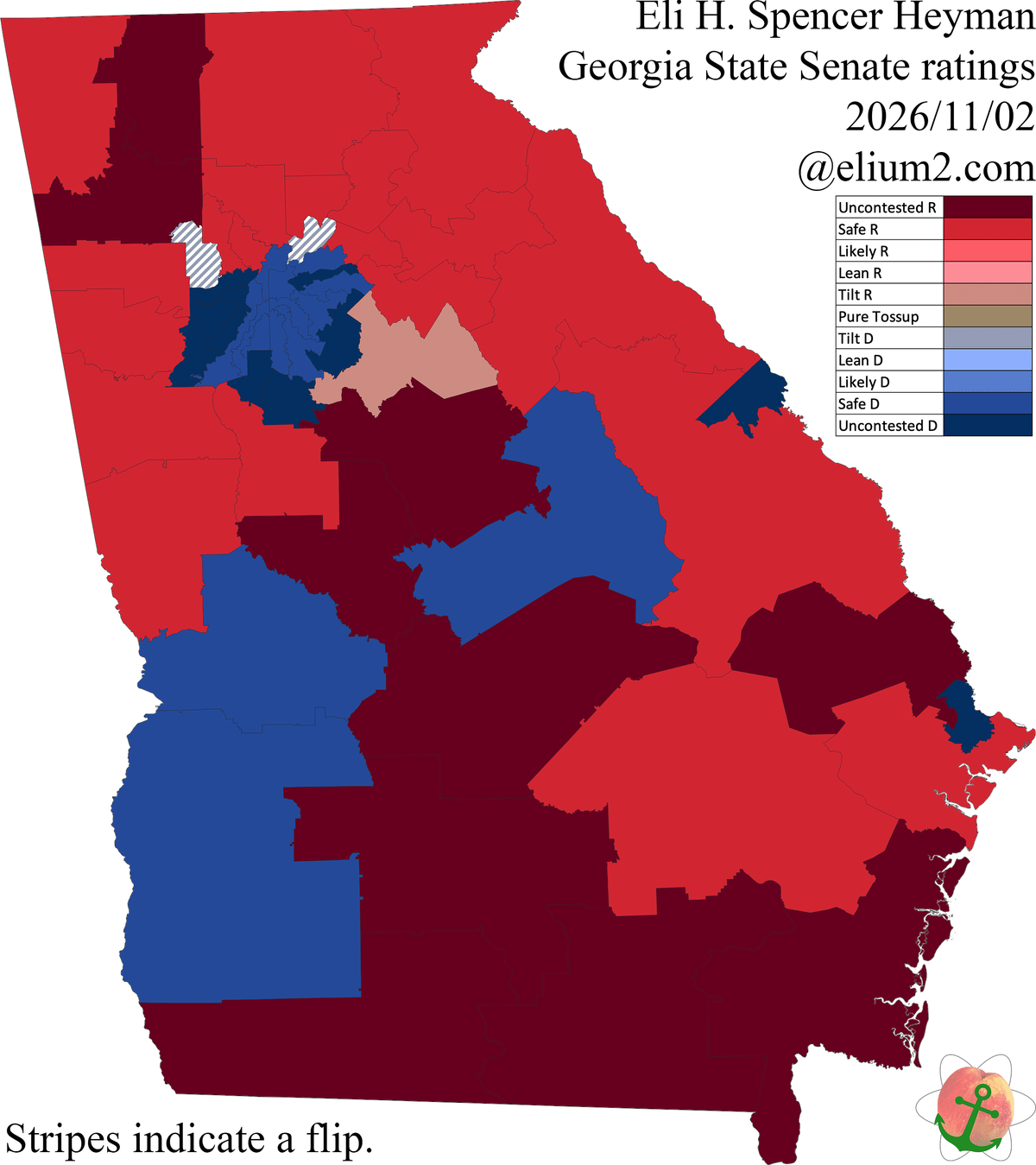
Here's an updated rating table and map:
| Uncontested R | Safe R | Tilt R | Tilt D | Safe D | Uncontested D |
|---|---|---|---|---|---|
| 10 R-held seats | 20 R-held seats | 42 (Strickland) | 37 (Setzler) | 14 D-held seats | 9 D-held seats |
| 48 (Still) |
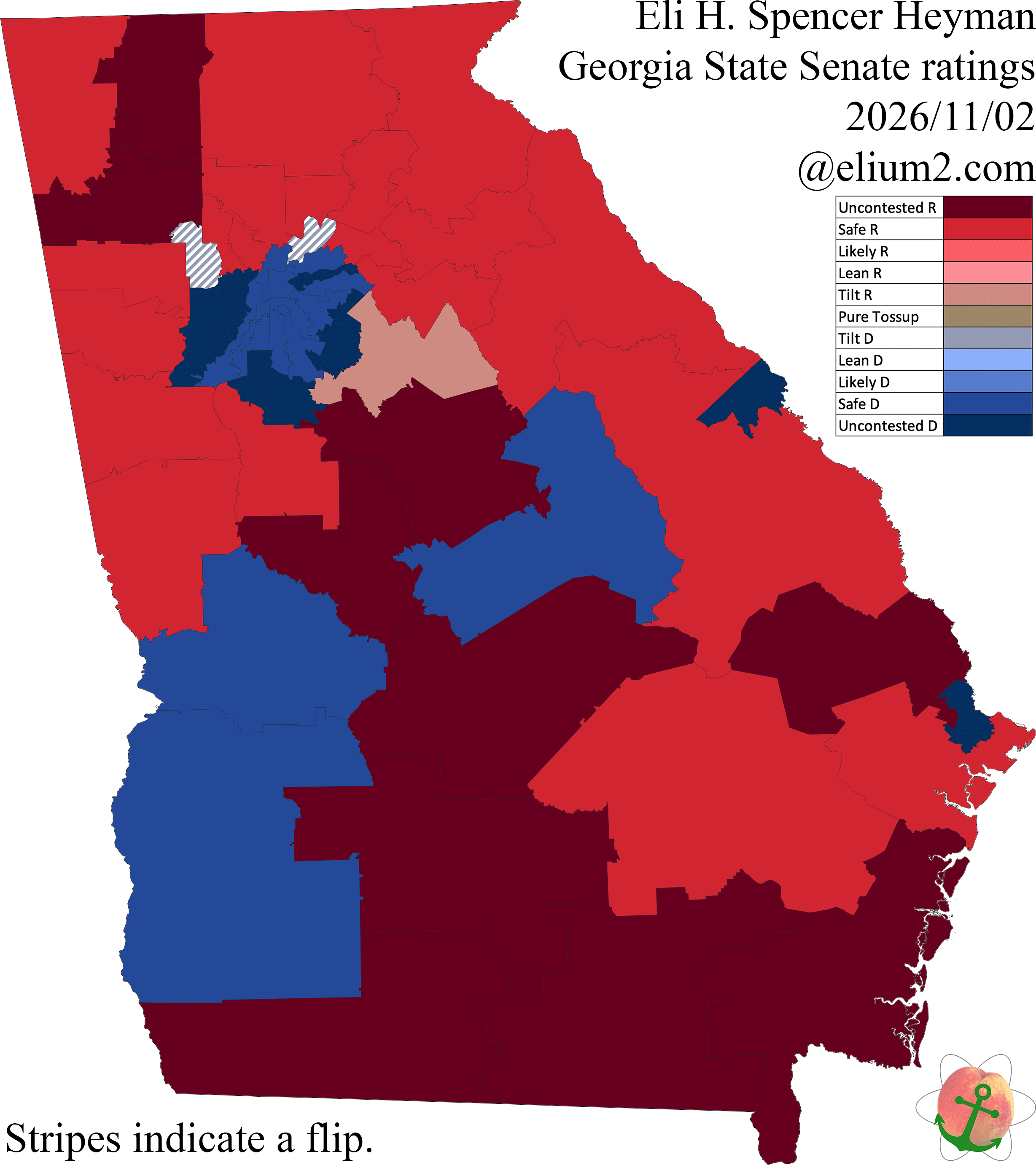
My chamber rating for the majority party in the State Senate remains Safe Republican.
And now for everyone's favorite part, the disclaimers and data notes. I do not comprehensively track Safe districts or assess candidate qualification challenges outside of races on my watchlist, so I have not updated the Safe and Uncontested columns to account for candidate disqualifications in Safe races unless those races are in this writeup. Also, please note that I am forecasting outcomes, not margins; the different categories represent approximate probabilities. I reserve the right to update ratings until polls close, although I do not anticipate doing so for any State Senate race in Georgia.
The rest of this section is the data notes; if you don't care about the details of cited data, you can skip this using the Table of Contents, but please read this before asking me questions about the included data.
2024 presidential results for districts are exact from CVR data I obtained from counties and from the Secretary of State's office, but have been rounded. 2022 results where not exact, are statistical estimates using regression; this is not a perfect method, but it produces more accurate results than other methodologies, sometimes dramatically so. Earlier results here for current districts are generally from Dave's Redistricting App (DRA), which splits precincts using voting-age population without any statistical adjustment; those results are less rigorous than the regression estimates.
CVAP stands for citizen voting-age population and TPOP stands for total population; statistics in both categories, as well as renter/owner data and median income statistics, are taken from the 2020-2024 estimates provided by the U.S. Census Bureau using American Community Survey data. Median incomes are for households. Renter/owner statistics indicate the share of the population residing in rented housing and in owner-occupied housing respectively; any remainder is “group quarters” population, such as university students, incarcerated people, and nursing home residents. The Census Bureau does not directly provide estimates of the total “group quarters” population or a margin of error for that population. I only provide TPOP data where I think the contrast to CVAP data is noteworthy; generally, AAPI and Hispanic populations are significantly lower in the CVAP, and there is often a further drop from the CVAP to registered voter demographics. The CVAP and TPOP statistics provided by the Bureau separately estimate the Asian-American and Pacific Islander population shares, which is why there is an “Asian-American” category for those statistics but “AAPI” for registered voters. Margins of error for all ACS-based data are presented as percentages, calculated by dividing the provided raw margin of error (which is a whole number of people) by the ACS estimate for the TPOP (or, where appropriate, CVAP); in doing so, I have ignored the margin of error on the denominator (i.e. the total population).
The percent rural is from the 2020 decennial census. Any statistics as to the percentage of a jurisdiction that is within a district (or vice versa) are also from the 2020 decennial census. All statistics about portions of districts are based on total population, not area or a subset of the population, unless otherwise noted.
Voter registration data is from a voter file dated October 19 that I purchased from the Georgia Secretary of State. Tabular campaign finance data is cumulative since January 1, 2025 unless otherwise noted. I have made a best effort to exclude loans and candidate contributions from calculations of the amounts raised by all candidates, which sometimes results in large differences from summary data on the Ethics Commission's website. I note in-kind contributions in the copy of the writeups when they meaningfully affect the overall picture of a candidate's activity. References to “Facebook” ads are inclusive of Instagram ads.
I do not discuss ballot order because under Georgia law, the party of the incumbent governor is listed first in all partisan races. Independents, when there are any, appear below partisan candidates.
District 1
| Category | Detail | Statistic |
|---|---|---|
| 2024 Pres | Trump | 56.6% |
| Harris | 42.8% | |
| 2022 Sen RO | Walker | 55.0% |
| Warnock | 45.0% | |
| 2022 Gov | Kemp | 60.9% |
| Abrams | 38.3% | |
| 2022 LG | Jones | 58.7% |
| Bailey | 39.0% | |
| 2022 SoS | Raffensperger | 61.3% |
| Nguyen | 35.8% | |
| 2022 AG | Carr | 58.9% |
| Jordan | 39.5% | |
| Reg. voters | White | 58.8% |
| Black | 22.7% | |
| CVAP | White | 62.1% ± 1.0% |
| Black | 24.5% ± 1.2% | |
| Housing | Owner | 67.7% ± 1.6% |
| Renter | 30.8% ± 1.4% | |
| Rural | 22.6% | |
| Median income | $83,063 ± $2,535 | |
| Contributions | Watson | $305,600.00 |
| Foreman | $63,030.50 | |
| Indiv. contribs. | Watson | $45,650.00 |
| Foreman | $43,145.00 | |
| Expenditures | Watson | $211,760.45 |
| Foreman | $43,250.61 | |
This district in the Savannah metro area comprises all of Liberty and Bryan counties and part of Chatham County. Bryan is a light red suburban/exurban county, while Liberty is a blue county that is largely rural. While Chatham County is blue, the portion of Chatham in the district is red and is actually a bit to the right of the district overall. Only 5% of the actual City of Savannah is in the district. The largest cities fully or mostly within the district are Hinesville and Richmond Hill. Skidaway Island, Tybee Island, Fort Pulaski, and Fort Stewart are all in this district (Fort Pulaski is a landmark, while Fort Stewart is an active military base). My original rating for this district was Safe Republican.
Republican incumbent Ben Watson, a physician who was first elected in 2014 and chairs the Health and Human Services Committee, faces Democrat Corey Foreman, an army veteran and business owner. Watson is white, while Foreman is Black. Foreman won a contested primary against Barbara Gooby with 59% of the vote. Watson last faced an opponent in the 2022 election, winning the race with 61.4% of the vote; in 2024, Watson won 78.5% of ballots cast. Ballots cast in an uncontested partisan race are a meaningful measure; generally, below 75% is potentially competitive, while a candidate who receives fewer than 70% of ballots cast is dead on arrival when a challenger runs. While the district isn't all that red, it does not seem particularly elastic and has shown limited leftward momentum. DRA estimates that it gave Romney a 22% margin and gave Trump a 20% margin in 2016. Margins have since narrowed, dropping to 16% for Kemp in 2018 and 13% for Trump in 2020.
There are a couple independent expenditures here. The big one is an absurd $318,939 from “First Amendment LLC”, a front for data center investor Scott Banister (see the SD 7 writeup). “Forge the Future Project”, which is wholly funded by Meta Platforms Inc. (Facebook/Instagram), has spent $25,583.28 on mail and $9,927.84 on texts. Finally, the NRA has spent five figures on text messages here. All three groups are supporting Watson. While the party leadership committees don't have to disclose particular beneficiaries for their spending, Facebook's ad library shows a small amount has been spent by Democrats on ads in support of Foreman.
I have been skeptical of Democratic chances here generally, in part because it has shown less leftward momentum than many other seats and in part because Democrats have often failed to field candidates here, which can be symptomatic of poor organization. However, it's worth keeping an eye on the race. Foreman is the first Democrat in many years to make a real effort here, and he's nearly matched Watson in funds raised from individual contributions, even though Watson had a substantial head start. I also noted that Watson is spending a substantial amount on advertising, including Facebook, YouTube, and – to my surprise – two television ads, with 138 spots on WTOC and 28 on WJCL. Perhaps he's just trying to run up the margins, but generally state legislative candidates in safe races don't put money into television ads.
Upon diving into the data, I also found that the district's leftward trajectory, while not strong enough for me to expect a flip, was more consistent than I had realized. And it is not nearly as prone to ticket-splitting as many of the Atlanta-area districts. The amount of spending by Republicans here is eye-catching, but it'd be a bit backwards to say that means they're in danger. Still, Foreman is far more credible financially than most Democratic challengers in reach seats, and his primary win was also impressive. I did take a look at early voting data, which is meaningfully better for Republicans than other districts in this writeup. At the end of the day, I don't think there's quite enough to move the race out of the Safe Republican category, but I did seriously consider it, and I'll be interested in the final margin here.
District 7
| Category | Detail | Statistic |
|---|---|---|
| 2024 Pres | Harris | 56.3% |
| Harris | 42.3% | |
| 2022 Sen RO | Warnock | 60.7% |
| Walker | 39.3% | |
| 2022 Gov | Abrams | 52.5% |
| Kemp | 46.7% | |
| 2022 LG | Bailey | 53.5% |
| Jones | 43.6% | |
| 2022 SoS | Nguyen | 50.3% |
| Raffensperger | 46.8% | |
| 2022 AG | Jordan | 53.5% |
| Carr | 44.5% | |
| Reg. voters | White | 35.2% |
| Black | 21.9% | |
| AAPI | 18.9% | |
| Hispanic | 10.7% | |
| Other | 9.4% | |
| CVAP | White | 44.3% ± 1.4% |
| Black | 22.7% ± 1.4% | |
| Asian-American | 18.4% ± 0.9% | |
| Hispanic | 11.9% ± 1.8% | |
| TPOP | White | 34.9% ± 1.5% |
| Black | 20.8% ± 1.5% | |
| Asian-American | 20.7% ± 1% | |
| Hispanic | 19.4% ± 1.8% | |
| Housing | Owner | 64.2% ± 2.0% |
| Renter | 35.3% ± 2.0% | |
| Rural | 0.0% | |
| Median income | $95,391 ± $5,034 | |
I have excluded campaign finance data from the table because it comes with significant caveats for both candidates. Shaikh was a candidate in the special election earlier this year as well as the simultaneous Republican primary, and I have not attempted to exclude special election activity from his data. Romman's campaign claims no financial activity in the October 20 filing except for ActBlue fees for the preceding period, which is not credible. Cumulatively, with the above caveats, Shaikh reports $25,281.03 in contributions and $22,426.23 in expenditures, while Romman reports $155,601.15 in contributions and $154,942.15 in expenditures. Shaikh claims an account balance of $6,179.93 as of Oct. 20, while Romman reports only $659.00 on hand.
This district is entirely within Gwinnett County northeast of Atlanta. The district was drawn from scratch in the 2020 redistricting and has no relationship to the 2010s district of the same number. Gwinnett is the second-largest county in Georgia and is highly diverse, with Black, Hispanic, Asian-American, and white residents all comprising a significant share of the population. SD 7's demographics are similar. The largest city fully in the district is Duluth; it also contains 40% of the cities of Peachtree Corners and Suwanee, small parts of Lawrenceville and Norcross, and all of the small city of Berkeley Lake. Buford Highway and I-85 both run through this district.
With incumbent Nabilah Parkes (née Islam) having vacated her seat in an unsuccessful bid for higher office, this is an open race. A special election was held on May 19; former Democratic party official Adrienne White, who did not seek the full term, advanced to the runoff alongside Republican Aizaz Shahbaz Shaikh. Although Democrats combined for nearly two-thirds of the vote in the first round, the runoff was expected to be close, as it was held on the same day of the primary runoff, where Republicans had prominent races and Democrats did not. White ultimately prevailed in the special runoff, receiving 51.1% of the vote (8,510 to 8,131), even as 52.6% of voters cast ballots in the Republican primary runoff.
In the general election, Shaikh, who is Desi and describes himself as both conservative and moderate, is the Republican nominee. Democrats have nominated State Rep. Ruwa Romman, a progressive who is the first Palestinian-American elected to office in Georgia. Both candidates are Muslim. Romman received national attention in 2024 when critics of the Biden administration's support for Israel's military campaign in Gaza proposed her as a DNC speaker. Romman was first elected to the House in 2022; she has won contested elections in 2022 and 2024 and won a contested primary in 2022. She spent a few months as a candidate for Governor this cycle and was the only unequivocal progressive in the race, but she dropped out and switched to running for the open Senate seat at the end of February. In this year's primary, she led in the first round with 38.2% and advanced to a runoff with Rahul Garabadu, going on to win the runoff with 60.1% of the vote.
Democrats had narrow margins in a couple races here in 2022, including the State Senate election, which Parkes won with 52.8% of the vote. Parkes won the 2024 election more comfortably, receiving 55.0%. As for Romman's electoral history, she won the 2024 election by 17.8% in a Harris +22.3% district, while in 2022 her margin was 15.4%, similar to Abrams's 15.6% margin and well behind Warnock's 26.4% margin on the same ballot.
Looking a bit deeper into the special election, 9,009 people voted in the simultaneous Republican primary runoff, versus 7,858 Democratic primary runoff voters and 271 people who only voted in the special. Looking at cast vote record data, we can see that Shaikh only won 3.5% of Democratic voters, while White won 8.7% of Republican voters and won over 70% of special-only voters.
Romman is no stranger to controversy or the spotlight, but her electoral performance has been fairly typical in the past. Interestingly, in what is arguably a self-inflicted October surprise, Romman revealed last week that she had become a dues-paying member of the Democratic Socialists of America. The revelation likely came too late to make it into Republican advertising or mail but could be included in texts, calls, and canvassing.
Given Romman's existing profile as a prominent progressive and critic of Israel, I don't know that the DSA affiliation loses her many voters she otherwise would have won, and I also suspect anyone who considers her membership a positive was already supporting her. At worst, her membership provides an easy shorthand for Shaikh to describe her platform – something Republicans also do for many non-socialists (see the SD 48 writeup).
I only have a single data point for a DSA member facing a partisan general election in Georgia, which is Gabriel Sanchez's 2024 race, where he narrowly avoided the bottom quartile in terms of performance relative to Harris – but the difference between the 25th percentile and the 50th percentile wasn't very large, and I generally wait until I have a bare minimum of two data points before extrapolating. (I am Sanchez's campaign treasurer.)
This district has consistently trended left, with the sole exception being the 2024 presidential election. I think that if Trump had lost the election and the nominees were the same, this would be an interesting and close race. But, of course, Trump won and immediately got to work angering every constituency he made gains with.
I have no idea how much Romman has actually raised or spent in the last three months, which is a major wild card. But it's not as if Shaikh's financials are impressive. There is, however, a massive independent expenditure against Romman here by “First Amendment LLC”, wholly funded by Scott Banister, which is estimated at $166,112 for “direct mail, phone calls & digital ads”. Banister is a longtime Republican donor, and the Florida Democratic Party, which is facing a similar onslaught from him, notes he has major investments in data centers and Flock cameras. There are no other reported IEs here.
It does not appear any ads are running on Facebook or YouTube in support of Romman. Despite his small budget, Shaikh is running ads on both platforms, but they have limited impressions and appear to include use the entirety of Gwinnett County as the target audience. Moving to early voting data, the white share of the electorate is down from both 2022 and 2024, while the Black share is up, especially from 2024. The AAPI and Hispanic shares are steady relative to 2024 but up substantially from 2022. I also find it striking how comparable the voter registration statistics are to the CVAP, except for the white population, which appears much lower among registered voters.
This is a tricky one. I expect Shaikh to overperform the fundamentals, but I just don't think it'll be enough in a seat Bottoms should carry with little trouble. I rated this district Safe Democratic in 2022, and while that race was closer than I'd expected, I was ultimately correct. Shaikh's failure to win the special election is also a strike against his chances. I am holding my rating at Safe Democratic.
While I always reserve the right to update my ratings until polls close, I note there is a nonzero chance I may receive updated financial information here, which increases the chance of an updated rating.
District 14
| Category | Detail | Statistic |
|---|---|---|
| 2024 Pres | Harris | 58.4% |
| Harris | 40.3% | |
| 2022 Sen RO | Warnock | 62.8% |
| Walker | 37.2% | |
| 2022 Gov | Abrams | 52.8% |
| Kemp | 46.5% | |
| 2022 LG | Bailey | 54.7% |
| Jones | 42.8% | |
| 2022 SoS | Nguyen | 49.2% |
| Raffensperger | 48.2% | |
| 2022 AG | Jordan | 54.3% |
| Carr | 44.0% | |
| Reg. voters | White | 55.0% |
| Black | 19.6% | |
| Other | 10.1% | |
| CVAP | White | 61.5% ± 1.7% |
| Black | 20.7% ± 1.2% | |
| TPOP | White | 53.9% ± 1.7% |
| Black | 19.7% ± 1.4% | |
| Hispanic | 14 ± 1.5% | |
| Asian-American | 8.3 ± 0.7% | |
| Housing | Owner | 59.1% ± 2.3% |
| Renter | 40.1% ± 2.0% | |
| Rural | 0.0% | |
| Median income | $109,708 ± $2,952 | |
| Contributions | Dvorscak | $46,367 |
| Abel | $557,938 | |
| Indiv. contribs. | Dvorscak | $25,301 |
| Abel | $490,022 | |
| Expenditures | Dvorscak | $160,967.17 |
| Abel | $542,331.68 | |
| 10/20 cash on hand | Dvorscak | $86,400.13 |
| Abel | $136,356.32 | |
This district, which I live in, is entirely contained within Fulton County, the largest county in Georgia. It contains 84% of Sandy Springs and 52% of Roswell, both of which are among the ten largest cities in Georgia. It also includes 4% of Atlanta, in Buckhead, as well as 17% of Johns Creek and 29% of Alpharetta; since Atlanta is much larger than the other cities, it actually contributes a greater population to the district than Johns Creek or Alpharetta. GA-400, a major interstate-grade highway, runs through this district from Exits 2 to 8. Other major roads include Roswell Road and Holcomb Bridge Road.
Like SD 7, this district was drawn from scratch in the 2020 redistricting and has no relationship to the 2010s district bearing the same number. It was considered one of the only competitive districts in the 2021 map, and in 2022 it was one of only two seats I rated anything other than Safe (my rating was Likely Democratic). Then-Rep. Josh McLaurin (D) ended up winning the 2022 election by a 9.4% margin, defeating Liz Hausmann (R), who was a member of the Fulton County Commission at the time. McLaurin, who is one of the more progressive legislators, was unopposed in 2024 and received 73.4% of ballots cast, which is actually a slightly weak showing but is not concerning absent other indicators.
With McLaurin running for Lieutenant Governor, this is an open seat. Both parties had contested primaries. Republicans nominated businessman Mike Dvorscak, who says in advertisements he is a “Reagan Republican”, while Democrats nominated former Georgia Board of Transportation member Kevin Abel. Both candidates are white. To my knowledge, Dvorscak has not previously run for office. Abel ran for the Democratic nomination in GA-06 in 2018, losing the primary runoff to Lucy McBath by 7.6%; McBath, of course, went on to defeat incumbent U.S. Rep. Karen Handel in the general election.
In this year's primary, Dvorscak easily dispatched two opponents, Carson McQueen and perennial candidate/ADOS advocate Tamara Johnson-Shealey.1 On the Democratic side, Abel received 37.4% in the first round and advanced to a runoff with lawyer Nathalie Kanani, who received 32.6%; businesswoman Kay Howell, who previously ran for Roswell City Council, received the remainder of the votes. After a hard-fought runoff campaign, Abel prevailed with 50.85% of the vote.
If elected, Abel would be one of the only Jewish members of the legislature; currently, only a single state representative is Jewish. He notably mailed a letter during the primary emphasizing his record in the Jewish community, which I strongly suspect was targeted to only a subset of his regular campaign mailing list, including myself.
There are no reported independent expenditures here that I can tell; a search on the Ethics Commission's website only returns two matches, both of which are blatantly erroneous filings claiming to oppose McLaurin's reelection (which I presume actually are opposing his election as Lieutenant Governor).
Both candidates have spent modestly on Facebook ads, with Abel spending $4,520 and Dvorscak spending $2,635, although some of Dvorscak's spending was during the primary. Abel is running a very cheap Google search ad, while Dvorscak has a video ad running on YouTube for $7-8K, which apparently has been shown over 1.75 million times. (This tracks, as I have seen his ads far more times than necessary to get the point across.) I only received a single mailpiece from the Democratic coordinated campaign here, but I voted halfway through the early voting period, so my experience might not be representative.
Dvorscak, who is largely self-funded, is running a competent campaign, and if I were advising him, I'd probably tell him to do more or less exactly what he's done, and maybe lay off the social media ads a bit. But SD 14 simply isn't getting any redder. Abel is also running a solid campaign and has few obvious weaknesses as a candidate. The district is decently prone to ticket-splitting, but Democrats should win it comfortably enough in the statewide races for that to be a non-issue. My rating here remains Safe Democratic.
District 23
| Category | Detail | Statistic |
|---|---|---|
| 2024 Pres | Trump | 58.9% |
| Harris | 40.7% | |
| 2022 Sen RO | Walker | 57.9% |
| Warnock | 42.1% | |
| 2022 Gov | Kemp | 61.0% |
| Abrams | 38.4% | |
| Reg. voters | White | 53.7% |
| Black | 34.6% | |
| CVAP | White | 57.0% ± 1.4% |
| Black | 35.7% ± 0.9% | |
| Housing | Owner | 69.8% ± 2.3% |
| Renter | 28.2% ± 1.7% | |
| Rural | 61.9% | |
| Median income | $62,761 ± $2,092 | |
| Contributions | Burns | $212,950.00 |
| Boston | $10,847.65 | |
| Indiv. contribs. | Burns | $68,850 |
| Boston | $5,348 | |
| Expenditures | Burns | $238,163.80 |
| Boston | $7,644.56 | |
| 10/20 cash on hand | Burns | $104,744.04 |
| Boston | $306.29 | |
This district contains portions of Columbia and Richmond counties and all of nine rural counties, which are, in descending order of 2022 ballots cast and with significant cities noted, Burke, McDuffie (Thomson), Emanuel (Swainsboro/Twin City), Jefferson, Screven, Jenkins (Millen), Warren, Glascock, and Taliaferro. Richmond County, which is nearly coterminous with Augusta, only contributes a small portion of the population, while Columbia is by far the largest contributor to the district's population; both municipalities in Columbia (Grovetown and Harlem) are in SD 23.
Sen. Max Burns, who chairs the Higher Education Committee and previously chaired Ethics (which handles election legislation), is seeking a fourth term. Burns previously served a single term in Congress from 2003-4 after defeating Democrat Charles “Champ” Walker Jr. in an upset.2 Burns lost reelection to Congress to John Barrow in 2004. In 2020, when Sen. Jesse Stone (R) retired, Burns stepped back into politics and won election to the State Senate.
This district is often watched, in part because of its large nonwhite population, and Democrats usually run credible candidates here, including this year, when their nominee is former Swainsboro City Council member Shayna Boston. SD 23 was represented by a Democrat, J.B. Powell, relatively recently, but when Powell ran for higher office in 2010, Stone flipped the district unopposed. However, the seat was more favorable to pre-Trump Democrats like Obama and Barrow than it is today, as white voters here are much more Republican than in the Atlanta metro. Ticket-splitting here is mild and could even favor Democrats in theory, and many local officials in the redder counties here are still Democrats, although the number is shrinking.
The only thing to suggest anyone sees this race as competitive is a pair of anti-Boston ads running on Facebook, one from the Republican Party and one from “Advantage Georgia”. Advantage Georgia is registered as an independent committee, but its chairperson is Max Burns, so I do not consider this an independent expenditure, and indeed its filings list the ad as a regular expenditure.
My rating here is Safe Republican. It would take a perfect storm and a political realignment for Democrats to win here, and neither of those things have happened.
District 32
| Category | Detail | Statistic |
|---|---|---|
| 2024 Pres | Trump | 55.9% |
| Harris | 42.9% | |
| 2022 Sen RO | Walker | 54.8% |
| Warnock | 45.2% | |
| 2022 Gov | Kemp | 61.2% |
| Abrams | 37.8% | |
| 2022 LG | Jones | 58.0% |
| Bailey | 39.0% | |
| 2022 SoS | Raffensperger | 60.3% |
| Nguyen | 36.0% | |
| 2022 AG | Carr | 58.9% |
| Jordan | 38.9% | |
| Reg. voters | White | 63.7% |
| Black | 13.8% | |
| CVAP | White | 70.8% ± 1.8% |
| Black | 14.3 ± 1.2% | |
| TPOP | White | 64.5% ± 1.9% |
| Black | 14.2% ± 1.1% | |
| Hispanic | 12.2% ± 1.0% | |
| Housing | Owner | 73.1% ± 2.1% |
| Renter | 26.2% ± 2.0% | |
| Rural | 1.7% | |
| Median income | $108,037 ± $4,028 | |
| Contributions | Kirkpatrick | $234,171 |
| Hettig | $9,796 | |
| Indiv. contribs. | Kirkpatrick | $50,901 |
| Hettig | $9,802 | |
| Expenditures | Kirkpatrick | $181,943.52 |
| Hettig | $6,656.56 | |
| 10/20 cash on hand | Kirkpatrick | $197,663.67 |
| Hettig | $3,139.44 | |
Financial data for Kirkpatrick begins July 1, 2025. In addition to the above data, Hettig has also received $1,746 in value from in-kind contributions.
This district covers territory in central-north Cobb County and in southwestern Cherokee County. It is largely unincorporated but includes nearly a third of Marietta and one fifth of each of Woodstock and Canton. It was drastically redrawn in 2021 after Biden won the previous version of the district by 79 votes; the old version was largely in East Cobb and even included a small portion of Sandy Springs. The current version, uh, definitely did not vote for Biden: DRA estimates Trump carried it by nearly 13% in 2020.
Sen. Kay Kirkpatrick, a surgeon who chairs the Children and Families Committee, is one of the more “moderate” Republicans in the Senate. I concede she is a touch more willing to vote no on the Senate floor than other “moderates”, but not by much. Kirkpatrick has become quite well established since winning the 2017 special to succeed Judson Hill here, and she won by 11.92% in 2020, running 11.99% ahead of Trump. After 2020, Republicans redrew the seat to cover East Cobb and parts of Cherokee, rather than East Cobb and parts of Sandy Springs, which didn’t hurt either. It’s more or less evenly split, with the light blue Cobb County portion being outweighed by the significantly redder Cherokee County portion.
Democrats have nominated attorney Michael Hettig here. This district is more or less a must-win seat for Democrats if they want a majority in the Senate. It's worth noting that while the current district is significantly redder in top races than its predecessor, the East Cobb territory that was largely cut out in redistricting was far more prone to ticket-splitting than the current district. In other words, while the toplines got much redder from redistricting, the district's State Senate voting – which is what actually matters – only got modestly redder.
Kirkpatrick won the 2022 election by 23.2% and was unopposed in 2024, receiving 78% of ballots cast, a share that's a bit outside the competitive range. DRA data suggests the district barely swung at all in the 2024 presidential election, even as the state swung 2% to the right. The campaign financials this year strongly favor Kirkpatrick; no outside groups are meaningfully active, and Kirkpatrick has run Facebook and YouTube ads uncontested. Although Kirkpatrick disclosed an expenditure for “TV and Video Ads[/]Social Media Ads”, I could not find records indicating any Kirkpatrick ads actually aired on television, suggesting the expenditure was simply reported using an overbroad category.
Even if Ossoff carries the seat, which isn’t completely out of the question, there’s no real chance Hettig prevails over Kirkpatrick. Wait another cycle or two, though, and this seat could be in play with a strong Democratic campaign. Safe Republican.
District 37
| Category | Detail | Statistic |
|---|---|---|
| 2024 Pres | Trump | 53.8% |
| Harris | 45.2% | |
| 2022 Sen RO | Walker | 53.1% |
| Warnock | 46.9% | |
| 2022 Gov | Kemp | 59.5% |
| Abrams | 39.7% | |
| 2022 LG | Jones | 56.4% |
| Bailey | 40.1% | |
| 2022 SoS | Raffensperger | 58.5% |
| Nguyen | 38.1% | |
| 2022 AG | Carr | 57.2% |
| Jordan | 40.9% | |
| Reg. voters | White | 60.4% |
| Black | 19.5% | |
| CVAP | White | 66.9% ± 1.8% |
| Black | 20.4% ± 1.2% | |
| TPOP | White | 61.7% ± 1.7% |
| Black | 20.2% ± 1.5% | |
| Hispanic | 10.1% ± 1.1% | |
| Housing | Owner | 79.7% ± 2.4% |
| Renter | 19.0% ± 1.4% | |
| Rural | 1.7% | |
| Median income | $113,172 ± $3,528 | |
| Contributions | Setzler | $176,390 |
| Castro | $106,741.69 | |
| Indiv. contribs. | Setzler | $94,840 |
| Hettig | $106,965.13 | |
| Expenditures | Setzler | $69,559.69 |
| Castro | $88,407.78 | |
| 10/20 cash on hand | Setzler | $134,758.28 |
| Castro | $18,333.91 | |
Financial data for Setzler is since July 1, 2025. In addition to the above figures, Castro has reported receiving $20,524.16 in value from in-kind contributions.
This district is based in northwestern Cobb County but extends into southeastern Bartow County. The Bartow portion, which is less than 5% of the district, is heavily Republican, while the Cobb territory is closely divided, although Trump and Walker still both carried the Cobb portion. This is the successor to a similar 2020s district that was fully contained within Cobb. The district contains all of Acworth, almost all of Kennesaw, and a sliver of Marietta, and it also contains the small city of Emerson in Bartow County.3
Sen. Ed Setzler, a Republican best known as the architect of Georgia’s six-week abortion ban, faces Democrat Darcy Castro, who works in communications. Both candidates are white. Setzler served eight terms in the State House and narrowly survived the 2020 election in HD 35 against Kyle Rinaudo, prevailing by just under 1% despite Joe Biden and Jon Ossoff carrying the seat (by 3% and 1% respectively, with Ossoff only getting a plurality). After HD 35 was redrawn into a safely blue district, Setzler ran for the open SD 37 seat, succeeding retiring Sen. Lindsey Tippins, who had been one of the most moderate Republicans. Democrats nominated ghost candidate Vanessa Parker for the seat, and Setzler won by 17.7%. Parker managed to squeak past a serious candidate in the 2024 primary, and Setzler won their rematch that year by 15.0%.
Setzler is one of the most conservative members of the legislature. In 2019, he was one of only 16 representatives to vote against medical cannabis. He also led a successful effort this year to force nonpartisan local elections on Cobb and other metro counties, which might well be thrown out in court. Unlike many swing district members, he has not worked to cultivate a moderate image. Indeed, in introducing and championing the state's abortion ban, he has done the opposite. Castro's opposition to that policy has been front and center in her campaign, alongside her family; her spouse is retired from the Air Force.
Setzler is apparently the chair of the Science and Technology Committee. During his tenure (including 2023, when he was Vice Chair), the five-member committee has held nine meetings and has had ten pieces of legislation referred to it during his tenure, with two being signed into law. I have a working theory that some of the General Assembly's committees only exist so that vulnerable incumbents can brag about chairing a committee. I'll let you judge whether this is such a committee.
After a couple cycles where Setzler had a cakewalk, Castro seems to finally be giving him a real fight. As the table shows, she has outspent him and has raised more in individual contributions, and she is competitive in overall fundraising. She also has a high but well-paced burn rate, which is often indicative of a smart campaign, and in the most recent report, she outspent Setzler 1.6:1. And the district trajectory is not good for Republicans. The seat swung left from 2020 to 2024, and it only swung 2.3% to the right between the 2022 Senate runoff and the 2024 presidential, even as Georgia swung 5% to the right. It's not very prone to ticket-splitting, and the Black population has grown slowly but steadily. I expect the seat to only vote a couple points to the right of the state; Ossoff should carry it, and there's a good chance a few other Democrats do so as well.
Castro's last name, which is a married name, could be an interesting factor. Per the voter file, 75% of Darcys are white, while 61% of Castros are Hispanic, and Castro is a much more recognizable name. Voters who walk into the polls clueless about the race may well think Castro is Hispanic. I'm not sure if that hurts or helps her, but the particular name has obvious associations with Cuban leaders that probably hurt. That said, I think the number of voters who see the name “Castro” and vote for Setzler on a whim will be pretty small, but in a close race it could make a difference.
Looking at advertising, both candidates have run substantial amounts on Facebook. There do not appear to be any pro-Setzler ads on YouTube, whereas Castro is running YouTube ads with significant reach, and the Democratic Party and Planned Parenthood Votes are both running anti-Setzler ads on the platform with even broader reach. Castro has also placed a small cable buy (h/t Steen Kirby), and neither candidate is airing ads on broadcast.
There are a number of independent expenditures here. First Amendment LLC, the Scott Banister front group, dropped $313,475 against Castro in September, while Planned Parenthood Votes has spent six figures to support Castro, although much of it benefits more than one candidate. Victory for Georgia (see the SD 42 writeup) has spent $21,739 on pro-Setzler mail. Finally, hard-right Christian group Frontline Policy Action has spent a few thousand dollars on pro-Setzler texts.
Early voting data here is bad for Republicans, with the white voter share down 6% from 2022 and 4% from 2024 while the Black voter share is up about 3% from 2022 and 4% from 2024. White voters still make up 62% of the early vote, above their share of registered voters, but 22% are Black, which is also above the Black share of registered voters. 21% of early voters here didn't vote in 2022.
I have had this race as a Pure Tossup. The election is tomorrow. I can't shake the worry that my prediction here is influenced by my desire to see Setzler lose, but I really do think this is the year. I am tilting this race to Tilt Democratic.
In both 2022 and 2024, I correctly rated this race Safe Republican. In 2020, I incorrectly forecast Setzler to lose reelection to the State House.
District 42
| Category | Detail | Statistic |
|---|---|---|
| 2024 Pres | Trump | 55.6% |
| Harris | 43.9% | |
| 2022 Sen RO | Walker | 56.6% |
| Warnock | 43.4% | |
| 2022 Gov | Kemp | 59.9% |
| Abrams | 39.5% | |
| 2022 LG | Jones | 58.3% |
| Bailey | 39.8% | |
| 2022 SoS | Raffensperger | 59.0% |
| Nguyen | 38.2% | |
| 2022 AG | Carr | 58.5% |
| Jordan | 40.1% | |
| Reg. voters | White | 49.3% |
| Black | 36.3% | |
| CVAP | White | 56.6% ± 1.0% |
| Black | 34.7% ± 1.2% | |
| Housing | Owner | 79.6% ± 2.1% |
| Renter | 19.5% ± 1.5% | |
| Rural | 45.6% | |
| Median income | $84,294 ± $3,514 | |
| Contributions | Dunn | $362,538.34 |
| Lee | $87,197.49 | |
| Indiv. contribs. | Dunn | $179,847.34 |
| Lee | $73,872.49 | |
| Expenditures | Dunn | $183,705.80 |
| Lee | ||
| 10/20 cash on hand | Setzler | $134,758.28 |
| Lee | ||
Dunn has also reported $5,305.73 in value from in-kind contributions. I do not consider Lee's reported expenditures or cash on hand to be credible, considering that he has raised tens of thousands of dollars.
This district contains all of rural Morgan County, 80% of suburban/exurban Newton County, nearly half of rural/exurban Walton County, and 15% of suburban Henry County. Newton and Henry, which are overall light blue and deep blue respectively, combine for 66% of the population, and the territory both counties contribute to the district leans blue. Walton and Morgan are both deep red. Significant cities in the district include McDonough (39%), Covington, Loganville (78%), Social Circle, and Madison.
To my knowledge, this is one of just three Senate districts in the entire state where Trump outright performed worse in 2024 than Herschel Walker's 2022 runoff performance.4 You may also note that the registered voter population has a higher Black share than the 2024 CVAP; as recently as 2020, the adult population of the district (including noncitizens) was just 31% Black. These are, obviously, extremely bad signs for Republicans. This district is essentially a ticking time bomb for them, which is rather incredible when you consider that they redrew it in both 2021 and 2023 (it was numbered 17 until 2023).
Incumbent Brian Strickland, who was first elected in a 2018 special election and previously served in the State House, won a nasty 2020 contest against Kelly Rose by 2% as Biden and Ossoff both carried the district. Strickland chose to make the contest nasty, to be clear. As with several other districts, Republicans promptly made the district much redder. However, while Atlanta's northern suburbs have swung left mostly due to changing voter preferences, the swing in the southeastern suburbs has primarily been powered by changes in the voters themselves. The district has grown rapidly: although its 2020 Census population was a hair below the mean population, it is now one of nine districts the Census estimates has over 200,000 residents as of 2024, and it has more registered voters than all but two districts.
Strickland then won reelection by 23% in 2022, running about 1% ahead of Kemp and almost 8% ahead of Walker. After the district was again redrawn, he won his 2024 race by 16.5%, almost 5% ahead of Trump. The district is not very prone to ticket-splitting; in 2022, Raffensperger only ran 2.2% ahead of Burt Jones by margin, and Gov. Kemp ran just 6.6% ahead of Herschel Walker (which sounds substantial, but is low for a competitive district and is well behind the statewide difference).
The Democratic leadership committee is spending on ads in support of Lee. The only major independent expenditure here is the Victory for Georgia IE ($19,562 for Dunn). Victory for Georgia is registered to Josh Mackey, of Capital City Public Affairs, who was involved in Geoff Duncan's campaign for Lieutenant Governor and in Marco Rubio's 2016 presidential campaign. Victory for Georgia bears the address of Tyson Younker on its filings, and it is wholly funded by “Southern Leadership United, Inc.”, whose registered agent is – shocker – Republican attorney Bryan Tyson. (Mackey is the sole officer of record for the nonprofit corporation, which does not appear have a 2025 form 990.) Interestingly, Southern Leadership United is directly running Facebook ads; it is not clear if this is part of the IE or distinct.
Early voting data here is apocalyptic for Republicans, with the white share collapsing to a plurality of 47.3% while the Black share is up to 41.9%. 22% of early voters did not vote in 2022. However, given the district's substantial rural portion and spread across four counties, early voting may be a less meaningful indicator here than in more compact districts.
Republicans' only hope of holding this district long-term is to redraw it again, and they may get that chance. However, when it comes to this year's race, Democrats haven't done quite enough to flip the seat. Probably. I expect Ossoff to carry the district, and there may even be other Democrats who do so, but I don't think it's going to be enough to carry Lee to victory. My final rating here is Tilt Republican, reflecting that I think it is close to a coin flip but that Dunn has an edge.
District 45
| Category | Detail | Statistic |
|---|---|---|
| 2024 Pres | Trump | 56.6% |
| Harris | 42.5% | |
| 2022 Sen RO | Walker | 55.6% |
| Warnock | 44.4% | |
| 2022 Gov | Kemp | 61.6% |
| Abrams | 37.6% | |
| 2022 LG | Jones | 58.9% |
| Bailey | 38.6% | |
| 2022 SoS | Raffensperger | 60.5% |
| Nguyen | 36.1% | |
| 2022 AG | Carr | 59.5% |
| Jordan | 38.7% | |
| Reg. voters | White | 47.2% |
| Black | 20.0% | |
| AAPI | 11.0% | |
| Hispanic | 9.7% | |
| Other | 8.5% | |
| CVAP | White | 57.2% ± 2.0% |
| Black | 21.2% ± 1.3% | |
| Hispanic | 10.7% ± 1.7% | |
| Asian-American | 8.4% ± 0.7% | |
| TPOP | White | 49.6% ± 2.0% |
| Black | 19.8% ± 1.4% | |
| Hispanic | 16.9 ± 2.0% | |
| Asian-American | 10.6 ± 1.0% | |
| Housing | Owner | 78.7% ± 2.5% |
| Renter | 19.6% ± 1.5% | |
| Rural | 5.3% | |
| Median income | $98,651 ± $3,848 | |
| Contributions | Dixon | $288,305.25 |
| Tippetts | $4,651.38 | |
| Indiv. contribs. | Still | $114,900.00 |
| Tippetts | $3,105.38 | |
| Expenditures | Dixon | $316,936.79 |
| Tippetts | $6,880.65 | |
| 10/20 cash on hand | Dixon | $111,453.24 |
| Tippetts | $1,130.08 | |
Financial data for Dixon is since July 1, 2025. In addition to the above data, Tippetts has also received $1,000 in value from in-kind contributions.
About 80% of this district is in northeastern Gwinnett County, with the remainder in northwestern Barrow County. The recently incorporated city of Mulberry is in SD 45, as are Auburn and most of Winder and Buford; parts of Sugar Hill, Suwanee, and Braselton are also in the district. Sen. Clint Dixon, who serves as vice chair of the Republican caucus, is seeking a fourth term and faces Scott Tippetts. Both candidates are white. Dixon works in real estate, while Tippetts is a data analyst.
Dixon won the 2020 election for what was then an open seat comfortably, winning by 11.2%. Republicans nevertheless redrew the district afterward to include part of Barrow County. Trump only won the previous version of SD 45 by about 6% in 2020, whereas DRA estimates he won this version by 17%. In the long term, this district could hypothetically pose problems for Republicans, but I don't personally expect this race to come on the map before the next post-census redistricting. Dixon won the 2022 election by 22.6% and was unopposed in 2024, receiving 77.6% of ballots cast (a figure that does not suggest to me he is vulnerable). Dixon doesn't present himself as particularly moderate, and he has rammed through multiple laws to boost Republicans in Gwinnett County elections over vociferous objections from the county's elected officials.
Looking at advertising, both Tippetts himself and the Democratic leadership committee are advertising on Facebook without opposition, and neither side seems to be running ads on YouTube/Google. The early vote data and demographic trends are also concerning for Republicans. However, the seat simply hasn't shown a strong enough leftward trend to be on the map given past election results, nor do the financials indicate a competitive race. My rating is Safe Republican.
District 46
This Trump +20% district based in the Athens area doesn't really belong on the list, so I'm not going to give it a table. Democrats have a solid candidate, Ray Smith, but I was only watching it in case Republicans nominated former State Rep. Doug McKillip, who is both an extremist and something of a loose cannon. They chose Marc McMain instead, so this race isn't on the map. Safe Republican.
District 48
| Category | Detail | Statistic |
|---|---|---|
| 2024 Pres | Trump | 51.8% |
| Harris | 47.0% | |
| 2022 Sen RO | Warnock | 50.9% |
| Walker | 49.1% | |
| 2022 Sen GE | Walker | 49.8% |
| Warnock | 47.4% | |
| 2022 Gov | Kemp | 58.4% |
| Abrams | 40.9% | |
| 2022 LG | Jones | 54.8% |
| Bailey | 42.8% | |
| 2022 SoS | Raffensperger | 59.4% |
| Nguyen | 37.7% | |
| 2022 AG | Carr | 56.0% |
| Jordan | 42.4% | |
| Reg. voters | White | 47.6% |
| AAPI | 22.3% | |
| Other | 10.4% | |
| Black | 8.9% | |
| CVAP | White | 59.2% ± 1.7% |
| Asian-American | 23.3% ± 1.0% | |
| Black | 9.0% ± 1.1% | |
| TPOP | White | 48.8% ± 1.7% |
| Asian-American | 31.7% ± 1.3% | |
| Black | 8.5% ± 1% | |
| Hispanic | 7.9% ± 1.1% | |
| Housing | Owner | 84.3% ± 2.3% |
| Renter | 15.5% ± 1.2% | |
| Rural | 0.0% | |
| Median income | $161,697 ± $5,073 | |
| Contributions | Still | $313,608.13 |
| Murvartian | $204,898.47 | |
| Indiv. contribs. | Still | $52,556.09 |
| Murvartian | $152,625.93 | |
| Expenditures | Still | $297,430.70 |
| Lee | $155,702.32 | |
| 10/20 cash on hand | Still | |
| Murvartian | $49,196.15 | |
Still's June 30, 2025 filing indicated an ending balance of $277,551.69, but his next filing claimed a starting balance of $69,995.19. While the precise figure quoted for his October 20 balance is thus very questionable, I do not doubt he has more cash on hand than Murvartian.
This district contains parts of Fulton, Forsyth, and Gwinnett counties. 83% of Johns Creek is here, by far the largest contribution any city makes to the district's population, but the district also contains 80% of Sugar Hill, 22% of Alpharetta, and a quarter of Suwanee. In 2022, 45% of ballots cast came from the Fulton portion, 31% from Forsyth, and 24% from Gwinnett. Major roads include Peachtree Parkway/Medlock Bridge Road (GA-141), Cumming Highway (GA-20), and State Bridge Road.
This is the wealthiest district in Georgia by median household income. It's not a close call, either; second place goes to SD 27, which comprises the balance of Forsyth County, at “only” $135,528 (±$3,394). This district is theoretically the successor to the 2010s district sharing its number, although the only overlap is in the Fulton County territory. David Shafer, who went on to serve as chair of the Georgia Republican Party, represented that version of SD 48. Democrats flipped SD 48 in 2018 when Shafer sought higher office, but after the 2021 redraw, Republicans won it back.
In that 2022 open-seat race, Shawn Still (R), who owns a swimming pool subcontracting company, defeated Josh Uddin (D) by 13.4%, running behind Kemp but well ahead of Walker. In 2024, Still defeated Ashwin Ramaswami (D) by 7.2%, only 2.4% ahead of Trump; while Ramaswami was a strong fundraiser, it is my understanding that his campaign was not well-run. Still serves on several committees but does not chair any, but he serves as chair of the Republican caucus.
Still was a fake elector for the Trump campaign in 2020, which is a major liability. He won reelection in 2024 while under indictment, but charges have since been dismissed, as with the other Georgia prosecutions over Trump's attempt to steal the election. This year, Still faces nonprofit director Laura Murvartian, who was the Democratic nominee in overlapping HD 48 in 2024, losing to incumbent Scott Hilton by 9.74% (Harris carried HD 48 by 1.04%). While Murvartian’s 2024 performance was unimpressive, Hilton was a significantly stronger opponent than Still. Ossoff is highly likely to carry this district, and some other statewide Democrats should do so as well. Murvartian won a contested two-way primary this year with 64% of the vote. Murvartian immigrated from Mexico at the age of eight and also has Armenian ancestry, while Still is white.
Still's performance in past elections has been weak for a Republican state legislator. In 2024, he had the second-worst margin relative to Trump of any victorious Republican candidate for the State Senate, with only Colton Moore doing worse (Moore actually ran behind Trump). It does not take a genius to observe that Colton Moore is not a generic Republican. Still notably ran behind Trump in the Forsyth portion of the district. Looking at 2022, only two Republican candidates for State Senate ran further behind Kemp than Still, including candidates who lost, and Still ran further behind Kemp than any victorious Republican State Senate candidate. Past election performance is, in my experience, one of the strongest predictors of future performance, especially with multiple data points. Murvartian's past performance is nothing to write home about either, but she's only run for office once before, so I don't weight it as strongly.
Both candidates are running Facebook ads with significant reach, with Still emphasizing his work to ban phones from classrooms and invest in SROs while Murvartian speaks to her life story and calls Still corrupt, accusing him of “pulling [the] ladder up”. Still is also running ads emphasizing his overall legislative record and Kemp's endorsement, but those ads have received orders of magnitude fewer impressions. There is also an ad from the “Georgia Leadership Alliance” urging viewers to call Still and thank him for voting to “invest in school safety and fully fund K-12 schools,” which totally isn't advocating for his campaign. Looking at YouTube, the Democratic Party of Georgia is running a “Shawn + Donald” ad, while the school choice group AFC is running an ad that attempts to tie Murvartian to Zohran Mamdani and Alexandria Ocasio-Cortez. Still's campaign is also directly running YouTube ads, which have similar themes to the Facebook ads (and may be identical) but also include one about keeping contraband out of jails.
There are a lot of independent expenditures here, unsurprisingly. I just mentioned AFC. The progressive Asian American Advocacy Fund has spent modestly on canvassing, phonebanking, and digital ads, all totaling roughly $10K, although the canvassing benefits multiple candidates. Scott Banister, the data center investor, has spent $280,047 to oppose Murvartian via First Amendment LLC. Care in Action, which advocates for domestic workers, included this race among others in a six-figure canvassing expenditure. (Six figures is a mind-boggling sum for canvassing, but one of the beneficiaries was Keisha Lance Bottoms, and Care in Action has spent heavily on gubernatorial canvassing in past cycles.) The Georgia Realtors have spent $33,121.64 to elect Still but failed to disclose the nature of the expenditure. Forge the Future, the Meta (Facebook) front group, has spent $24,662.82 on calls and $57,862.77 on mail supporting Still. Dark money group Victory for Georgia has spent $23,214 on pro-Still mail. Finally, Frontline Policy Action, the hard-right Christian group, spent a small amount on texts supporting Still and a few other candidates.
I rated this seat Pure Tossup for most of 2024 but tilted it to Still’s challenger in my final pre-election update, which proved incorrect. In 2022, I rated it Lean Republican and noted that it was a tough call whether to rate it Likely Republican. In 2024, I based my tilt rating on a major assumption that turned out to be incorrect: I thought Harris would carry the district. The statewide races this year look better for Democrats, and another two years of demographic change haven't helped Republicans, either. I try not to read too much into early voting data, but, well, it's not good for Republicans. Early voters are only 52% white, and 25% of them didn't vote in 2022. I, thought the early voting data looked bad for Still in 2024, too, but this is worse. On the other hand, Murvartian has not been nearly as strong a fundraiser as Still's 2024 opponent.
I am moving this race to Tilt Democratic, reflecting that Murvartian is slightly more likely than not to pull off the victory.
District 56
| Category | Detail | Statistic |
|---|---|---|
| 2024 Pres | Trump | 55.0% |
| Harris | 42.8% | |
| 2022 Sen RO | Walker | 53.7% |
| Warnock | 46.3% | |
| 2022 Gov | Kemp | 62.0% |
| Abrams | 37.0% | |
| 2022 LG | Jones | 58.2% |
| Bailey | 38.9% | |
| 2022 SoS | Raffensperger | 62.3% |
| Nguyen | 34.3% | |
| 2022 AG | Carr | 59.5% |
| Jordan | 38.6% | |
| Reg. voters | White | 73.2% |
| Other | 8.1% | |
| CVAP | White | 80.2% ± 2.1% |
| Housing | Owner | 86.3% ± 2.2% |
| Renter | 13.2% ± 1% | |
| Rural | 0.0% | |
| Median income | $130,153 ± $4,223 | |
| Contributions | Albers | $157,626 |
| Thompson | $6,623 | |
| Indiv. contribs. | Albers | $49,801 |
| Thompson | No data | |
| Expenditures | Albers | $343,760.30 |
| Thompson | $2,475.00 | |
| 10/20 cash on hand | Albers | $496,963.80 |
| Thompson | $6,148.00 | |
Data for Albers is since July 1, 2025. I note that Albers's filings in the previous system indicate a balance over $100K larger than that currently reported. Thompson has not itemized any contributions.
About half of this district is in East Cobb, with the remainder in southern Cherokee County and North Fulton. It includes over a third of Roswell (including the downtown area), three quarters of Woodstock, and nearly half of Holly Springs, as well as all of the tiny municipality of Mountain Park. Highway 92 runs through this district (under the names East Crossville Road and Woodstock Road in Fulton). It is considered the successor to the 2010s district of the same number, which was entirely within North Fulton.
This is the third wealthiest district in Georgia by median household income, after SDs 48 and 27. Sen. John Albers, a Republican who has chaired the Public Safety Committee since 2017, is seeking a ninth term. Like many Republicans, he won reelection in 2020 in a Biden district, winning by 2.2% while Biden carried his district by 10.2% and Ossoff by 3.9%. (Jason Shaw carried that seat by 0.3%, and Daniel Blackman by 0.8%). The 2021 redistricting made this seat much redder. The seat is also, as Albers’s 2020 results make clear, prone to significant ticket-splitting, and in the redistricting it picked up much of the territory from SD 32 that helped Kay Kirkpatrick run similarly far ahead of Trump. This also shows up in the tabular statistics.
Albers won both the 2022 and 2024 elections by about 23%. Both Albers and his Democratic opponent, Patrick Thompson, are business owners. Thompson's campaign disclosures are difficult to parse, but I feel comfortable concluding he's not spending much on the campaign. The only independent expenditures I am aware of here are from the NRA's multi-candidate texts, supporting Albers. Looking at advertising, Albers ran a Facebook ad that ended in early October, and neither candidate is active on YouTube or television.
While there’s a chance Ossoff carries this seat, it would be a much tougher lift to beat Albers, who has no major controversies to speak of. Albers presents himself as a moderate, even as he has shepherded several “tough on crime” policies through the legislative process, and it would take a sustained effort to convince voters otherwise, especially in a district so prone to ticket-splitting. This is a Safe Republican race.
If you've read to the end, I'd greatly appreciate either a paid subscription or a one-time tip. I have a State House preview still to come for Georgia, and even after the election, I'll have deep dives on election-related subjects and perhaps also on legislative and policy developments. In Georgia, every year is an election year, and I plan to have coverage of any special elections next year, as well as the regularly scheduled November municipal elections. If you're not in a position to sign up for a paid subscription, though, even the free subscriptions help as I work to build up a subscriber base. (You can sign up for a free subscription at the same link used for paid subscriptions.)
1ADOS stands for American Descendants of Slavery. ADOS is beyond the scope of this footnote, to put it mildly, but it has a Wikipedia article.
2Walker's father, who was then Senate Majority Leader, simultaneously lost reelection despite representing a district wholly within Augusta, but won his seat back in 2004, only to resign after being convicted of a variety of crimes in federal court.
3Emerson is named for Gov. Joseph Emerson Brown, not for Ralph Waldo. Brown was governor during the Civil War and was a staunch secessionist, joined the Republican Party during Reconstruction and, while Chief Justice, ruled that Black people had the right to hold elected office, and then retired and profited heavily from the convict lease system, which was effectively slavery. Oh, and then he was elected to the U.S. Senate as a Democrat. Quite the career. I could write a whole article about place names in Georgia, and maybe someday soon I will.
4The other two are, interestingly, SDs 49 and 54, both deep red seats in North Georgia with large Hispanic populations.
Edits: Added paragraph summarizing advertising to SD 37 race, which was inadvertently omitted, 11/02 at 5:29 p.m. EST. Added note that my chamber rating remains Safe Republican, 11/02 at 7:34 p.m. EST.
For questions, corrections, or feedback, you can reach me at eli@elium2.com.