Rhode Island General Election Preview, 2026

This post may not display properly in a mobile email client. To view it in your browser, click here.
Here, I provide general election ratings for 2026 state and federal elections in Rhode Island and explain every rating in brief. I have reprinted my initial synopses for federal, statewide, and State Senate contests with updates where merited to reflect party nominees. I also release, for the first time this cycle, State House contest ratings and descriptions, and I have added a brief discussion of the statewide ballot questions to the federal/statewide section. If you'd like to skip straight to the State House descriptions, please use the table of contents.
As always, I appreciate every subscription, even the free ones. Please take a moment to subscribe if you haven't already.
Table of Contents
- Ratings tables
- Miscellaneous Notes and Methodology
- Statewide and Federal Races and Questions
- State Senate
- State House
- House District 5
- House District 7
- House District 13
- House District 15
- House District 18
- House District 19
- House District 22
- House District 23
- House District 27
- House District 33
- House District 35
- House District 37
- House District 39
- House District 41
- House District 42
- House District 44
- House District 49
- House District 53
- House District 59
- House District 67
Ratings tables
I have the following ratings for statewide and federal elections, which aren't particularly surprising and haven't changed since my pre-primary writeup.
| Office | Rating 09/15 |
|---|---|
| U.S. Senator | Safe Democratic |
| U.S. House, Dist. 1 | Safe Democratic |
| U.S. House, Dist. 2 | Safe Democratic |
| Governor | Safe Democratic |
| Lieutenant Governor | Likely Democratic |
| Secretary of State | Uncontested Democratic |
| Attorney General | Safe Democratic |
| General Treasurer | Safe Democratic |
As previously noted, among the safe races, I will closely monitor the gubernatorial race and the General Treasurer race, which have some potential to develop. The U.S. Senate race, both U.S. House races, and the Attorney General race do not have that potential and will be monitored less closely. I still summarize every contested race below. While I will of course watch every race, I do not anticipate that I will provide future updates in this newsletter regarding the federal races or the Attorney General race. If my ratings for those races somehow change, I will provide updates about the changes.
I have the following ratings for state legislative seats. Italics indicate that the incumbent is not seeking reelection, and the color of the text indicates the incumbent's party. (While I typically only list competitive districts, due to the small number of Senate districts that are anything other than Uncontested Democratic, I have listed all Senate districts in the other categories.)
| State Senate (38 seats, no tiebreaker) | |||||
|---|---|---|---|---|---|
| Uncontested R | Lean R | Likely D | Safe D | Uncontested D | |
| 21 (Rogers) | 17 (Paolino) | 33 (Raptakis) | 5 (Bell) | 30 D-held seats | |
| 23 (de la Cruz) | 34 (Morgan) | 14 (Lawson) | |||
| 38 (Gu) | |||||
| State House (75 seats) | ||||||||||
|---|---|---|---|---|---|---|---|---|---|---|
| Uncontested R | Safe R | Lean R | Pure Tossup | Tilt D | Lean D | Likely D | Safe D | Uncontested D | ||
| 6 R-held seats | 41 (Chippendale) | 53 (Santucci) | 27 (Serpa) | 15 (Paplauskas) | 22 (Solomon) | 5 (DeSimone) | 7 D-held seats | 49 D-held seats | ||
| 42 (Fascia) | 39 (Cotter) | 23 (Shekarchi) | ||||||||
| 49 (Brien) | 44 (Costantino) | |||||||||
| 59 (Stewart) | ||||||||||
| 67 (Knight) | ||||||||||
Both chambers will, of course, remain under Democratic control. There are technically exactly enough contested seats in the State House that, if Democrats lost every contested race, they would lack a supermajority, but as you can see, I consider seven of those races safely Democratic. The State Senate therefore has an Uncontested Democratic supermajority, while the State House has an Uncontested Democratic majority and a Safe Democratic supermajority. (I am referring to the two-thirds supermajority of the number of elected members required to pass a budget; overriding a veto only takes three-fifths of members voting on the override.)
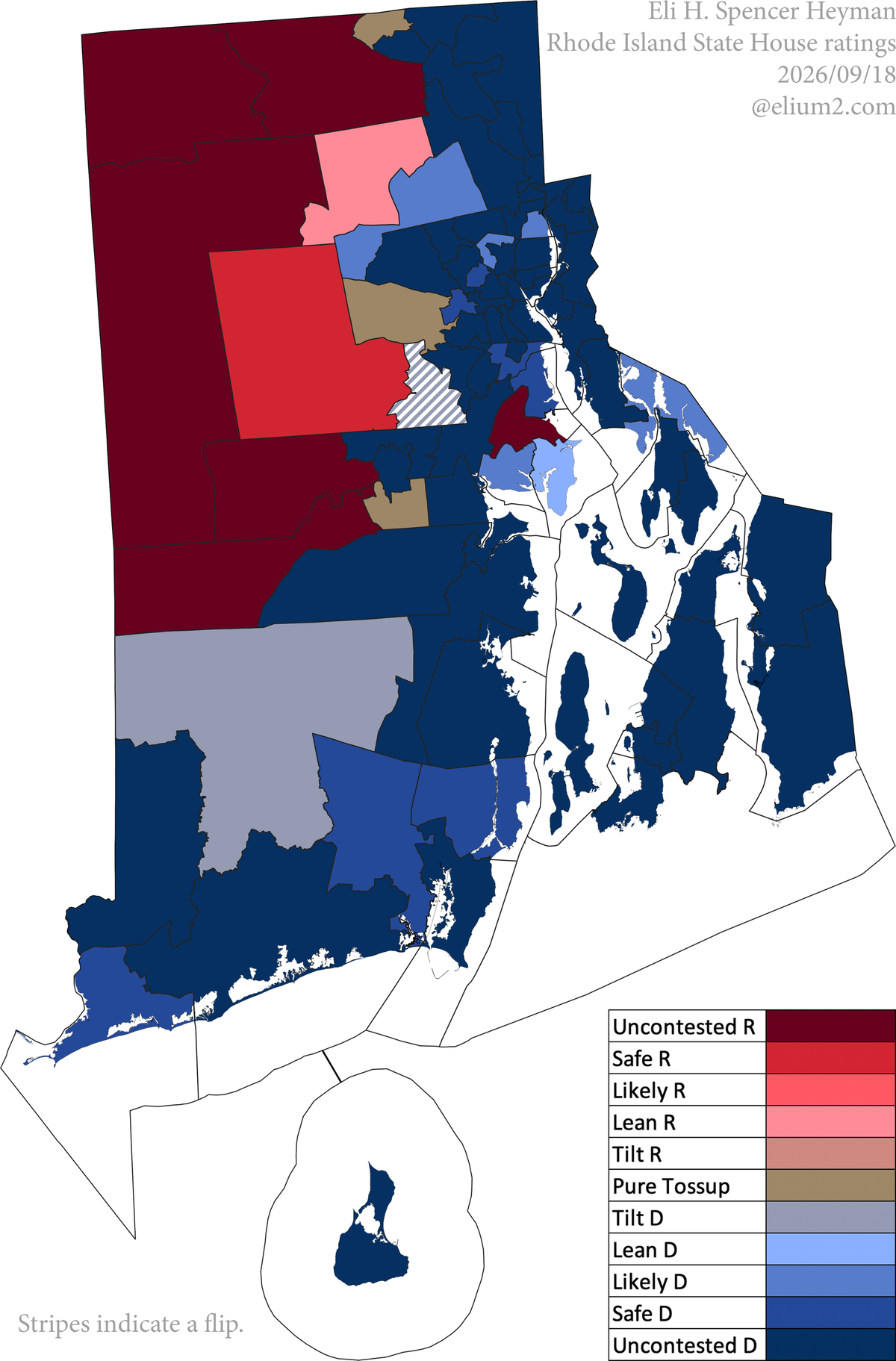
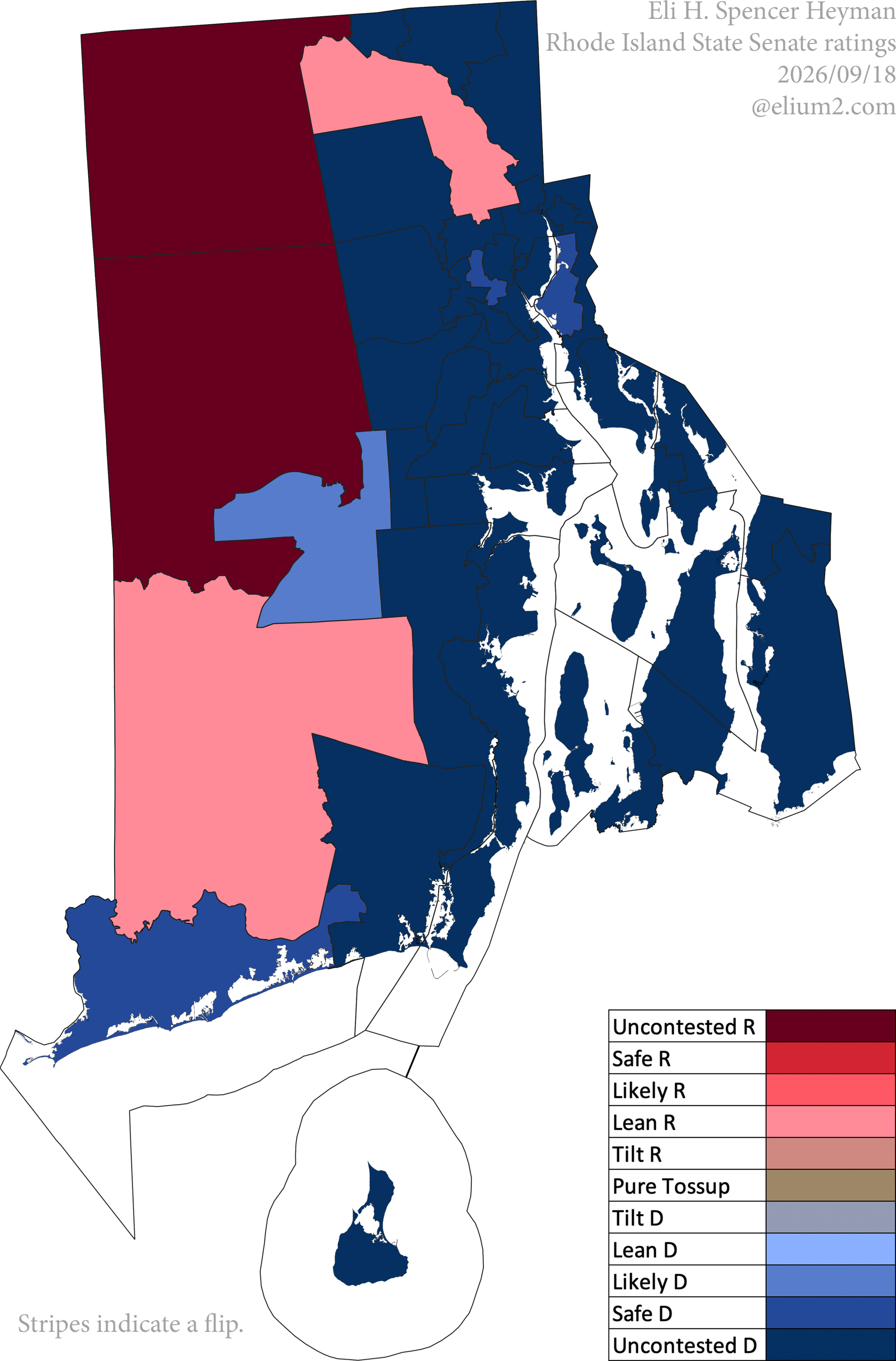
I also have maps of my ratings! Apparently I haven't done rating maps for Rhode Island since 2018. New this cycle, I now show the district outlines over the coastline so that it's clear when a district crosses landmasses. I have added lines connecting Block Island to its appropriate districts. (These should display in both dark and light mode.)
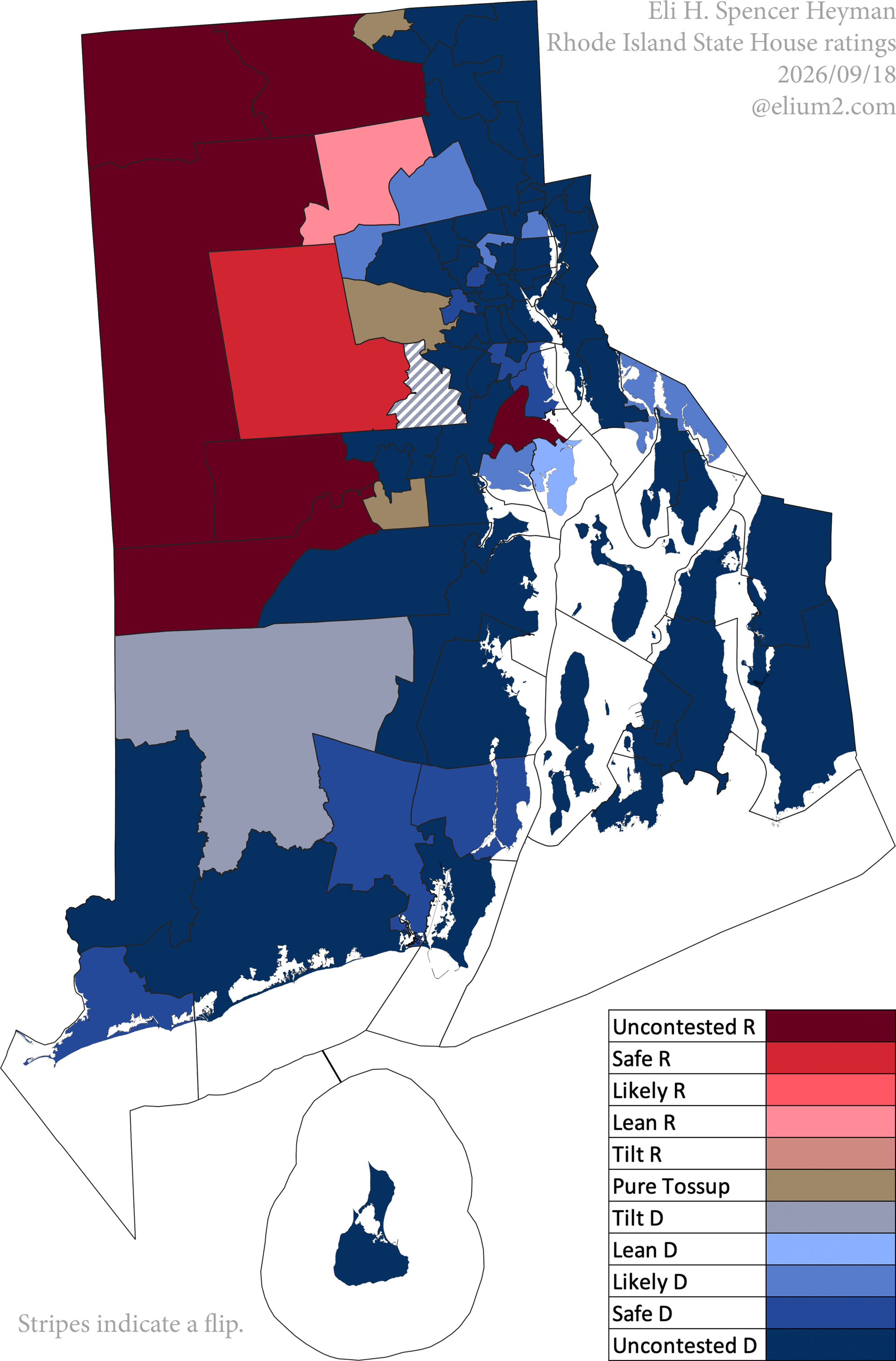
For several races, I expect this will be my final long-form update before the general election. I've indicated those races in their descriptions. Of course, if something changes to make those races unexpectedly competitive, I will still provide updates on them; the indication simply means I don't expect that to happen.
Miscellaneous Notes and Methodology
Feel free to skip this section if you don't care about these details, but it was too long for a footnote and didn't make sense to leave for the end.
In Rhode Island, general election ballot order for state and federal offices is determined by lottery at the political party level. Specifically, a lottery is conducted for the ordering of all political parties with ballot access (currently, this is just the two major parties). The Republican Party won the lottery this year, and Republican candidates will appear first on the ballot for all single-winner offices they are seeking, with Democratic candidates immediately following. Party candidates will appear ahead of independent candidates, including independents who have chosen a label. In races with multiple independent candidates, a lottery is conducted to determine their relative order.
I will list candidates in ballot order here, but as there are only two state or federal races with multiple independent candidates, I will only specifically mention ballot order in those cases.
I may elect, in my sole discretion, to issue ratings and/or provide writeups of select municipal offices and questions at some point after the “28 days before election” financial reports are due. There are several interesting contests, including mayoral races in East Providence, Providence, and Woonsocket, an election for Town Administrator in Lincoln, a divestment ballot question in Providence, and a referendum on Johnston's eminent domain powers as the town government seeks to block an affordable housing development.
I provide statistics about district partisanship from the 2022 and 2024 elections. I think the state-level elections from 2022 generally are more useful in predicting state legislative contests, but at times the 2024 federal statistics are useful in identifying districts undergoing rapid shifts. As such, I include 2022 statistics in nearly all cases and use the 2024 statistics more selectively. A table of party nominees in these races, many of whom I will reference at various points, is below.
| Year | Contest | Democrat | Republican |
|---|---|---|---|
| 2022 | Governor | Dan McKee | Ashley Kalus |
| 2022 | Lt. Gov. | Sabina Matos | Aaron Guckian |
| 2022 | Sec. of State | Gregg Amore | Pat Cortellessa |
| 2022 | Attorney Gen. | Peter Neronha | Charles Calenda |
| 2022 | Gen. Treasurer | James Diossa | James Lathrop |
| 2024 | U.S. Senate | Sheldon Whitehouse | Patricia Morgan |
| 2024 | U.S. House D1 | Gabe Amo | Allen Waters |
| 2024 | U.S. House D2 | Seth Magaziner | Steven Corvi |
All district-level population statistics for race/ethnicity, ancestry, and housing tenure are from the Census Bureau's 2020-2024 American Community Survey 5-year estimates. All statistics for ancestry and housing tenure are for total residents. For districts that are not racially homogenous, I provide racial statistics for both all residents and for the adult citizen population, which is abbreviated as CVAP (citizen voting-age population). The “white” share of the population always means non-Hispanic white. As the ACS groups all Hispanics together for the CVAP estimates, the Black share is also non-Hispanic, but I take care to specify this when the Black share is high enough to mention. Statistics on the portion of a district that is within a particular city or town (and vice versa) are from the 2020 decennial census.
Some notes on ancestry data in particular. First, you might wonder why I insist on using fractions rather than percentages for the ancestry numbers. The main reason is that the margins of error are pretty substantial, and using approximate fractions conveys the approximate nature without cluttering the text with margins of error. Second, I use data on respondents reporting ancestry or origin generally, meaning that someone who reports two ancestries is counted towards two groupings and the groups thus overlap.
Unless you find the subject of how the Census Bureau measures race, ethnicity, and ancestry interesting, you really might want to skip to the statewide writeups. I do think this is a pretty interesting and important subject, and I also care about being transparent in my methodology, but you can definitely understand the remainder of the post without reading the next three paragraphs.
For the data I refer to in the rest of this post as “ancestry” data, I use tables B04006 (ancestry among people reporting ancestry), B02025 (Black alone or in combination by origin), and B03001 (Hispanic by specific origin), except as discussed in the next paragraph, with B02025 taking precedence over B04006 for groups appearing in both tables. B02025 is taken from the ACS's race question, which asks respondents to provide more detail about their origin(s). B03001 is taken from their ethnicity question, which is similarly prominent and has a similar prompt. B04006, however, is taken from the ancestry question, which is still distinct for some reason and much further down, even though they also ask for more detail in the race and ethnicity question. The ancestry table is not exclusive to white respondents, so groupings like “Italian” can include nonwhite people of Italian ancestry. However, B04006 and B02025 both aggregate all Hispanic responses into “other” categories, despite “Dominican” and “Mexican” literally being example responses on the ancestry question used to compile B04006. Also, from what I can tell, European ancestries are more often indicated on the ancestry question than on the race question, while the reverse is true for African and Caribbean ancestries. (If this all sounds very confusing and arbitrary…well, it is. It's worth noting, however, that the ACS didn't allow white or Black respondents to elaborate on their origin outside the ancestry question until 2020, and didn't have distinct tables for them until 2024, so the “problem” of having multiple ethnic origin tables for those groups is a new one, and the Bureau is seemingly still sorting out some kinks.)
Third and most importantly, after some consideration, I have determined that the category “Other Black or African American, specified”, which indicates that the respondent indicated a specific ancestry that is not common enough to be reported on its own in B02025 (such as Senegalese or Tanzanian), should not be aggregated with the categories “African American” and “Other Black or African American, not specified”, the latter of which indicates that the respondent did not further specify an origin or “wrote in a generic term such as ‘Black.’” (This is a direct quote from the Census documentation and does not represent my own view on the term. It is not clear which other terms are also considered “generic”.) The “African American” category indicates that the respondent wrote in the term “African American” or (I assume) “Afro American”, which the Census Bureau thankfully does not consider to be “generic”. I have aggregated the “African American” category from B02025 and “Other Black or African American, not specified” category from B02023 into “Black/African-American not otherwise specified”. (B2023 is the table for respondents who reported only Black/African-American as their race and no other race; I use this table for this category because otherwise it might include, for example, Dominicans, who are a “Hispanic origin”, not an ancestry group or tabulated Black origin. Again, take it up with the Census Bureau and the White House.) This is as close as I can come to a category for Black Americans who cannot trace their roots earlier than enslaved people in the United States.
This is a change from my State Senate preview, which aggregated all three categories into a single category. I apologize for the judgment error. All statistics in this post reflect the updated approach.
Statewide and Federal Races and Questions
My pre-primary writeups can be found here.
U.S. Senate
The candidates here are former Warwick telecommunications manager Raymond T. McKay (R), incumbent John F. “Jack” Reed (D), and independent Michael Anthony Bahry. McKay, who is a Republican activist, lost the 2024 primary for RI's other Senate seat to Patricia Morgan by a wide margin. Reed, the former chair of the Senate Armed Services Committee, is seeking a sixth term. Reed is extremely popular, to put it mildly, and ran well ahead of Joe Biden in 2020 in his last contested general election; in 2014, he was similarly by far the best-performing statewide Democrat. For a wide range of reasons, this is a Safe Democratic contest.
U.S. House, Dist. 1
The candidates here are Republican Kellie Keenan, incumbent Democrat Gabriel “Gabe” Amo, and independent Pedro deSouza. Amo was first elected in a 2023 special election after David Cicilline resigned from the seat. This is the bluer of Rhode Island's two congressional districts, covering Bristol County, Newport County, and northeastern Providence County. In 2024, Kamala Harris won by 22% here (59.7% to 37.5%) and Whitehouse carried it by 28%. Amo received 63% of the vote that year to win election to his first full term. The district more or less covers the eastern half of Rhode Island by population. My rating is Safe Democratic.
U.S. House, Dist. 2
The candidates here are Victor Mellor (R) and incumbent Seth Magaziner (D). This is the less blue of Rhode Island's two congressional districts, covering Kent County, Washington County (a.k.a. “South County”), and western/southern Providence County. The district more or less covers the western half of Rhode Island by population. In 2024, Kamala Harris won by 7% here (52.1% to 45.2%), Whitehouse won by 13%, and Magaziner won by about 17%.
Magaziner served two terms as state General Treasurer before winning a hard-fought 2022 election, a result that surprised some national observers. It is my understanding that he does not reside in the district. Mellor describes his vision as “Rhode Island First”, a theme that is prominent in his messaging. He spent nearly $3 million of his own money to win the primary, including substantial radio ad buys and a variety of other expenditures. Magaziner has wasted no time in criticizing Mellor over his attendance at the January 6 attack on the U.S. Capitol, and Mellor is also a registered foreign agent of the Cuban government.
There are circumstances under which RI-02 could be competitive. Those circumstances are not present this year. I think it's Safe to say that Mellor will not be winning this Safe Democratic race.
In 2022, I correctly rated this contest Lean Democratic. I do not know of any other forecaster that had Magaziner favored with a comparable level of confidence.
Governor
The candidates are, in ballot order, Aaron Guckian (R), former CVS executive Helena Buonanno Foulkes (D), centrist businessman Ken Block (I), Jasjit S. Gotra (I), and C. D. Reynolds (I).
I reprint my previous analysis here:
Nine independents originally filed, but only three actually turned in the 1,000 signatures required to appear on the general election ballot. (This is the same number required for party candidates to appear on the primary ballot.) Business[man] Ken Block is by far the most prominent and will appear third on the ballot, immediately after the party nominees, which doesn’t exactly hurt. (The other candidates are Jasjit S. Gotra and C.D. Reynolds.) Block, a businessman, raised $133K from individuals in Q2 and spent $53K, ending with $91K on hand, although his campaign owes him over $1M in debt from his previous campaigns. For comparison, Gotra had $692.19 on hand as of June 30, and Reynolds has several overdue filings.
Block regularly gets media attention, but I don't believe he's ever even won an election or nomination. In 2010, he was the Moderate Party nominee for Governor of Rhode Island, placing fourth (behind the party candidates and independent Lincoln Chafee, who won). In 2014, he ran for the Republican nomination, losing to Cranston mayor Allan Fung by a 10% margin.
I did note above that the last time Dan McKee lost a primary, he waged a write-in campaign in the general election. That general election ballot had only one name on the ballot, that of his primary opponent. I don't think McKee is foolish enough to try the same feat in a statewide race with five names on the ballot. Perhaps more importantly, if he were, those parts of the party infrastructure that have backed him or remained neutral thus far would almost certainly mobilize behind Foulkes, leaving him with no base of support.
Given Block’s political views, I imagine he may hurt the Republican nominee more than the Democrat. However, he may be able to effectively take advantage of the weaknesses of […] Foulkes in his campaign.
McKee polled worse against Block than Foulkes, and McKee didn't win the nomination. My rating is Safe Democratic, reflecting that Foulkes already has a substantial polling lead; that independent statewide candidates usually lose ground over the course of a campaign, rather than catching fire; and that Block does not have an especially impressive electoral record. Again, though, I'll keep an eye on things.
Lieutenant Governor
The candidates here are former State Rep. John Loughlin II (R) and incumbent Sabina Matos (D). Matos won a contested primary over four other candidates, receiving 38% of the vote, 11% ahead of the second-place finisher. Matos won the 2022 election by an 8% margin, the narrowest margin of any statewide Democrat that year; at the time, she was an appointed incumbent. I previously wrote:
Former State Rep. John Loughlin II, who lost the 2010 RI-01 open-seat election to David Cicilline by 6%, is considered one of [Republicans'] better hopes to break through in the general election. Out of caution, this is Likely Democratic to start, although I'm quite skeptical that this will be the year Republicans finally win statewide office again.
I'm still skeptical, but Matos is hardly invulnerable. The race remains Likely Democratic for now.
One thing I left out of my summary in the primary: what the office does. Rhode Island has a very weak lieutenant governorship (and governorship). Unlike many states, the Lieutenant Governor has no role in the State Senate. The office's main function is actually its public platform. Of course, it can become very important, as we were all reminded when Gina Raimondo was appointed as the U.S. Secretary of Commerce.
Secretary of State
For Secretary of State, incumbent Gregg Amore has no opposition whatsoever after Anthony Tamba failed to make the primary ballot. Incredibly, no Republican or independent even filed, making this the first completely uncontested statewide general election in several years, and the first completely uncontested statewide race (including the primary) in…I’m not sure how long. Uncontested Amore for both the primary and general election.
Nothing has changed, so I have nothing to add. Obviously, I do not anticipate providing updates about this race.
Attorney General
The candidates are cannabis legalization advocate Alan Gordon (R) and former Cannabis Control Commission chair Kimberly Ahern (D). Ahern won a contested primary over three other candidates, receiving 36% of the vote, 3% ahead of the second-place finisher. She has no prior electoral record.
Republicans do have a nominee here, Alan Gordon, who the state party notably did not endorse. Gordon lost the two-way 2018 general election to Peter Neronha, who was not yet the incumbent, by a 60% margin, but Gordon was the nominee of the pro-marijuana, er, I mean pro-cannabis Compassion Party that year. While he should do a bit better on the Republican line, I don't expect the general to be competitive; my rating is Safe Democratic, and I do not anticipate reevaluating that.
Getting elected statewide in Rhode Island as a Republican isn't an easy feat. I don't think Gordon even has the Rhode Island Republican Party – the organization, not the ballot line – behind him. He simply doesn't have the infrastructure to make this a real race. This will be an easy win for Ahern.
General Treasurer
The candidates are Micholas Credle (R) and incumbent James Diossa (D).
There's no primary for Treasurer, where incumbent James Diossa will face Republican Micholas Credle in the general. Diossa won narrowly in 2022, when some unions opposed him not only in the primary but in the general election, but he should be in better shape this year, having already been endorsed by the AFL-CIO and NEARI. The 2022 Republican nominee, James Lathrop, raised over $14,000 in Q2, ended Q2 with over $16,000 on hand, and was able to self-fund to an extent; Credle's filings, which appear not to properly report his donors, indicate he had $186.78 on hand at the end of Q2 after raising $2,050 and spending $2,071.61 in Q2. For comparison, Diossa raised $46,671.18 in Q2, spent $61,106.07 and had $342,330.37 on hand. I rate the race Safe Democratic to start but will monitor any developments carefully.
I don't have anything to add at this point. I do plan to provide updates on this race.
Ballot Measures
There are five statewide ballot measures this year, all of them legislatively referred (like all statewide ballot questions in Rhode Island).1 All five are bonds rather than constitutional amendments. In order, they are:
- Higher Education Facilities $275,000,000
- URI Integrated Health Building $165,000,000
- RIC Adams Library Renovations $50,000,000
- CCRI Workforce Innovation Center $60,000,000
- Housing and Homeownership $120,000,000
- Economic Development $100,000,000
- Site Development $55,000,000
- Growth Industry Infrastructure $45,000,000
- Cultural Economy $50,000,000
- State History Center $45,000,000
- State Preservation Grants Program $5,000,000
- Green Economy Bonds $55,000,000
- Brownfields Remediation and Economic Development $3,000,000
- Facility Improvements $12,000,000
- Local Recreation Projects $1,000,000
- Marine Infrastructure Development $1,000,000
- Resilient Rhody Infrastructure Fund $25,000,000
- Narragansett Bay Watershed Restoration $7,000,000
- Agriculture Land Preservation Commission $3,000,000
- Open Space Program $3,000,000
At present, I anticipate all will pass. The last time Rhode Island voters rejected a statewide bond referendum appears to have been all the way back in 2006, when one of the six bond votes failed by 1.2%. (Three bonds out of 12 failed in 2004, two of them by large margins.) Voters have repeatedly approved bonds for higher education facilities, housing opportunity/affordability, cultural funding, and green economy uses, including at the 2024 and 2021 elections. I don't anticipate they'll suddenly stop.
The economic development question (Question 3) is rarer. I am not going to “rate” these ballot measures, but Question 3 strikes me as being the least assured of passage. Nevertheless, at present I see no reason to think it will fail.
State Senate
Only one of the contested State Senate general elections had a contested primary.. I have reprinted my pre-primary writeups with additions for all other races.
Senate District 5
SD 5 is located in northwestern Providence, covering all of Federal Hill and parts of Mount Pleasant, Elmhurst, Valley, Smith Hill, and the West End. 57% of adult citizens are white, while 26% are Hispanic and 12% are Black non-Hispanic. Looking at all residents, 42.3% (±5.3%) are white, while 40.6% (±6.0%) are Hispanic and 11.3% (±4%) are Black non-Hispanic. The top ancestries are Dominican and Guatemalan (one eighth each), Irish (one tenth each), and Italian (one eleventh). There appear to be relatively large populations of Liberian and Haitian ancestry here; both are still less than 5%, but they are significant segments of the Black non-Hispanic population. It is more or less evenly split between non-renters and renters.2
William Connell Jr. (R) has a rematch with incumbent Sam Bell (D), a democratic socialist who is seeking a fifth term. Bell won a contested primary this year by a large margin. This is a rematch of the 2024 general election, which Bell won 78.6% to 20.8%. SD 5 is something like 45% to the left of Rhode Island by relative margin, and a Republican simply isn't getting elected here: it's Safe Democratic. I do not anticipate providing future updates about this race.
Senate District 14
This district comprises nearly three-fifths of East Providence, covering the western portion of the city. 78% of the adult citizen population is white, while 10% is Black non-Hispanic and 7% is Hispanic. Looking at all residents, 72% are white, 11% are Hispanic, and 9% are Black non-Hispanic. The top ancestry is Portuguese by a long shot, at nearly one quarter of the population; other major segments include Irish (one eighth), Italian (one eleventh), and Black/African-American not otherwise specified (one thirteenth). 66% of residents live in owner-occupied housing.
The incumbent is Senate President Valarie Lawson (D), who was first elected in 2018; she faces Brian Gary Coogan (I).
Senate President Valarie Lawson faces a general election challenge from former Rep. Brian Gary Coogan, an independent supported by the League of Rhode Island Businesses. Lawson, who is also president of the National Education Association-Rhode Island (NEARI), has a strong electoral record and should beat Coogan in this rather blue seat, which was at least 13% to the left of Rhode Island by margin in all 2022 statewide races. Coogan's first campaign finance report is due October 6, covering all activity since the end of Q2, when he had not yet started fundraising; Lawson had $336,650.61 on hand at the end of Q2. I'll keep an eye on this – it's not as if chamber leaders haven't lost general elections before – but it starts at Safe Democratic, and I don't expect that to change.
I’m not sure how long Coogan served in the State House, but he last won election to the House in 2002. He lost renomination to Helio Melo in the 2004 primary. He later narrowly won the nonpartisan election for Ward 2 on the city council in 2008, which I believe is his most recent electoral victory.
I will probably provide a brief update about this race after the 28BE campaign finance report due to its prominence, even if the update is that the race remains safe.
Senate District 17
This district includes most of Lincoln (69% of the district), about half of North Smithfield (25%), and a small part of North Providence (6%). 91% of adult citizens here are non-Hispanic white. The top ancestries among residents are Irish and Italian (one sixth each), French (one eighth), English (one ninth), French Canadian (one twelfth), and Portuguese (one thirteenth). 82% of residents live in owner-occupied housing. In ballot order, the candidates are incumbent Thomas Paolino (R), clinical psychologist Nelly Burdette (D), John Douglas Barr II (I), and attorney Jina Petrarca (I). As this is a competitive race, I gave it a longer writeup.
Sen. Thomas Paolino represents a seat that, on paper, should be a top Democratic target. Kamala Harris narrowly carried it in 2024, and it typically votes a split ticket in statewide races. It voted for Dan McKee by 7% in 2022; Republicans' three other seats all voted for Aaron Guckian, with only Elaine Morgan's seat being remotely close. However, Paolino has survived challenge after challenge since winning a close 2016 general election over Democratic nominee Jina N. Petrarca-Karampetsos, who herself won a contested primary. After narrowly beating progressive Democrat Dennis Lavallee in the 2018 general, Paolino easily beat John Douglas Barr II in 2020. He faced a divided field in 2022 comprising Democrat Cameron Joseph Deutsch and former state Rep. John “Jack” Lyle Jr., a progressive Republican (yes, really) who ran as an independent. Paolino won with 47% of the vote to 28% for Lyle and 25% for Deutsch. In a 2024 rematch with Deutsch, whose campaign was poorly funded, Paolino won with 58%.
Paolino draws a stark contrast with most Republicans in the General Assembly by largely keeping his mouth shut; to take just one metric, his Twitter account has a mere 254 posts. For comparison, Senate Minority Leader Jessica de la Cruz has 1,366, House Minority Leader Mike Chippendale has 9,463, and Brian Newberry has over 25,000. Keeping quiet is, in my view, a smart move for a swing-seat Republican. Democrats here seem to be poorly organized, holding just one seat on the five-member Lincoln Town Council (the other members are all independents, as is the town administrator) and lacking a district committee for SD 17, one of only two such districts. Paolino's predecessor, Edward O'Neill, was an independent who served four terms in the Senate and first won election by defeating then-Senate President Joseph Montalbano.
(O'Neill joined the Republican Party after winning his final election but before leaving the Senate.)
This year, Paolino, who is a professional chauffeur, faces clinical psychologist Nelly Burdette, a Democrat who is backed by the Working Families Party, PPVRI, and Lead Locally. I expect a hotly contested race. I am closely watching two independent candidates, John Douglas Barr [II] and attorney Jina N. Petrarca, both of whom made the ballot. Yes, both are the same people who were previous Democratic nominees against Paolino. Barr is effectively a perennial candidate, having run for office eight times this century and lost every time. He did, however, serve for ten years in the State House…last century. Jina Petrarca's only past run for office is her 2016 campaign, but [her brother and business partner] Peter Petrarca served multiple terms as a state representative. […] This race is Lean Republican to start [emphasis removed]. This could very well be the year Paolino loses, but the independent candidates could easily play spoiler – or Burdette could, if Petrarca's campaign takes off. Barr, however, simply is not going to win.
The Valley Breeze printed Burdette's initial campaign announcement in April and briefly listed the candidates in July, although it said that Petrarca lost the 2016 race to the “sitting senator” (it was an open seat).
I have since learned that Peter Petrarca and Jina Petrarca are siblings. I have also learned that Petrarca plans to self-fund her entire campaign and refuse donations, which might sound nice to voters but is typically not a wise campaign decision. She seems to be running on a fairly bland platform that might not pull too many votes, giving me some reason to be optimistic about Burdette here. That said, the possibility of Petrarca's campaign becoming a nonfactor is something I priced into my rating, and right now it's still just that: a possibility.
One other thing I felt was interesting: in the 2021 special election for Lincoln Town Administrator, Paolino was the Republican candidate and Barr was the Democrat. Paolino got 19.0% and Barr got 10.6%; the winner was independent Philip Gould, who received 63.0%. (There were three other independent candidates, who all placed behind the partisan candidates.)
In 2022, I rated this contest Likely Republican. In 2024, I indicated my best guess was that Paolino would win but that there was high uncertainty (I rated the race a tossup until Election Day).
The race remains Lean Republican.
Senate District 33
This district includes nearly three quarters of Coventry (90% of the district) and about two fifths of West Greenwich (10%). The adult citizen population is 93% non-Hispanic white. Looking at total residents, the top ancestries are Irish (one fifth), Italian and English (one sixth each), French (one eighth), Portuguese (one twelfth) and French Canadian (one thirteenth). The ACS estimates only 33 residents (out of over 27,000) are of Greek ancestry, plus or minus 42. 82% of residents live in owner-occupied housing.
The candidates are Coventry school committee member James Pierson (R) and longtime incumbent Leonidas Raptakis (D), known as Lou or occasionally Leo.
Sen. Leonidas “Lou” Raptakis, who is perhaps the most conservative Democrat in the Senate, faces a rematch with Republican James Pierson, who serves on the nonpartisan Coventry School Committee, representing District 5 (there are five districts). Pierson was poorly funded in 2024 and lost by about 17%, even as Trump and Morgan carried the district. The seat voted for Republicans in all five 2022 statewide races, with only Gov and AG within 4%. (Seth Magaziner did win the district in 2024.) I underrated Raptakis here in 2024, which if memory serves was his first contested race in quite some time. I'm starting this at Likely Democratic, but if Pierson's campaign shows signs of life, I'll reevaluate. I am only aware of one endorsement here so far: LORIB has endorsed Raptakis.
Nothing new to report here. One thing to note that I left out of the initial writeup is that Pierson's term on the School Committee is four years, and the seat wasn't up in 2024 but is up this year. (Rhode Island does not generally allow candidates to seek multiple offices simultaneously.) However, the terms of the Coventry School Committee were actually shortened to two years in 2022, with a delayed effective date.
Further complicating matters, it does not appear there will be any candidate on the ballot for School Committee, meaning that the position will be elected via write-in, unless I'm missing some reason that the position shouldn't be up for election. At the 2026 General Assembly session, legislators approved a reform to the state's write-in system such that specific write-in votes need only be tallied if an eligible write-in candidate requests the tally or the outcome of the race could be affected. (Previously, local boards were required to tally virtually all write-ins.) Obviously, if no one is on the ballot, the outcome would be affected. This is all to say that there is a nonzero chance Pierson could remain on the School Committee if enough people write him in – assuming he loses to Raptakis, of course.
As noted above, in 2024 I rated this contest Tilt Democratic, which was far too generous to Pierson.
Senate District 34
This district includes Hopkinton (30% of the district), Richmond (28%), Exeter (23%), about half of Charlestown (15%), and about one fifth of West Greenwich (4%). The adult citizen population is 94% non-Hispanic white.
Looking at residents overall, the top ancestries are Irish and English (one fifth each) and Italian (one sixth), followed by French and German (one eleventh each) and Polish (one fourteenth). 87% of residents live in owner-occupied housing.
Here, we have Elaine Morgan (R) and former Richmond Town Council president Samantha Wilcox (D). As this is a competitive race, I gave it a longer writeup.
Like Sen. Paolino, Sen. Elaine Morgan (R) represents a district that is often closely divided at the top of the ticket, although it's redder than Paolino's. In 2024, Magaziner won here, while Trump and Morgan carried the seat. In 2022, AG Neronha was the only statewide Democrat to carry the seat, although McKee came close. Morgan has been known to make controversial and Islamophobic remarks and is quite right-wing. Naturally, LORIB has endorsed her.
In 2024, Morgan beat Dem Stephen Moffitt by 7%, slightly ahead of Trump and Patricia Morgan's performances (Patricia is not related, to my knowledge). Moffitt is the former president of the Hopkinton Town Council; he was the top vote-getter for Town Council in 2020 and placed third in 2022 (the top five win election), running as an independent in both those races. Elaine Morgan faced progressive Jennifer Douglas the previous three times and won by 8-9% each time, ahead of most statewide Republicans. The last Democrat to hold this seat was Morgan's predecessor, Catherine Cool Rumsey, who ousted a Republican incumbent in 2012 by a 10-point margin; Morgan defeated Cool Rumsey in a close 2014 race (5%) and beat her in a 2016 rematch by 10%. 2012 was a long time ago.
The Democrat running this year, Richmond Town Council president Samantha Wilcox, is backed by the state party. In 2022, Wilcox, who works as a paralegal, was the sole Democrat elected to the Richmond Town Council, with Republicans winning the other four seats in the vote-for-five race (Wilcox placed third). In 2024, when Democrats won four of five seats (and did not run a fifth candidate), Wilcox was the top vote-getter by a decent margin and also notably received more votes than Morgan. On her website, she highlights not only her votes for various council initiatives but also her work with Rep. Megan Cotter (D) to kill a tax giveaway to a development for wealthy residents and her opposition to the Council's illegal attempt to install a Republican on the Chariho School Committee.
Democrats have repeatedly lost to Morgan, and I'm skeptical this year will be different. It would take a lot for me to be convinced Wilcox is favored, but she seems to be a much stronger candidate than Democrats have previously had. I'm starting this at Lean Republican and will watch closely.
My rating hasn't changed. I guess I can add the financials: Wilcox had $13K on hand at the end of Q2, while Morgan had $9K. Neither had any debt. (I am not reporting activity because most campaigns had not begun in earnest in Q2.)
In both 2022 and 2024, I correctly rated this district Likely Republican.
Senate District 38
This district contains Westerly (81% of the district), about half of Charlestown (12%), and a bit of South Kingstown (7%). 94% of the adult citizen population is non-Hispanic white, while just 2% is AAPI. Looking at all residents, the top ancestries are Italian (one fourth), Irish (one fifth), and English (one sixth), followed by German (one twelfth). 82% of residents live in owner-occupied housing.
We have Westin Place (R) and incumbent Victoria Gu (D), in a full rematch of the 2024 general election and a partial rematch of the 2022 general election, both of which Gu won comfortably. Neither candidate has otherwise sought office in Rhode Island.
Sen. Victoria Gu, a progressive Democrat who voted for Lawson, faces a rematch with Republican Westin Place, who[m] the LORIB is backing. Gu crushed Place last time around. Gu's immediate predecessor, Sen. Dennis Algiere, was the longtime Republican leader in the State Senate; Gu was the first Democrat to run for the seat since 2006 (and only the second since 1992), so Algiere's long tenure doesn't say much about the seat. This district always stuck out like a sore thumb when Republicans held it, being well to the left of even Paolino's seat, and Gu should easily win again. Safe Democratic.
I'll add that in the 2022 elections, SD 38 ranged from 1.6% to 8.0% to the right of the state, getting progressively redder (by relative margin) the further downballot the race was and only barely voting for Diossa over Lathrop. This would seem to indicate it may be less blue downballot than it is for statewide races, unlike much of the state. Still, Gu crushed Place by a 16% margin in their one-on-one matchup in 2024, and in 2022, she won by 19%, although she only received 46.5% of the vote and Place barely finished ahead of the independent candidate. (The larger statewide officer margins here in 2022 were similar.) Past candidate performance is, in my experience, highly predictive. The race remains Safe Democratic. I do not anticipate providing future updates about this race.
In 2022, I rated this district Likely Democratic, and in 2024, I rated it Safe Democratic.
State House
At last, we move to new territory. There are 20 contested State House districts in November. Some are more interesting than others, but I address all of them at least briefly.
House District 5
This is a 45% white, 37% Hispanic, 10% black non-Hispanic district in northwestern Providence, containing parts of Charles, Wanskuck, and Elmhurst neighborhoods, including the campus of Providence College. The adult citizen population is 60% white, 24% Hispanic, and 9% Black non-Hispanic. The total population is evenly balanced between renters (41%) and non-renters (39%), with another 20% in “group quarters” housing. The “group quarters” category includes university housing, nursing homes, and prisons; in this case, it's likely Providence College students. The largest ancestry groups are Irish (one seventh), Dominican (one eighth), Italian (one ninth), and Puerto Rican (one thirteenth). There is a significant segment of the Black population with Subsaharan African ancestry, especially Liberian. The district is about 30% to the left of the state by partisan margin, with no statewide Republican breaking 30% of the vote here in 2022 or 2024.
Incumbent Anthony J. DeSimone (D), who is seeking a third term, faces Brittany Kubicek, an independent who is running with the ballot label “Socialist”. Kubicek is endorsed by Rhode Island DSA (RIDSA) and is, to my knowledge, their first endorsed candidate since they swore off Democratic primaries and rebranded from Providence DSA (PvDSA). DeSimone is the son of former Majority Leader John DeSimone, a conservative who held the seat until losing the 2016 primary to progressive Jamaican-American schoolteacher Marcia Ranglin-Vassell. When Ranglin-Vassell retired in 2022, there was a four-way contest to succeed her, and progressives did not unite behind a candidate. DeSimone, the lone conservative in the race, won that primary with 52.3%. He went on to defeat an independent candidate in the general election, receiving 79.6% of the vote.
PvDSA had an impressive record. With their backing, Sam Bell, David Morales, and Enrique Sanchez each ousted incumbent legislators in successive cycles. I believe their only loss was in 2022, when their former co-chair Kinverly Dicupe lost a primary for State House by a wide margin – in Pawtucket, not Providence. However, this record was in Democratic primaries. Winning a general election as an independent is a very different task. Rhode Island State House districts are small enough that it's hardly an unimaginable feat; there were just 2,456 ballots cast in HD 5 in the 2022 general election. Nevertheless, I am skeptical.
Kubicek has had respectable fundraising thus far and ended Q2 with $4K in the bank to DeSimone's $64K. (That may not sound like much, but Kubicek has also been spending some of what she's raised, and again, the electorate isn’t huge.) This contest starts at Likely Democratic, reflecting that DeSimone is a strong favorite but there is potential for an upset. (I rated the 2022 election Safe Democratic.)
House District 7
This Providence district contains parts of Mount Pleasant, Elmhurst, and Valley. Looking at the adult citizen population, 39.5% are white, 36.8% are Hispanic, and 16.8% are Black non-Hispanic. Moving to all residents, 54% are Hispanic, 27% are white, and 13% are Black non-Hispanic. For ancestry, the top groups are Guatemalan (one fifth), Puerto Rican and Dominican (one ninth each), and Black/African-American not otherwise specified (one twelfth). The white population includes substantial Irish and Italian segments, but they are less prevalent than elsewhere because the district simply isn't very white. 60% of residents live in owner-occupied homes. The seat gave every statewide Democrat over 70% of the vote in 2022 and is some 30+ points to the left of the state.
With incumbent Rep. David Morales, who is a democratic socialist, running for higher office (and certain to win), this seat is open. Morales's chosen successor, Amy Santiago, won an expensive primary against centrist City Council member Jo-Ann Ryan, receiving 62% of the vote. Santiago identifies as having Latine heritage and as “a proud member of the Kanienke community”. The general election pits Christopher Ireland (R) against Santiago (D). Ireland previously ran against Morales in 2022 as an independent and received a mere 18% of the vote. At the end of Q2, Ireland had $165.20 in the bank to Santiago's $5,517.48, and Santiago actually had a slightly larger sum on hand as of her September 1 pre-primary filing. There is zero reason to expect a competitive race here: Safe Democratic. I do not anticipate providing future updates about this race.
I correctly rated the 2022 contest Safe Democratic.
House District 13
This district contains about 7% of both Providence (86.1% of the district) and Johnston (13.9%). The Providence portion contains parts of Hartford and Silver Lake. 61% of residents are Hispanic, to 18% white and 16% Black non-Hispanic. However, the adult citizen population is only 48% Hispanic and 14% Black non-Hispanic, with the white share rising to 30%. Looking back at total population, the top ancestries are Guatemalan (three tenths), Dominican (one sixth), Italian (one thirteenth), Liberian (one sixteenth), and Black/African-American not otherwise specified (one seventeenth). 65% of residents live in owner-occupied housing.
In 2022, every statewide Democrat except Dan McKee got over 60% here, with McKee falling slightly short. (This is unusual, as McKee performed much better statewide than Matos and Diossa.) The district voted well to the left of the state that year, except that it was only 3% left of the state for Governor. However, in the 2024 election, Trump received 44% here, losing the district by only about 9%, a better performance than his statewide 14% loss. The district still voted to the left of the state in the U.S. Senate race, giving Sheldon Whitehouse a 25% margin (he won by 20% statewide).
The candidates here are Derick A. Reels (R) and incumbent Ramón Pérez (D). Reels is Black; Pérez is Hispanic. In 2022, an independent candidate, Ivan J. Montanez, received 35% of the vote in a two-way race against Pérez. In 2020, a write-in candidate held Pérez to 81% of the vote.
While HD 13 has gotten redder in topline contests, thus far it remains quite blue downballot. Pérez is one of the most conservative members of the General Assembly, and he is best known for having background porn tabs in a printout he distributed to his colleagues. (He subsequently lost renomination, but he won the seat back in the 2020 primary.) As of the end of Q2, he had a whopping $518.93 in the bank (and was $592.28 in debt).
A general election challenger could plausibly run a competitive campaign against Pérez. That path is significantly tougher for a Republican candidate like Reels than it is for an independent. I haven't seen any signs thus far that Reels, who has yet to file any campaign finance reports, is running the sort of campaign that is needed to make this into a real contest, nor does he seem like the kind of candidate who would run such a campaign; he's clearly fairly right-wing and doesn’t seem to be making efforts to appeal beyond the Republican base. I’m interested to see his vote share, but my rating here is Safe Democratic. I do not anticipate providing future updates about this race.
I correctly rated the 2022 contest Safe Democratic. I correctly assessed Pérez as favored in 2020 but did not rate the contest as Safe.
House District 15
This district comprises nearly one fifth of Cranston, in the western part of the city but excluding the far west. The CVAP is 82% non-Hispanic white, 7% Hispanic, 5% AAPI, and 5% Black non-Hispanic. 80% of residents live in owner-occupied housing. This is one of the redder districts in Rhode Island, voting 19-28% to the right of the state in every 2022 race and only voting for a single Democrat, Peter Neronha. It did, however, vote for Seth Magaziner in 2024, and it has historically been fairly close in State House races.
There are three candidates here: incumbent Christopher G. Paplauskas (R), attorney Colleen M. Crudele (D), and former Mayor of Cranston Allan Fung (I). Fung was elected mayor as a Republican, serving three terms (2008-2020), and was considered popular. He was twice the Republican nominee for governor, losing both races but winning Cranston handily, and doing even better in HD 15. He was also the Republican nominee for U.S. House District 2 in 2022, a race he lost to Seth Magaziner; Fung did carry Cranston again, but less comfortably than in past races, although he still carried HD 15 by a whopping 21%. Furthermore, Fung's wife, Barbara Fenton-Fung, is Paplauskas's immediate predecessor, serving two terms (also as a Republican). Paplauskas narrowly beat Democrat Maria Bucci in 2024 for what was then an open seat, and he previously served on Cranston's city council for Ward 5, including service as council president.
Oddly enough, the wild card here may be Crudele, who has a limited electoral record (having last sought office in 2006) and a much lower public profile than, well, anyone else who has sought this seat in the last decade. Neither Crudele nor Fung have reported finances yet, while Paplauskas had $28K on hand at the end of Q2. This is a red-leaning seat, but I'm starting this at Tilt Democratic because Fung is likely to draw more Republican support than Democratic support. However, there is certainly potential for that to change, which could lead to a Fung victory – or to Paplauskas holding on with a plurality, if neither of his opponents consolidates support. (I'd be surprised by a Paplauskas majority, but I suppose it's not out of the question.) The Fungs served on the Republican district committee until resigning earlier this year, leaving Steven Frias, a teacher and former counsel to the Public Utilities Commission, as the sole member of the committee.
Historically, this has been a competitive seat despite being fairly red in statewide contests. As noted above, Paplauskas narrowly won the 2024 general election. Frias faced off against Democrat Nicholas Mattiello, then Speaker, in both 2016 and 2018, losing both races narrowly. The 2020 election, where Fenton-Fung defeated Mattiello, actually wasn’t very close, with Fenton-Fung winning 58% of the vote, including over 40% of Biden voters. (I rated both 2018 and 2020 pure tossups, although my gut instinct both times was correct.)3
In 2024, I rated this contest Likely Republican; I was correct about the ultimate winner, but in retrospect the rating was overconfident.
House District 18
This district comprises about one sixth of Cranston, in the city’s eastern appendage. The adult citizen population is 66% white, 16% Hispanic, and 9% Black non-Hispanic; residents overall are about 21% Hispanic. The top ancestries are Italian (one seventh), Dominican (one eighth), Irish (one ninth), and English (one eleventh). 65% of residents live in owner-occupied housing.
Jessica Gomes (R) faces incumbent Arthur Handy (D) here. Handy is a progressive, and this is by far the bluest part of Cranston; this district voted at least 20% to the left of the state in all 2022 races. Gomes had $564.69 in the bank at the end of Q2, while Handy had $23,661. While Handy hasn't had an opponent in some time, there's no reason to think Gomes can make this a race in such a tough district. Safe Democratic. I do not anticipate providing future updates about this race.
House District 19
This district contains about one eighth of Warwick, in the city’s northeast (73.4% of the district), and one twentieth of Cranston, in the city’s far east (26.6%). The adult citizen population is 87% white. The top ancestries are Irish (one fifth), Italian (one sixth), and English (one seventh). 86% of residents live in owner-occupied housing. In the 2022 election, it voted at least 10% to the left of the state in every statewide race.
Incumbent Joseph McNamara (D) faces independent Patrick Earl Maloney Jr. here. This is a rematch of the 2020 election, which McNamara won with 63% of the vote. McNamara served for some time as the chair of the RIDP and had his share of fights with the left there, but his voting record at the State House is solidly mainstream (i.e. not conservative). As for Maloney, he ran for City Council Ward 1 in 2022, receiving 42.5% in a two-way race against the Democratic incumbent, and he ran for Mayor of Warwick in 2024 against fellow independent Frank Picozzi, the incumbent. Maloney received a dismal 7.6%, well behind both Picozzi and the Democratic nominee. In fact, Maloney has sought office every cycle since 2012 and has lost every time, although he did narrowly win election to the Warwick School Committee in 2008.
There's no reason to think this race will go any differently than in 2020. Just like that year's contest, this is Safe Democratic. I do not anticipate providing future updates about this race.
House District 22
This district comprises about one sixth of Warwick, in the city’s coastal southeast. The CVAP is 87% white. Among residents overall, the top ancestries are Italian (one fourth), Irish (one sixth), and English (one seventh). 84% of residents live in owner-occupied housing. In the 2022 election, it voted 9-13% to the right of the state in all statewide races, voting for the Republican nominees for Lieutenant Governor and General Treasurer. In 2024, it narrowly went for Kamala Harris, giving her 49.2% to Trump's 48.0%; it voted for Whitehouse by 10% and Magaziner by 15%.
With conservative incumbent Joseph J. Solomon Jr. leaving to run for Attorney General (unsuccessfully), this is an open seat, and the ballot will feature registered nurse Barbara Quigley (R) and Zakary “Zak” Pereira (D), who works with veterans at URI. Pereira won a heated, expensive primary against charter school advocate Janie Lee Segui that saw substantial involvement from unions (supporting Pereira) and the charter lobby (supporting Segui). Despite all the outside spending, it wasn't a close race: Pereira received 70% of the vote.
Solomon faced opposition in the last three general elections. In 2020, he defeated independent Gerald Carbone by 5.3%. In 2022 and 2024, he defeated Republican David Stone by 12% and 14% respectively. Pereira and Quigley both have run for office once before: Pereira challenged Solomon in the 2022 primary, receiving just under a third of the vote (in a two-way race), while Quigley ran for State Senate the same year, receiving 19% of the general election vote – for District 15, which is in Pawtucket and Central Falls (and is about 19% Republican).
This district's partisanship is in line with other seats where Republicans have been able to compete in Rhode Island, and the absence of an incumbent doesn't help Democrats' chances, either. Quigley's 2022 campaign was not well-funded, and at the end of Q2 this year she had not yet begun raising money; neither had Pereira, but by Sept. 1 he had $8,228.61 in the bank (including $3K of debt). Assuming unions are as solidly behind him in the general election as the primary, he shouldn't have too much trouble raising money. Considering one of Quigley's major platform points is so-called “parental rights” in education, I don't think she's going to peel off union support. I rate the district Lean Democratic to start, but it could get either less or more competitive depending on Quigley's campaign.
In 2020, I correctly gave Solomon the edge in the general election against an independent, although my Likely rating may have been overly confident (he won by 5%). In both 2022 and 2024, I correctly rated the contest as Likely Democratic.
House District 23
Like HD 22, this district comprises about one sixth of Warwick, this time in the city’s coastal south-central portion. The CVAP is 89% white. Among residents overall, the top ancestries are Italian (one fourth), Irish (one fourth), and English (one seventh). 82% of residents live in owner-occupied housing. In the 2022 election, this district was 8-11% to the right of the state in all statewide races, only voting Republican for Lieutenant Governor. In 2024, it voted narrowly for Kamala Harris, giving her 49.7% to Trump's 48.0%; Whitehouse won by 9.9% and Magaziner by 14.7%.
K. Joseph “Joe” Shekarchi, who served as Speaker until earlier this year, has represented this district since 2013. He recently resigned the speakership and declined to seek reelection, opting to instead pursue an appointment to the state Supreme Court, which he did not receive. However, he did not resign the seat.
In the general election, white-hat hacker Dana James Traversie (R) will face city councilmember Willam “Bill” Muto (D). Muto, who represents Ward 6, won a close Democratic primary over former councilmember Timothy Howe, who was backed by much of Warwick's political establishment, including Mayor Frank Picozzi, who isn't actually a Democrat. Muto was backed in the primary by Shekarchi's allies on the district committee (but not formally by Shekarchi himself), by various liberal issue groups, and by Sen. Mark McKenney, who represents part of the district, as well as by a single colleague on the city council. 40% of HD 23 by population is in Ward 6; Warwick has 9 wards.
Muto won the 2024 election for City Council with 56.7% of the vote against one opponent, a Republican; he has no prior electoral record. Traversie ran for the seat in 2022, receiving 40% of the vote. He did have $28K on hand at the end of Q2, although it was all loaned, while Muto had only $11K and as of Sept. 1 was down to $4K. Both candidates owe more money than they have in the bank.
This seat is a bit bluer than HD 22. Reflecting that and my gut feeling (hey, it's usually right), it starts at Likely Democratic, but I'll certainly be keeping an eye on this race.
I rated the 2022 contest here Safe Democratic but had it at Likely until Election Day, when I moved it to Safe.
House District 27
This district contains the southern third of West Warwick (72.2% of the district) and the southeastern ninth of Coventry (27.8%). The CVAP is 88% white. The top ancestries are Irish, Italian, and English (each a little over one sixth) and French (a little less than one sixth). 84% of residents live in owner-occupied housing. In the 2022 election, the district voted 13-17% to the right of the state in all statewide races, voting for Republicans for LG and Treasurer and giving them over 45% of the vote in the other three races. In 2024, Trump carried the district by 3%, receiving 50.4%; Whitehouse won the seat by 3.9%, and Magaziner won it by 9.5%.
This is another open seat (don't worry, there's only two more after this). Rep. Patricia Serpa, a heterodox Democrat, is retiring after twenty years at the statehouse. In the running to succeed her are attorney Lawrence P. Almagno Jr. (R) and West Warwick School Committee member Angela S. Coburn (D). Coburn, who is a small business owner, currently represents Ward 5 on the school committee (42% of HD 27's population is in Ward 5). Coburn first won election in 2022, when she was unopposed; she won the 2024 election with 56.5% of the vote against a Republican (a 13.3% margin). For comparison, Harris lost Ward 5 with 48.3%/by 1.2%, Whitehouse won it by 4.4%, and Magaziner won it by 9.7%. (In 2022, Ward 5 voted Democratic in three of five statewide races and voted for Fung by 4.1% for Congress; HD 27 gave Fung a similar margin.)
Almagno has not previously sought office in Rhode Island but had $7K in the bank at the end of Q2, and it's not immediately obvious from his website that he's a Republican:
Lawrence has spent his career leveling the playing field between everyday citizens and powerful corporations. As State Representative, he will bring that same fight to the State House by protecting workers' rights, lowering costs, and ensuring Rhode Island families are never left behind by a system that too often favors the politically connected. Families are being squeezed from every direction by rising utility bills, taxes, and the overall cost of living, and Lawrence is committed to addressing the root causes instead of offering empty promises.
Almagno goes on, however, to attribute rising electricity costs to green energy mandates, but he also expresses a commitment to increasing medical reimbursement rates in Rhode Island.
In 2018, I correctly gave Rep. Serpa a strong edge in the general election, rating it as Likely Democratic. In 2022, I rated it Lean Democratic, and in 2024, I rated it Safe Democratic; Serpa won both races comfortably. Almagno looks like a potentially strong candidate, and this district is red enough that the right Republican could plausibly win it, especially with no incumbent. The race starts as a Pure Tossup.
House District 33
This district contains one fifth of South Kingstown (50.5% of the district), in the town's northeast, and the northern half, or nearly half, of Narragansett (49.5%). The CVAP is 95% white. Among residents, the top ancestries are Irish (nearly a third), Italian and English (one fifth each), German (one thirteenth), and French (one fourteenth). 81% of residents live in owner-occupied housing. In 2022, this district voted 1-9% to the left of Rhode Island in the five statewide elections.
Jessica Drew Day (R) is running against incumbent Carol Hagan McEntee (D) for the third cycle in a row. Hagan McEntee is considered a solid progressive. Drew Day got 39% in 2022 and managed 41% in 2024; I rated both contests Safe Democratic. This is a safely blue district that is to the left of Rhode Island overall, and the race is Safe Democratic. I do not anticipate providing future updates about this race.
House District 35
This district comprises nearly half of South Kingstown, in the town’s north and central south. Much of the area known as Kingston is in this district, including all of the University of Rhode Island's flagship campus. 50.0% (±5.8%) of residents live in owner-occupied housing, with another 10.8% (±3.9%) renting and the remainder living in “group quarters” housing, likely mainly on URI's campus. The CVAP here is 84% white and 8% Hispanic; looking at total residents, the population is 79% white, 9% Hispanic, and 7% AAPI. The top self-reported ancestries here, according to the ACS estimates, are Irish and “American” (one sixth each), English and Italian (one seventh each), and German (one thirteenth). I was surprised by this, as the “American” ancestry grouping is most prevalent in Appalachia and the South; respondents who identify with this grouping tend to be descended from peoples of the British Isles, but so long ago that they do not identify with that ancestry.
The ACS figure for American ancestry was 2,370 ±288. I took a look at the 2000 decennial census, the most recent census (rather than survey-based estimate) for which ancestry data is available. In the 2000 census, 977 respondents in South Kingstown identified their ancestry as “United States or American”. This doesn't explain the unusual concentration, but it does indicate that it doesn't seem to be some sort of survey design issue (at least, not with the sampling).
Anyway, the district is to the left of Rhode Island overall. In four of the five 2022 statewide races, it voted 7-11% to the left of the state, but for Treasurer it only voted 0.3% left of the state. Harris won here by 27%, nearly 14% left of her statewide margin. Whitehouse actually won by less, only carrying the district by 25%, just 5% greater than his statewide performance.
Jennifer Nerbonne (R) is running against incumbent Kathleen Fogarty (D) for the second cycle in a row. Nerbonne received 38% last time, and a different Republican got 36% against Fogarty in 2022; I rated both contests Safe Democratic. This is a safely blue district, and the race is Safe Democratic. I do not anticipate providing future updates about this race.
House District 37
This district comprises three fifths of Westerly, the state's westernmost and second southernmost municipality. The CVAP is 93% white. Among residents overall, the top ancestries are Italian (two sevenths), Irish (one fifth), English (one sixth), and German (one eleventh). 79% of residents life in owner-occupied housing. In the 2022 election, this district voted between 0.0% left of the state4 and 7.4% to the right in the statewide races, interestingly getting relatively redder the further downballot the race was. It did vote for Democrats in all five races, although the Treasurer contest was close here. In 2024, Harris won here by 12.7% and Whitehouse by 17%, both slightly to the right of their statewide margins.
First-time candidate Christopher M. Stanton (R) is running against incumbent Samuel A. Azzinaro (D), who is seeking a tenth term. Stanton appears to own or co-own a housing renovation and construction business. Azzinaro, 83, is a retired textile worker and business owner. He last faced a general election opponent in 2020, when he received 69% of the vote against an independent candidate (I rated that race Safe Democratic). Azzinaro last faced a Republican opponent all the way back in 2014, when he defeated Westerly Town Council member Caswell Cooke Jr. by about 9%.
At the end of Q2, Azzinaro had $20K on hand; Stanton's first financial report isn't due until October. This district simply isn't in the range where a generic Republican stands a chance of defeating a longtime incumbent, especially one like Azzinaro, who is hardly a progressive. Maybe in a perfect storm it could flip, but not this year. My rating is Safe Democratic. I do not anticipate providing future updates about this race.
House District 39
This district contains Richmond (55% of the district), four fifths of Exeter (35%), and one fifth of Hopkinton (10%). It is entirely encompassed by Senate District 34. The CVAP is 91% white. The top ancestries are Irish and English (one fifth each), Italian (one seventh), German (one twelfth), and Portuguese and French (one fourteenth each). 92% of residents live in owner-occupied housing. District 39 voted for Republicans in four of five 2022 races, including a 1.7% margin for Ashley Kalus (for Governor); the only Democrat to carry it in a state race was Peter Neronha, who won it by a whopping 0.2%. Trump won here in 2024 with a narrow majority; his 4.3% margin was similar to Pat Cortellessa's 2022 margin (for SoS). Patricia Morgan (R) also carried the seat in 2024, by 2.3%, but Magaziner won it by 2.8%.
Hopkinton Town Council member Jasmin Roy (R), who is a former small business owner, is running against two-term incumbent Megan Cotter (D), who works in seafood distribution. As stated above, only one fifth of Hopkinton is in HD 39. Roy was first elected in 2024, placing fourth out of six candidates (the top five were elected). She was the third best-performing Republican in that race, receiving significantly fewer votes than the top two Republicans.
This is one of the reddest districts Democrats have flipped in recent years. Justin Price, who was first elected in 2014, narrowly beat progressive Megan Cotter in 2020. In their 2022 rematch, amid attention to Price's attendance at the January 6 attack on Congress, he lost an even closer race to Cotter; an independent candidate received about 10% in that race. However, in 2024, Price lost a one-on-one rematch with Cotter by 8%. (Price is running for the Richmond Town Council this year; we'll see if he has any more luck.)
Cotter has an impressive electoral record, even going back to 2020, before Price had attended January 6. (Cotter was associated with the Co-Op in 2020, but not in 2022.) At the end of Q2, Cotter had $28K on hand to Roy's $5K. I have to imagine Roy will do better than Price did in 2024, but I'm skeptical she can pull off the win. Cotter has proven to be a smart politician. Conveniently, progressives and Republicans have generally aligned on certain issues of government accountability; Cotter largely separates herself from the Democratic establishment by standing for accountability and against handouts to corporations, although she notably opposed the 2025 assault weapons ban. Roy's website includes incredible statements such as “I will continue conservation efforts by promoting Farming & Forestry as a way to preserve our rural beauty,” and cites the climate-denialist CO2 Coalition, which focuses on “the important contribution made by carbon dioxide to our lives and the economy.” Opposition to clean energy standards and promotion of farming might play well with voters, but the way she's framing these stances strikes me as rather odd.
I rate this race Tilt Democratic, but I suspect I'll be moving in one direction or the other by Election Day. In 2018 and 2020, I rated this race Lean Republican (Price won by 8% in 2018). In 2022, I rated it Tilt Republican, although until Election Day I had it rated Lean Republican (meaning my late shift was directionally correct but insufficient). In 2024, I rated the contest Tilt Democratic.
House District 41
This district contains all of Scituate (71.9% of the district) and one twentieth of Cranston (28.1%). Adult citizens here are 91% white. The top ancestries are Italian (nearly a third), Irish (one fifth), English (one sixth), French (one ninth), and Portuguese (one fifteenth). 90% of residents live in owner-occupied housing. This is arguably the reddest district in Rhode Island, voting 30-40% to the right of the state. In 2024, Trump got 59.8% here. (Yes, that is considered “deep red” for Rhode Island.) Even Seth Magaziner lost the district by 13% in 2024. Oh, and this has been a red district for a while: its predecessor was Obama's worst district all the way back in 2012, and was just one of two Romney districts in the state, the other of which (HD 30) promptly became a blue district.
With incumbent Robert Quattrocchi (R) retiring, the ballot features Michael J. Riley (R) and Shaina N. Smith (D). Smith ran against Quattrocchi in 2024, receiving 35% of the vote (a 30-point loss). Riley seems not to have previously appeared on a ballot, but in 2010 he filed at least some paperwork to run for State House in Providence.
It actually hasn't been that long since Democrats could compete here; Quattrocchi only narrowly ousted Rep. Michael Marcello (D), a progressive, in 2016. However, a lot has happened in politics since 2016, in case you haven't noticed. Even Marcello himself wouldn't be able to win the seat back these days, and this is the only Safe Republican seat this year. (There are several Uncontested Republican seats, to be clear, many of which would be safe if they were contested.) I do not anticipate providing future updates about this race.
In 2018, I rated this race Lean Republican, which was definitely an underestimate of Quattrocchi's chances. In 2020, 2022, and 2024, I correctly rated it Safe Republican.
House District 42
This district contains two fifths of Johnston (78% of the district) and a small part of Cranston (22%). The overall population is 81% white and 10% Hispanic, while adult citizens are 88% white and only 7% Hispanic. Looking back at residents overall, a whopping three-sevenths report Italian ancestry. Other significant ancestry groups include Irish (one seventh) and English (one twelfth). There also appears to be a relatively large population of Haitian descent, but it is only about 5% of the district. 76% of residents live in owner-occupied housing. The district voted 18-25% to the right of the state in the 2022 statewide races, generally voting less to the right in the races further downballot. The only statewide Democrat to carry it that year was Neronha. In 2024, Trump received 57% of the vote here (for a 16% margin), better than any statewide Republican in 2022. However, Whitehouse carried the district by 0.4% and Magaziner by 2.2%.
First-term incumbent Richard R. Fascia (R), a former Providence police sergeant, faces attorney Edward W. Stravato Jr. (D). Stravato, who I admittedly had never heard of before he declared, seems to have been grown in a lab to be a Democratic state representative from Johnston.
Fascia was the Republican nominee for SD 25 back in 2010, receiving 25% of the vote in a contest that featured four independents (the winner, Democrat Frank Lombardo III, received 44%). Until 2024, that was the only time he had sought office. I suspect he would have had a very close race in 2024 against then-incumbent Ed Cardillo Jr., who was a moderate, but Cardillo actually lost the primary to Kelsey Coletta, who was backed by the SEIU and various liberal issue groups.5 Coletta, a progressive, went on to lose the general election to Fascia by about 9%. Cardillo had previously won by 5% in 2022 and (under different lines) by 1.6% in 2020. Cardillo filed to run again this year but withdrew rather than face Stravato in the primary.
I'm not sure how much of Coletta's loss was her progressivism and how much was the simple fact that she wasn't an incumbent. I suppose we might find out. Stravato's policy priorities include supporting small businesses, supporting police, “local control of development”, and supporting seniors. The only remotely controversial positions Stravato takes are conservative, as far as I can tell. (Johnston recently attempted to stop a housing development by abusing its eminent domain and condemnation powers; the development was authorized under Shekarchi's housing reforms.)
Like Stravato, Fascia is a conservative. In many cases, when offered a choice between two conservatives, voters will pick the one that's actually a Republican. However, Johnston is still fairly Democratic downballot, with Democrats currently holding every local government office to my knowledge, although voters rarely even have a choice.
At the end of Q2, Fascia had almost $10K on hand (but owed $2K of debt), while Stravato had almost $46K on hand, all of it loaned. I think this is a Pure Tossup, but that might be underrating Stravato's chances.
In 2018, I rated this contest Likely Democratic. In 2020, I rated it a pure tossup. In 2022, I rated it as Tilt Republican for most of the election but correctly shifted it to Tilt Democratic in my final update. In 2024, I correctly rated it Lean Republican.
House District 44
This district contains two fifths of Smithfield (62.5% of the district), one fifth of Lincoln (25.1%), and a small part of Johnston (12.4%). The CVAP is 92% white. The top ancestries among residents are Italian (one third), Irish (one sixth), and French, Portuguese, and English (one twelfth each). 90% of residents live in owner-occupied housing. In 2022, HD 44 voted 21-27% to the right of the state in the five statewide races and voted for only one Democrat, Peter Neronha. In 2024, Trump won by 12.1% (receiving 54.8% of the vote); Patricia Morgan carried the seat by 4.2%, and the aggregate congressional vote was Republican by 1.2%.
Joseph Hosey (R) faces incumbent Gregory Costantino (D); interestingly, both are residents of Lincoln. Costantino was first elected in 2012, defeating then-Rep. Peter Petrarca in the Democratic primary. Hosey has not previously sought elected office in Rhode Island; he is a small business owner “with 30 years of senior leadership experience in major U.S. corporations”. Costantino has often been unopposed in general elections, but he won in 2024 and 2022 with 54% and achieved over 60% in 2014 and 2012, all in two-way races against Republicans.
Looking at financials, Costantino had $57K on hand at the end of Q2, although his campaign owes him almost $200K in debt. (He probably can lend himself even more money if he needs to.) Hosey had $19K on hand, all of which he lent to himself.
Costantino doesn't appear to have a campaign website yet this year. Hosey's website emphasizes four issues: “lower taxes, affordability, accountability, [and] small business”. Lower taxation, cutting regulation, and government accountability are traditional themes for Rhode Island Republicans (and they sometimes have a point about accountability). Affordability is a less common theme for them. One of Hosey's claims, similar to Roy in HD 39 and Almagno in HD 27, is that Rhode Islanders' energy bills have risen because of liberal green energy mandates, which strikes me as questionable. He does also list a commitment to housing affordability, but it is preceded by a statement that “Ranking and numeric claims need sources before publication,” which, well, I don't think he wrote that sentence himself. (The energy claim has an attached image which appears to be Hosey's own power bill, so I feel more confident he wrote that one.)
Like other Democrats representing Smithfield and Johnston, Costantino is rather conservative and has generally been aligned with leadership (long before leadership moved left). Considering his margins in 2022 and 2024, I don't especially anticipate he'll have trouble this year. However, Hosey is already much better funded than Peter Trementozzi, the Republican nominee in both ‘24 and ‘22, ever was.
Housing development has also become an issue here. Rep. Costantino recently commented on a proposed housing development in Lincoln:
This has got to stop! Rhode Island should build affordable housing without taking away our rural communities’ ability to determine the appropriate scale, density, and setbacks while considering infrastructure capacity, neighborhood character, and the effects on our school systems.
Costantino, like every other Democrat who was present, voted for Speaker Shekarchi's 2023 legislation (2023-H 6081A) requiring at least 20% of the total residential units approved by local zoning boards to be for low-to-moderate-income housing. (I do not know if this specific development was required by the legislation.)
My initial rating is Likely Democratic, but I intend to keep a close eye on the race, as it has the potential to develop towards Hosey, who appears to be a much more serious candidate than Peter Trementozzi. In 2022, I rated the seat Tilt Democratic, and in 2024, I rated it Lean Democratic.
House District 49
This district contains almost a third of Woonsocket (90.2% of the district) and about one tenth of North Smithfield (9.8%). The district is 53% white, 27% Hispanic, and 9% Black non-Hispanic; narrowing to adult citizens, it is 64% white, 20% Hispanic, and 9% Black non-Hispanic. The top ancestry among residents is Puerto Rican (one sixth), followed by French (one seventh), Irish (one eleventh), Black/African-American not otherwise specified (one twelfth), and French Canadian (one fifteenth). There are also notable populations of subsaharan African and Polish ancestry. 71% of residents are renters.
In the 2022 statewide races, HD 49 ranged from 8% to the right of the state to 3% to the left, voting for all five statewide Democrats by at least 9%. However, in 2024, Harris only carried the district by 4.6%, receiving 51.1% of the vote. Whitehouse carried it by 15.5% and Gabe Amo carried it by a similar 15.4%. (Trump notably carried Woonsocket by almost 2% in 2024, after losing it by about 7% in both 2016 and 2020.)
The ballot features progressive Veronicka Vega (D) and far-right incumbent Jon D. Brien (independent). Brien, an attorney, represented the seat for three terms from 2007 to 2012 as a Democrat and served on the Woonsocket City Council, which is nonpartisan but quite conservative, from 2017 to 2020. He seems to spend much of his time complaining about socialism and posting vitriolic comments about Muslims online and is a rather Trumpian figure – and I doubt he'd object to that comparison.
Vega is currently studying for a master's in Public Administration at Roger Williams University (in Bristol, RI). She doesn't seem to have a campaign website yet, but she did an interview with progressive journalist Steve Ahlquist back in June and has a campaign Instagram. She has been endorsed by progressive organizations like the Working Families Party, Reclaim RI, and Run for Something. I am not aware of endorsements for either candidate by any major unions, but those often come later on when there's not a primary.
Brien's only opposition in 2024 was perennial candidate Michael Disney, who also ran as an independent; Brien won that race easily. In 2022, he narrowly beat mainstream Democrat Glenn Dusablon, who himself defeated progressive Alex Kithes in the primary. In the 2018 election for City Council, he received the most votes out of the 12 candidates, narrowly ahead of John F. Ward and well ahead of all other candidates (the top 7 were elected); again, Woonsocket City Council races are nonpartisan. In the 2016 general election, he placed fourth of fourteen candidates, while in the nonpartisan primary that year, he placed second of nineteen candidates.6
As of the end of Q2, Vega had $5K on hand (and no debt), while Brien had $25K on hand, of which nearly $23K was debt to himself.
I consider this a Pure Tossup at the moment and will be closely watching it. It is worth noting that in 2022, I underrated Brien, rating the race Likely Democratic, although that was actually a better assessment of the race than a certain other forecaster, which rated it “Very Likely Democratic”. In 2024, I correctly had Brien as a strong favorite. Back in 2020, when the dynamic was reversed and a progressive independent challenged the conservative Democratic incumbent, I rated the contest Lean Democratic; the incumbent won by 28%.
House District 53
This district covers over half of Smithfield (89.8% of the district) and about one seventh of Glocester (10.2%). Bryant University is located here. The CVAP is 90% white. The top ancestries among residents are Irish and Italian (one fifth each), English (one seventh), and French (one tenth). 68% of residents live in owner-occupied housing, with another 25% living in “group quarters” housing, presumably mostly Bryant students. In 2022, it voted 16-22% to the right of the state in the five statewide races; the only Democrat it voted for was Peter Neronha (by 6.7%), although it was quite close for both SoS and Governor. In 2024, it voted for Trump by 7.8% and for Patricia Morgan by 1.4%, and the composite congressional vote was Democratic by 2.0%.
Incumbent Paul M. Santucci (R) faces former Smithfield Town Council member Suzanna L. “Suzy” Alba (D). Both have a fairly substantial electoral history. In fact, they were the top two finishers (of ten candidates) in the 2016 Town Council general election, with Santucci finishing a hair ahead of Alba; Republicans won three of five seats that year. Santucci did not seek reelection in 2018, when Democrats won four of the five seats; Alba was again the second-place finisher that year but was not the top Democrat. She again placed second in 2020, this time behind future Sen. David Tikoian (D), and did not seek office in 2022 or 2024. Alba did place first in both 2012 and 2014; the second-placing Democrat both years was future Rep. Bernard Hawkins.
Santucci was the Republican nominee for SD 22 in 2020 and 2022, losing by 8.6% to longtime Sen. Steven Archambault (D) in 2020 and by 7% to Tikoian in 2022. These were fairly strong performances: Archambault won by 15% in 2016 and by a whopping 29% in 2018, and SD 22 voted for Democrats in three 2022 statewide races.
Looking at HD 53's history, Rep. Thomas Winfield served from 1993 to 2018 and generally won comfortably. (He was, incidentally, elected to the Town Council in 2024.) When he retired in 2018, Hawkins was nominated for the seat. He won close races against Republicans in 2018 and 2020 by 5% and 1.3% respectively. In 2022, after redistricting, Hawkins lost his rematch with Brian Rea (R) by 1.2%. Rea declined to seek reelection in 2024, but Hawkins was again the Democratic nominee, losing to Santucci by over 10%.
At the end of Q2, Santucci had $35K on hand and owed $39K in debt. Alba had an effective $5.3K on hand and had $4.9K in debt. Santucci does not appear to have a campaign website, at least not yet, while Alba's is up and running.
My initial rating here is Lean Republican, reflecting that I think Santucci begins with a modest edge. I note that in 2018, I correctly rated Hawkins as a modest favorite (Lean D), and in 2020, I correctly gave him a narrow edge (Tilt D). In 2022, factoring in redistricting, I correctly gave Republican Brian Rea a narrow edge to oust Hawkins (Tilt R), and I favored Santucci to hold it in 2024 (Tilt R), although he did a bit better than I'd expected. (Lots of pressure to keep the streak going…)
House District 59
After this post was originally published, I learned that Jean Philippe Barros has withdrawn from the election. I am not certain when he withdrew. This leaves the race at Uncontested Democratic. I updated my rating on September 27 but am not updating the contents of this post, except for this note.
This district comprises one fifth of Pawtucket, in the Oak Hill and Woodlawn neighborhoods. It is bounded on the north and west roughly by I-95 and on the east by the Seekonk River, and U.S. 1 (Pawtucket Ave/George St) approximately divides it in half by area. The CVAP is 51% white, 26% Hispanic, and 17% Black non-Hispanic. Expanding to all residents, the population is 41% white, 34% Hispanic, and 19% Black non-Hispanic. The top ancestry is Cape Verdean (one ninth), followed closely by Black/African-American not otherwise specified, Dominican, and Puerto Rican (one tenth each), and then Irish (one thirteenth). 62% of residents are renters. In 2022, every statewide Democrat received at least 79% of the vote here, ranging from 44-52% to the left of the state; it was the bluest district outside of Providence in four of the five statewide races and was also bluer than several Providence districts. In 2024, Harris carried the district by 58%, Whitehouse by 64%, and Amo by 67%.
Incumbent Jennifer A. Stewart (D), a teacher, faces her predecessor, Jean Philippe Barros, who is running as an independent. Barros served in the legislature as a Democrat from 2015 to 2022 but lost the 2022 primary to Stewart by 5%, in a major upset; Stewart was one of the Co-Op's only successful non-incumbent candidates that year. Barros is hardly a conservative himself: he was one of the leading advocates at the statehouse for a Percentage Income Payment Plan (PIPP) for low-income ratepayers. However, during his tenure he was aligned with House leadership, including during Mattiello's speakership.
As of the end of Q2, Barros had $50K on hand and owed $2.4K in debt.7 His campaign had not yet begun actively fundraising or making campaign expenditures. Stewart had $42.2K on hand at the same point (and no debt).
Barros had previously filed for a rematch with Stewart in 2024 but withdrew from the race. Notably, his campaign donated to the reelection campaign of longtime Pawtucket Mayor Donald Grebien in Q2, while Stewart publicly endorsed Adam Greenman, who unseated Grebien by a 9% margin in the Democratic primary.
Barros isn't someone I can write off, but it's worth repeating that this is the bluest district in the state outside of Providence, routinely giving Democrats around 80% of the vote. (District 56 is occasionally bluer.) Strong partisanship isn't always a barrier to an independent performing well, especially when an incumbent has a scandal; Joe Almeida nearly lost an even bluer seat to an independent back in 2016. However, Stewart doesn't seem to have any scandals, and it's not 2016 anymore. This contest starts at Likely Democratic.
House District 67
This district contains just under half of Barrington (56.8% of the district) and just over half of Warren (43.2%). The CVAP is 92% white. Among all residents, the top ancestries are Irish (one fifth), Portuguese (one sixth), and English and Italian (one seventh each). 83% of residents live in owner-occupied housing. In 2022, it voted 5-10% to the left of the state in the five statewide races, giving Democrats 56-65% of the vote. In 2024, Harris and Whitehouse both won by 32% here, while Gabe Amo won by a slightly larger margin of 34%.
In this open-seat contest, clinical social worker Nicole P. Jellinek (D) faces Warren Town Council president Joseph A. DePasquale (independent). Jellinek's husband, incumbent Jason Knight, has held this seat since 2016 but retired to run for Attorney General; while he came in last place in the primary, he did carry HD 67. Knight and Jellinek are both progressives, and Jellinek won the primary with a whopping 77% this year. DePasquale has been on the Town Council for quite some time, having first run in 2002 or earlier, but in 2010 he also ran for the State House as an independent. He lost that race, but he got 47% of the vote against then-incumbent Jan Malik, a conservative Democrat. (Malik lost the 2016 primary to Knight by 12.6%)
According to his Facebook page, DePasquale is a member of Teamsters Local 521 and is a commercial driver. The page also includes the slogan “Persistence over resistance,” which I have to imagine is a jab at liberals. DePasquale seems to be a conservative, from what I can tell. If he's not an outright conservative, then he's at least a NIMBY, being opposed to the state-mandated threshold for low-to-moderate-income housing developments per year (which, as mentioned previously, was a major initiative of Speaker Shekarchi).
2010 was a long time ago. Yes, DePasquale has performed well in municipal contests, but his politics seem a poor match for voters in Barrington and Warren. Maybe he'll do better than another former Warren elected official, the late Bob Healey Jr., a third-party activist who received 32% of the vote in this district's predecessor in 2014 (Raimondo won the district with 41%). But Healey was a longtime Warren resident and as of 2014 resided in Barrington, and it wasn't enough to win HD 67 in a statewide race; although he did carry Warren handily, he placed third in Barrington. Of course, DePasquale doesn't have a Republican opponent to split the vote, but, well, 2014…was a long time ago, too.
My rating is Likely Democratic. That said, I plan to watch the contest closely.
If you made it all the way here and you somehow aren't subscribed, well, what are you waiting for? Free subscribers get every edition, but if you purchase a RI “Hope” subscription, I'll leave you off of the Georgia newsletters (which will soon begin in earnest). You can also leave me a one-time tip.
1 Technically, the vote every ten years on whether to call a constitutional convention is directly referred by the Constitution of Rhode Island.
2 To be precise, the estimates are 47.9% ±6.4% in owner-occupied housing and 48.8% ±5.4% in renter-occupied housing. There's no such thing as a statistical tie, but that's pretty darn close.
3 A tossup rating for the district was, of course, perfectly defensible, but it would have been nice to be publicly correct about the Speaker of the House losing!
4 0.04% to the left of the statewide margin in the gubernatorial race.
5 Cardillo was conservative on some issues but voted for the 2021 Act on Climate and to raise the minimum wage, and did not really come off as conservative in a 2022 op-ed about National Grid's renewable energy policies. On a separate note, I made a sizable donation to Coletta after she won the 2024 primary.
6 Nonpartisan offices have a primary conducted when there are more than twice the number of candidates as there are offices to elect. In the case of Woonsocket City Council, voters can select up to seven candidates in such a primary, with the top fourteen advancing to the general election. Being nonpartisan, the primary appears on both Democratic and Republican ballots, and a distinct “nonpartisan” ballot is also offered.
7 He also had $7.7K in “accounts payable” debt, which usually denotes expenditures committed to but not yet paid for; however, the debt appears longstanding and I am not certain it is actually owed.
Edits: Added header image of State House ratings; added share of HD 27 that is within West Warwick Ward 5; added note to HD 59 regarding Barros withdrawal (10/13; ratings update announced 09/27 via social media post).