RI state & federal primary preview
Can Dan McKee somehow survive? Who's favored for LG and AG? And what's the state of the state?

Dan McKee is facing a tough statewide primary and is in serious danger of losing renomination. The lieutenant governor is facing an energetic, young opponent backed by several Democratic city and town committees. What year is it, again?
In this post: The state of politics in Rhode Island; previews of the primaries for Governor, Lieutenant Governor, and Attorney General, as well as all three federal races; and brief general election previews and initial general election ratings for those races and for General Treasurer. (There are no primaries for Secretary of State or Treasurer.) I also have an appendix with details on the polls that are cited.
This is the first in a four-part series of posts in advance of the Wednesday, September 9 primaries. Next up is my State Senate preview and look at the general state of Rhode Island politics, followed by the State House and finally local races.
I’m Eli Spencer Heyman, a political analyst based in Georgia; I attended Brown University and lived in Providence for the better part of five years. I’ve been predicting Rhode Island primaries since 2018 and general elections since 2020, and I have a pretty good track record. I’m a leftist, and that comes through in my writing, but I analyze the actual state of things, not how I want them to be. I am also known for my unrelenting hope, something that Rhode Island might know a bit about.
I have never taken any paid work in Rhode Island politics, nor do I have any consulting or advisory roles with any current Rhode Island campaigns. A couple people who I knocked doors for are still in the State Senate. I have only donated to a single Rhode Island campaign this year, which is not covered in this post. I am a past donor to a large number of Rhode Island progressives, none of whom are in this post.
Please subscribe or send me a tip if you found this valuable! (There'll be another chance at the end if you haven't made up your mind yet.)
Table of Contents
The State of Rhode Island Politics
Rhode Island, as you probably know if you’re reading this, is a safe blue state in New England that has trended right in the Trump era but remains quite blue. The Ocean State has thirty-nine cities and towns and a population of slightly over 1 million people, and it is the smallest state by area. It was the last of the Thirteen Colonies to ratify the Constitution, having held out (like North Carolina) over opposition to a strong central government; today, Rhode Island (like North Carolina) has one of the weakest governorships of any state. At the 2020 Census, RI was 69% non-Hispanic white, one sixth Hispanic, and 5% non-Hispanic Black; 2024 one-year estimates place the Hispanic population at almost 19%. The Hispanic population is dominated by Dominican-Americans, Puerto Ricans, and Guatemalan-Americans, each of which comprise between a fifth and a third of the state’s Hispanic population; no other group tops 6%, with Mexican-Americans and Colombian-Americans both around 5%. Specific cities and towns will be covered in my writeups when appropriate.
Unaffiliated voters make up a significant proportion of registered voters, having recently attained a majority, with Democrats in second and Republicans in a distant third. Note that Rhode Island allows unaffiliated voters to participate in either party's primary. While Republicans used to win statewide races with some frequency, holding the governorship from 1995 to 2010, the last Republican Speaker of the House was in 1941, closer to the Civil War than the present day. Rhode Island Democrats, as an institution, have long been conservative, although as Sen. Samuel Bell often points out, that's a more recent development than Democratic dominance in the state. In recent years, the Democratic establishment has moved substantially to the left as conservative incumbents either lost primaries, adapted, or found themselves outnumbered. A progressive infrastructure sprung up to challenge the establishment, comprising pro-choice groups, the pro-gun control RICAGV, environmentalists at Sunrise and the Sierra Club, and (in select races) Providence DSA and Reclaim RI. In the heyday of it all, in 2020 and 2022, the Rhode Island Political Cooperative sprung up to support left-wing candidates across the state and boasted a couple dozen candidates each cycle, led by former Secretary of State Matt Brown, then-Sen. Jeanine Calkin, and State Senate candidate Jennifer Rourke.
Many of the progressives who won from 2018-2022 are still in office. But the progressive infrastructure has largely collapsed. Sunrise no longer has a non-university hub in Rhode Island. (I was active in Sunrise but have not stayed in touch with leadership, so I’m not sure exactly what happened, although I could hypothesize.) The Sierra Club hasn't issued endorsements this year, and neither has the RI Democratic Women’s Caucus, which was forced to split from the state party. The Co-Op collapsed amid infighting after a poor 2022 cycle, with Brown achieving a dismal result in the gubernatorial primary, Calkin losing renomination, and Rourke losing the general election in a blue seat to a Republican. PvDSA, now Rhode Island DSA, disavowed Democratic primaries entirely after 2022 and has only a single endorsed candidate this year, whose chances are…well, that'll be in the State House preview.
But, as mentioned, the party establishment has moved to the left. When I first came to Rhode Island in 2016, the speaker was Nicholas Mattiello, a pro-gun, pro-life conservative, and the Senate President was Theresa Paiva-Weed.4 Paiva-Weed quit in 2017 and was replaced by fellow conservative Dominick Ruggerio, although her successor in the District 13 seat was the much more liberal Dawn Euer. By 2019, Mattiello and Ruggerio let the Reproductive Privacy Act reach a vote, with Ruggerio even calling it a “good bill” and pulling strings to get it through, although he did vote against passage.
Crucially, Mattiello lost reelection in 2020 to Republican Barbara Fenton-Fung, who was arguably to his left. Majority Leader Joe Shekarchi, who had voted for the Reproductive Privacy Act, ascended to the speakership in the wake of Mattiello’s loss. Shekarchi was a breath of fresh air compared to Mattiello and prioritized a package of pro-housing legislation. He and Ruggerio collaborated to push through major gun control measures in 2024, leading the NRA to turn on Ruggerio and several other incumbents, much as Right to Life had previously done (yes, both groups were previously cozy with leadership). Ruggerio passed away in office in 2025 and was replaced by NEARI president Valarie Lawson, a liberal, with the more conservative Frank Ciccone, who was then the Labor Committee chair, replacing Lawson as Majority Leader. Ciccone notably voted for the 2025 assault weapons ban and has close ties to organized labor. Finally, Shekarchi resigned earlier this year to seek a spot on the state Supreme Court (which is appointed), although he was snubbed. Majority Leader Chris Blazejewski, who is regarded as a progressive, secured unanimous Democratic support to succeed him as Speaker and promptly announced his support for a state Inspector General, typically a rallying cry of people who don't hold power.
There’s a lot more I could say, but much of it will be covered in individual races. The big thing to note is that progressives this year are mostly left to go it alone or with a scattering of endorsements, but that doesn’t mean they’re doomed; in fact, many of the major progressive victories in the state were from 2016-2018, outside of the Co-Op era.
Some terminology notes: A “party-endorsed” candidate received the endorsement of the applicable committee of their political party and appears first on the primary ballot, ahead of all non-endorsed candidates, with an asterisk next to their name denoting the endorsement. Endorsed candidates also have a significantly easier time making the ballot, as a voter can sign a single paper for all endorsed candidates at once. For statewide office, Democrats decide this at a convention where over a hundred state committee officers receive a vote. State Senate and State House districts each have distinct committees, as do the state's cities and towns, although in cities like Providence, the city committee is just a composite of the various ward committees. All these committees, including most state committee officers and all other committee officers, are elected (when contested) on the primary ballot for terms that coincide with the offices they file endorsements for. Party-endorsed candidates are usually establishment-aligned, but some progressive incumbents control their district committees.
As for Republicans, they have a handful of district committees and several city or town committees, but most endorsements for state office are filed by the party chair, who has the power to endorse when a district committee either does not act or does not exist at all. (While this provision has been utilized by the Rhode Island Democratic Party in the past, including an infamous 2018 case, it was not used this year.) I obtained copies of the endorsement forms for state legislative office from the Secretary of State, which I may occasionally mention.
28BP and 7BP refer to the 28 days before primary and 7 days before primary campaign finance reports. This year, 28BP covers July 1 to August 11 and 7BP covers August 12 to September 1. (I may also make references to earlier reports, which will be identified by a numbered quarter of the year, e.g. 2026 Q2, and correspond to a precise three-month period.)
Throughout my district writeups in the upcoming posts, I will reference several votes, including the 2019 Speaker vote, the 2021 Senate President and speaker votes, the 2023 Speaker vote, and the 2025 Senate President votes. The 2019 Speaker vote featured 47 votes for Mattiello (D) and 9 for Republican leader Blake Filippi, with 19 abstentions to Mattiello's left. The 2021 Senate President vote featured Ruggerio as the sole candidate, with seven left-wing senators abstaining. The 2021 Speaker vote pitted Shekarchi (D) against Filippi (R), with Shekarchi winning 62-9 and only 4 abstentions.5 The 2023 Speaker vote pitted Shekarchi against Republican Michael Chippendale, with 3 left-wing abstentions. (Sen. Bell was the only vote against Ruggerio in 2023.) In January 2025, Dominick Ruggerio was reelected Senate President unopposed, receiving 26 votes with 12 abstentions (11 “present”, oddly including himself, and 1 “abstain”). Finally, in April 2025, after Ruggerio passed away, the Senate saw its first properly contested vote in some time: Valarie Lawson was elected Senate President with 24 votes, with Ryan Pearson receiving 8 votes (all from progressives), Republican leader Jessica de la Cruz receiving 4 votes, and 1 senator abstaining. I may also reference votes on legislation, which will be explained when referenced.
I will likely update this section as I finish writing the local and state legislative previews, as it's meant to be in part a reference for those. Edits will be noted at the bottom of this post.
U.S. Senate
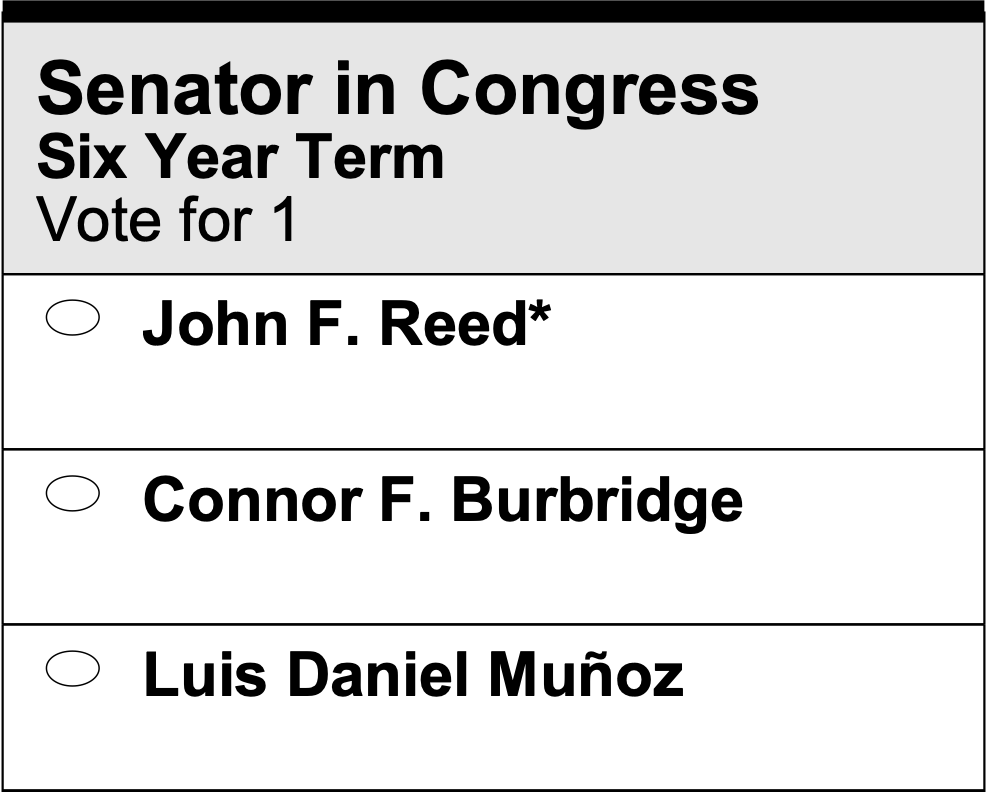
U.S. Sen. Jack Reed, who is seeking a sixth term, faces two opponents in the primary: progressive small business owner Connor Burbridge and doctor Luis Daniel Muñoz.
Reed, who has been the top Democrat on the Armed Services Committee since 2015, is endorsed by virtually every organization that endorses Democrats in Rhode Island and a wide range of elected officials. Two state legislators have endorsed Burbridge, as have a handful of other people active in Rhode Island politics.
Reed's total receipts for the election through August 20 are $4,468,935.56, including $2,798,867.41 in individual contributions; his operating expenditures are $2,804,462.42, and he has $3,093,683.60 on hand. Most of that activity is since the start of 2025.
Burbridge has raised a total of $25,189.15, including a $3,500 contribution from himself; he reports operating expenditures of $20,949.05 and $4,130.10 on hand. Muñoz, who is a past candidate for statewide office, has not filed any financial reports with the FEC except a notice of organization.
Muñoz ran for Governor in the 2022 primary and received 3.1% of the vote, finishing in last place out of five candidates. Reed won his last contested primary, all the way back in 2008, with 87% of the vote, and has consistently run ahead of other Democrats in general elections. I do not believe Burbridge has previously run for office.
The most recent Ocean State Poll conducted by UNH (Aug. 20-24, n=451, ±4.6%, weighted to ACS data) found Reed with 54%, Burbridge with 18%, and Muñoz with 2%, with 26% undecided.1 This was a weaker lead for Reed than their April poll, which had him leading Burbridge 65% to 15%, or their June poll, where Reed was up 63% to 25%. Burbridge actually led among the 18-34 demographic and among self-identified socialists, which is an option rarely seen in polling.
Another poll, by Embold Research on behalf of Salve Regina University's Pell Center2 (Aug. 3-11, n=553, weighted to registered voters), found Reed up 61% to 12%, with Muñoz at 4% and 25% undecided. I consider the UNH poll to be of higher quality.
Burbridge has a strong progressive platform, and I'm interested to see how he performs. But winning a statewide election takes more than a good platform. My rating for this race is Safe Reed, indicating that Reed is guaranteed victory. (I've never been wrong on a Safe rating before.)
Looking ahead to the general election, the Democratic nominee will face Republican Raymond T. McKay and independent Michael Bahry. My rating is Safe Democratic, reflecting that Reed will easily defeat both of them. If I'm somehow wrong about the primary, I'll reevaluate.
U.S. House, District 1
Neither party has a primary here. The general election ballot will feature Republican Kellie Keenan, incumbent Democrat Gabriel “Gabe” Amo, and independent Pedro deSouza. Amo was first elected in a 2023 special election after David Cicilline resigned from the seat. This is the bluer of Rhode Island's two congressional districts, covering Bristol County, Newport County, and northeastern Providence County; Kamala Harris won by 22% here (59.7% to 37.5%). The district more or less covers the eastern half of Rhode Island by population. My rating for the general election is Safe Democratic.
U.S. House, District 2
This is the less blue of Rhode Island's two congressional districts, covering Kent County, Washington County (a.k.a. “South County”), and western/southern Providence County. The district more or less covers the western half of Rhode Island by population. Kamala Harris won by 7% here (52.1% to 45.2%). Democratic incumbent Seth Magaziner, who served two terms as state General Treasurer before winning a hard-fought 2022 election, is unopposed in the primary. However, there is a Republican primary between surgeon Stephen T. Skoly, 70, and Marine veteran Victor Mellor, 56, with Skoly being the party-endorsed candidate. Mellor describes his vision as “Rhode Island First”, a theme that is prominent in his messaging.
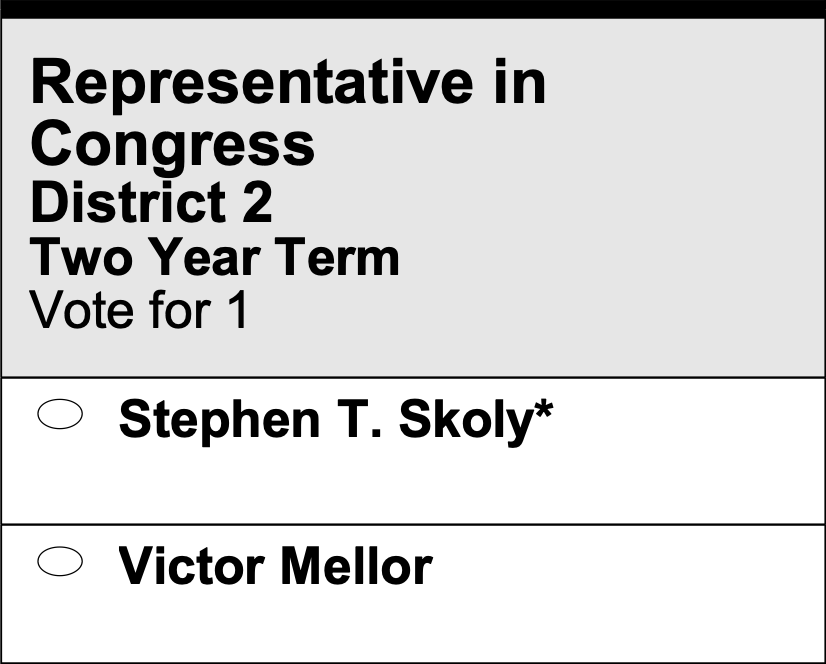
The Pell Center/Embold Research poll2 asked about this primary and found Skoly with 29%, Mellor with 22%, and 48% undecided (n=304, Aug. 3-11). Looking at FEC data from the start of 2025 through Aug. 20, 2026, Skoly has raised a total of $224,747, including loaning himself $150,000 (with all but $50 of the balance being individual contributions); he has spent $153,642.71 and has $71,104.29 on hand. Mellor has “raised” a total of $3,018,774.72, but that includes $2,195,000 in loans from himself and a further $735,333.79 in non-loan contributions from himself, leaving just $32,192.72 in individual contributions. Mellor's operating expenses total $3,841,518.42, and he has $280,079.21 on hand. At a brief glance, that didn't appear to include television ads, although I may have missed something. Mellor has made substantial radio ad buys across a large range of stations and has also appeared on some radio programs.
In a shocking turn of events, the Rhode Island Current reported that at their one debate, Mellor and Skoly sparred over “who is MAGA enough”. Skoly argued that Mellor may be “too hard-line to get elected”, while Mellor argued Skoly is “too easy”, or (in the moderator's words) too much of a “pushover”. But both candidates supported Trump's war with Iran and his withholding of funding from universities. Donald Trump has not made an endorsement in the race, to my knowledge, although he is notorious for endorsing close to the election.
Republican primaries in Rhode Island are notoriously difficult to predict and poll, and there aren't very many of them. As a general rule, I stick to predicting primaries where the winner has a chance of winning the general election, and my rating here is Safe Democratic, so I'm not rating this primary. Nevertheless, it'll be interesting to see if Mellor pulls off the victory in the primary or if Skoly is able to hold on.
Governor
Democratic
Incumbent Dan McKee faces a long-expected matchup with former CVS executive Helena Buonanno Foulkes,6 who lost the 2022 primary to McKee by about 3%. McKee was the incumbent then, but he had only previously won election as Lieutenant Governor, ascending after Gov. Gina Raimondo joined the Biden administration. McKee won that race with 32.8% of the vote to Foulkes's 29.9%, with SoS Nellie Gorbea taking 26.2% and left-wing candidate Matt Brown taking 7.9%. This time, Foulkes has a clean shot at the still-unpopular incumbent, with no other candidates on the ballot. The state party convention voted 81-75-11 in favor of endorsing McKee, but a majority of ballots (84) was required to endorse, so he failed to earn the endorsement. In my view, the close vote confirmed McKee's weakness with party insiders. Foulkes did win the endorsement of the association of city and town parties and has backing from several local parties, which does not appear on the ballot. This notably includes the endorsement of the Cumberland Town Committee as well as Cumberland Mayor Jeff Mutter; McKee was Mayor of Cumberland for twelve years, and Mutter has long been an ally of his.
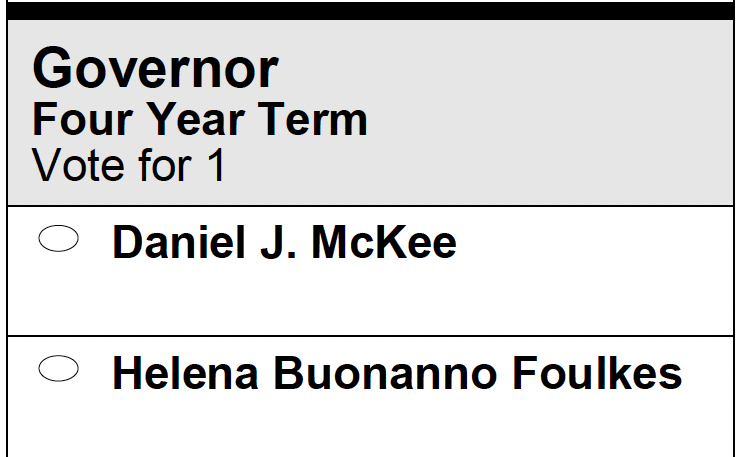
After spending much of his career at odds with unions, McKee is the choice of many in this year’s primary, including both statewide teacher’s unions (NEARI and RIFTHP) as well as the conservative AFSCME State Council 94. Foulkes has support from the more liberal SEIU Council and UNITE HERE Local 26, while the AFL-CIO is neutral. This split is a pretty big shift from past years: unions tried to knock off McKee in both the 2018 primary and the 2014 general election. Long a supporter of charter schools, McKee more recently signed into law a statewide moratorium, which likely helped him win over unions. Well, some of them, anyway.
Gov. McKee is clearly the underdog here. Of course, he defied my expectations in 2018, but as I wrote my synopsis that year (my first ever primary preview) I came to understand it was a close race. Many party institutions are either neutral or behind Foulkes, which is a problem for McKee, but less of a problem than it would be if they were all behind Foulkes. Every poll has shown Foulkes with a substantial lead, but she has only topped 50% in one poll. Of course, someone has to get over 50% in the actual results, since there are only two candidates, so Foulkes merely needs to make sure undecideds don’t break for McKee. And things have gotten worse, not better, for McKee, with time. While he has sought to bring Foulkes' record overseeing marketing at CVS under scrutiny and tie her to the opioid crisis, Foulkes has her own weapon: the Washington Bridge between Providence and East Providence, which was abruptly closed in late 2023 due to critical defects and remains closed today. Among other things, Foulkes called for the firing of RIDoT director Peter Alviti Jr. in January 2026; Alviti resigned a few weeks later. Polls show that primary voters are well-informed about both Washington Bridge and Foulkes’s handling of the opioid crisis. McKee’s problem, as Ted Nesi (“NEE-see”) points out, is that 40% of voters who disapprove of Foulkes on the opioid crisis are still voting for Foulkes. McKee doesn't fare so well with voters who disapprove of him on the Washington Bridge.
The fundraising numbers don’t add much here. Foulkes consistently outraised McKee 4-to-1 among individuals in each of the Q2 report, the 28BP (28 days before primary) report, and the 7BP report. She outspent him narrowly in Q2, 3.5-to-1 in the 28BP report, and over 5-to-1 in the 7BP report. The race has seen some outside spending, with pro-charter group Collective Action for Education spending a nominal amount ($18K) on direct mail in support of Foulkes, while conservative union LiUNA and the Democratic Governors’ Association have partnered as “Working RI Forward” to spend $100K on digital ads and $30K on direct mail backing McKee. A crypto-funded PAC, America's Future, is spending $550K on its own digital ads backing Foulkes, part of the industry's trademark strategy of spending on behalf of people who are already going to win instead of trying to actually elect pro-crypto candidates. (Reminds me of RI Right to Life…)
I spent a bit of time reflecting on what, exactly, I have to add about this race that might have been missed by others. No one worth listening to is running around saying McKee is going to pull this one off. I think the main thing I can offer is this: when Foulkes prevails on Wednesday, it won't just be because of a bridge. No, the bridge didn't help. But Foulkes has been running against McKee virtually since the day she lost to him four years ago. McKee has won many a tough race, winning the 2006 mayoral primary; the 2014 primary, the 2014 general election, and the 2018 primary for Lieutenant Governor; and the 2022 primary for Governor, with the two most recent races being within 3%. His opponents seem to have learned something from his close win last time; there’s a reason Peter Neronha and Joe Shekarchi aren’t running for governor. (Neronha has endorsed Foulkes, while Shekarchi is conspicuously neutral, even after receiving a well-publicized snub from McKee.)
Throughout his statewide career, McKee has never been particularly popular, and yet he's survived by just barely having enough constituencies in his corner. In 2018, his strength in northern cities and towns and with Hispanic voters proved decisive. For what it's worth, the Pell Center poll2 found him trailing badly not only in Providence County but also in Washington and in Bristol/Newport, which were combined. (He was only down by 1% in Kent.) The Ocean State Poll1 found Foulkes up by large margins everywhere but aggregated the northern Blackstone Valley, which includes Cumberland, with Kent County. That poll only found McKee up with a single group: 2024 Trump voters. A third poll, by Emerson College for 12 News (Aug. 21-22, n=528, ±4.2%), which found Foulkes up 45% to 30%, did find McKee leading with non-college voters and union members, but not with union households or with any group having any level of post-high-school education.3 He simply hasn't peeled off enough constituencies this time to survive, and that's a sign of Foulkes's strength just as much as it's a sign of his weakness. (I do note that we don't have polling on his strength with Hispanic voters.)
McKee has lost races before. In 2004, he lost renomination for Mayor of Cumberland to David Iwuc by a 10% margin. He mounted a write-in campaign in the general election, but Iwuc took 62% of the vote to 38% for write-ins. However, McKee went on to comfortably win their 2006 rematch. (I'm curious to see how Cumberland votes, but I wouldn't treat it as too much of a bellwether.)
Prominent races like this don't tend to change on a dime. This is not a close race; it looks more like a Foulkes blowout than a nail-biter. About the only thing that’s gone right for McKee is that he will appear above Foulkes on the ballot. My rating is Likely Foulkes, and I think there’s a decent case it’s actually Safe. (I correctly had McKee as a slight favorite in 2022 but incorrectly thought he’d lose to Regunberg in 2018.)
Republican
Republicans also have a primary. 2022 Lieutenant Governor nominee Aaron Guckian, who was closest to a statewide win for Republicans that year, is the party-endorsed candidate and frontrunner. He faces Elaine Pelino for the nomination. (Guckian has had a varied career, while it is unclear to me what Pelino's occupation is.)
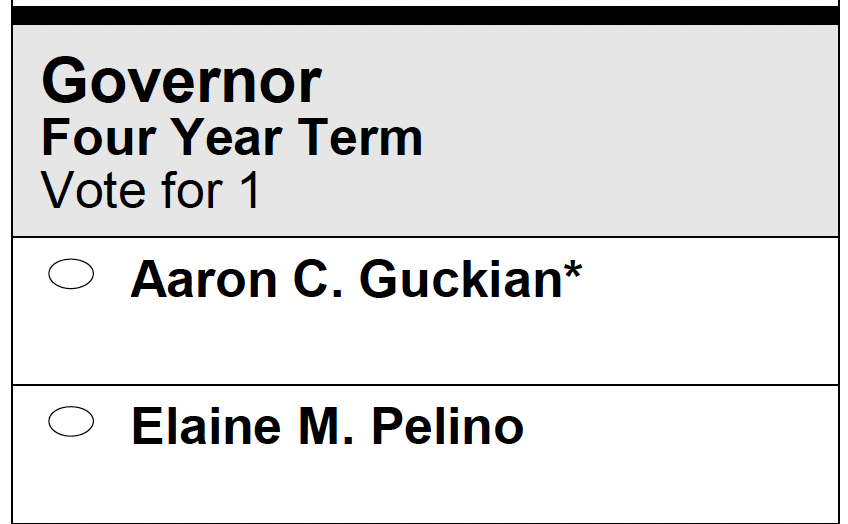
Guckian has led by a wide margin in spending, but fundraising has been closer in the home stretch. In Q2, he raised $9.1K from individuals to Pelino's $2.1K and spent $61K to Pelino's $2K. In the 28BP filing, he raised $4,489.59 from individuals to Pelino's $8,929.52 and spent $18,490.84 to her $1,574.51. Finally, in the 7BP filing, he raised $13,263.45 from individuals to her $5,266.37 and spent $16,906.09 to her $3,406.86. The fundraising is close enough that I don't think it's determinative, but the spending could be.
The Pell Center poll2 did ask about this primary and found Pelino with 37%, Guckian with 17%, and 44% undecided (n=304, Aug. 3-11). Even if Pelino does win, I'd be surprised if she won by 20%, but as previously mentioned, Republican primaries in Rhode Island are notoriously difficult to predict. A big part of this is low turnout. In 2022, only 15% of gubernatorial primary ballots (21,193 of 136,576) were Republican, even though Republican nominee Ashley Kalus went on to receive 39% of the general election vote.
Because neither Republican would be competitive, I am not rating this primary.
General election
Nine independents originally filed, but only three actually turned in the 1,000 signatures required to appear on the general election ballot. (This is the same number required for party candidates to appear on the primary ballot.) Businessman Ken Block is by far the most prominent and will appear third on the ballot, immediately after the party nominees, which doesn’t exactly hurt. (The other candidates are Jasjit S. Gotra and C.D. Reynolds.) Block, a businessman, raised $133K from individuals in Q2 and spent $53K, ending with $91K on hand, although his campaign owes him over $1M in debt from his previous campaigns. For comparison, Gotra had $692.19 on hand as of June 30, and Reynolds has several overdue filings.
Block regularly gets media attention, but I don't believe he's ever even won an election or nomination. In 2010, he was the Moderate Party nominee for Governor of Rhode Island, placing fourth (behind the party candidates and independent Lincoln Chafee, who won). In 2014, he ran for the Republican nomination, losing to Cranston mayor Allan Fung by a 10% margin.
I did note above that the last time Dan McKee lost a primary, he waged a write-in campaign in the general election. That general election ballot had only one name on the ballot, that of his primary opponent. I don't think McKee is foolish enough to try the same feat in a statewide race with five names on the ballot. Perhaps more importantly, if he were, those parts of the party infrastructure that have backed him or remained neutral thus far would almost certainly mobilize behind Foulkes, leaving him with no base of support.
Given Block’s political views, I imagine he may hurt the Republican nominee more than the Democrat. However, he may be able to effectively take advantage of the weaknesses of either McKee or Foulkes in his campaign. General election polling has been limited so far, and partisans tend to consolidate behind their party's nominee, but it is worth noting that what polling we do have suggests that if McKee somehow wins renomination, Block would be in serious contention. While I'm certainly watching the race, the general election starts at Safe Democratic, in part because McKee is so unlikely to win the nomination, and in part because independent statewide candidates usually lose ground over the course of a campaign, rather than catching fire.
Lieutenant Governor
![Sample ballot for the Democratic gubernatorial primary. The English heading reads “Lieutenant Governor | Four Year Term | Vote for 1”. The Spanish heading reads “Vicegobernador | Periodo de cuatro años | Vote por [uno]”. The options are, in order, “Sabina Matos”, “Susan AnderBois”, “Ross McCurdy”, “Cynthia Armour Coyne”, and “Xaykham Rexford Khamsyvoravong”.](https://storage.ghost.io/c/fc/f0/fcf0397a-be45-44af-ab11-740e2116f083/content/images/2026/09/LG-sample-bilingual.png)
Finally, we reach a Democratic primary with genuine uncertainty. Incumbent Sabina Matos, who McKee appointed in 2021 after ascending, faces several challengers. In 2022, Matos, a former Providence City Council President, went on to win the three-way primary with 47%, ahead of 33% for then-Rep. Deborah Ruggiero and 20% for then-Sen. Cynthia Mendes. Note that the City Council chooses the President from among its members, so Matos was never elected citywide.
Matos ran in the 2023 special election to succeed U.S. Rep. David Cicilline, but her campaign was derailed by a scandal regarding fraudulent nomination signatures and she ended up receiving just 8% of the vote. My understanding is that her reputation has yet to recover, but I don't think she's in quite as much trouble as McKee. After all, Rhode Islanders don't have to drive across nomination papers to get to work. In ballot order, her challengers for the nomination are: Providence City Council member Sue AnderBois; Ross McCurdy, who ran in the 2022 general as an independent; former State Sen. Cynthia Armour Coyne; and Newport Mayor Xaykham “Xay” Khamsyvoravong (pronounced “sigh”). None of the challengers, aside from McCurdy, have run statewide before. Note that Newport's City Council elects one of their number as mayor; all council candidates run together citywide for the same set of seats. Coyne’s district, SD 32, covered Barrington and parts of Bristol and East Providence. AnderBois represents Ward 3, one of fifteen wards in Providence.
At the state party convention, 162 ballots were cast; Khamsyvoravong received 71 votes to 55 for Matos, 15 for AnderBois, and 13 for Coyne, with eight abstentions. Again, the state party thus failed to endorse anyone (82 votes were needed). Polling has shown a close race between Matos and Khamsyvoravong, and the latter has an impressive list of endorsements from party organizations. Progressives who have taken a stance are mostly behind AnderBois (Marcia Ranglin-Vassell, Steve Ahlquist, Brandon Potter), with Khamsyvoravong having won over AG Peter Neronha and Josh Miller. A number of moderate and conservative Democrats also back Khamsyvoravong. At least eight unions, including NEARI, the AFL-CIO, the progressive SEIU Council, and the conservative Council 94 and BCTC, are backing Matos, with the only union endorsement for Khamsyvoravong that I’m aware of being RIFTHP.
If I didn’t have any polling, my expectation would be Matos winning with under 40% support, with Khamsyvoravong coming closest to her. That said, we do have some polling, with all three of the previously mentioned polls asking about the race.
| Candidate | UNH | Pell | 12 News |
|---|---|---|---|
| Matos | 20% | 18% | 20% |
| AnderBois | 8% | 8% | 8% |
| McCurdy | 2% | 4% | 4% |
| Coyne | 5% | 2% | 9% |
| Khamsyvoravong | 22% | 16% | 18% |
| Undecided | 42% | 48% | 43% |
While Khamsyvoravong is quite close to Matos in the polling, what's most notable is that over 40% were undecided in all three polls. It is also unclear if any poll asked about the candidates in ballot order. That said, it's nice to have polling at all; I don't believe the 2018 primary for Lieutenant Governor had a single public poll.
As for the fundraising, in Q2, Khamsyvoravong raised the most from individuals, at $116K; Coyne raised $62K and AnderBois raised $58K, with Matos raising the least from individuals, at $24K. (Well, the least aside from McCurdy, who has raised and spent virtually no money and is not a serious candidate.) Khamsyvoravong also led in spending, at $57K, with Matos and AnderBois effectively tied around $42K and Coyne at $29K. In the 28BP report, Khamsyvoravong was significantly more dominant, raising $54K from individuals and spending over $214K. The other candidates combined raised $43K from individual contributions and spent $177K during that period, with Matos raising $14K from individuals and spending $40K.
Finally, looking at the 7BP filing, Khamsyvoravong again raised more from individuals than the other four candidates combined ($37.6K versus $35.2K), but did not raise more overall due to substantial PAC support for Matos. AnderBois was the second-best individual fundraiser, at $19.2K, with Matos and Coyne both under $10K. He spent $206K to $100K from Coyne, $96K for AnderBois, and $38K for Matos. Both Khamsyvoravong and AnderBois ended the period with $11-13K in the bank, while Matos and Coyne both had $24-26K left.
Television advertising has been limited to Khamsyvoravong and Coyne. Both of them have run Facebook ads, with AnderBois recently joining. Khamsyvoravong appears to be the only candidate running ads on Google/YouTube. Matos has no advertising on any of those platforms.
Outside spending has been limited to the federal Democratic Leadership PAC, which is principally funded by the Democratic Lieutenant Governors' Association and is backing Matos. The PAC has spent $50,443.35 on direct mail and $49,999.06 on radio ads, for a total of $92,035.81. Khamsyvoravong recently called for Matos to denounce DLP's support, noting DLGA has received contributions from “pharmaceutical companies, a private-prison company involved in President Donald Trump’s ICE detention infrastructure and Big Tech”, specifically pointing to Amazon as well as an obscure logistics company.
While it's impressive that Khamsyvoravong is polling even with the incumbent, the undecideds are the big question here. His strength with party insiders and elected officials may not translate to strength with undecided voters. And unlike the gubernatorial race, there are four challengers here. My gut sense is that, even without the party endorsement, undecided voters may break towards the incumbent. It also helps Matos quite a bit that she literally won the lottery – the ballot placement lottery, that is.
There's one other glaring thing. All three of the public polls were conducted in English only, even though Rhode Island has a substantial Hispanic population and provides bilingual ballots in four major cities, as seen above. Matos is the only Hispanic candidate and is, according to Wikipedia, the first Dominican-American elected to statewide office in the United States. In the 2022 primary, she received roughly 80% support in HDs 11 and 12, which are majority-Dominican, and also received over 70% in Central Falls, which is majority-Hispanic but isn't very Dominican. These are all places with bilingual ballots and substantial Spanish-speaking populations. Matos herself spoke no English when she moved to the United States at the age of 20. While no candidates have run ads on the local Telemundo affiliate, Matos placed an ad buy on WKKB (Latina 100.3 FM), which I thought was particularly notable given she isn't running television ads, unlike Khamsyvoravong and Coyne.
My rating for this race is Tilt Matos. (I correctly had Matos favored in 2022, although I was surprised by her margin of victory.)
Republicans have no primary here; former State Rep. John Loughlin II, who lost the 2010 RI-01 open-seat election to David Cicilline by 6%, is considered one of their better hopes to break through in the general election. Out of caution, this is Likely Democratic to start, although I'm quite skeptical that this will be the year Republicans finally win statewide office again.
Secretary of State
For Secretary of State, incumbent Gregg Amore has no opposition whatsoever after Anthony Tamba failed to make the primary ballot. Incredibly, no Republican or independent even filed, making this the first completely uncontested statewide general election in several years, and the first completely uncontested statewide race (including the primary) in…I’m not sure how long. Uncontested Amore for both the primary and general election.
Attorney General
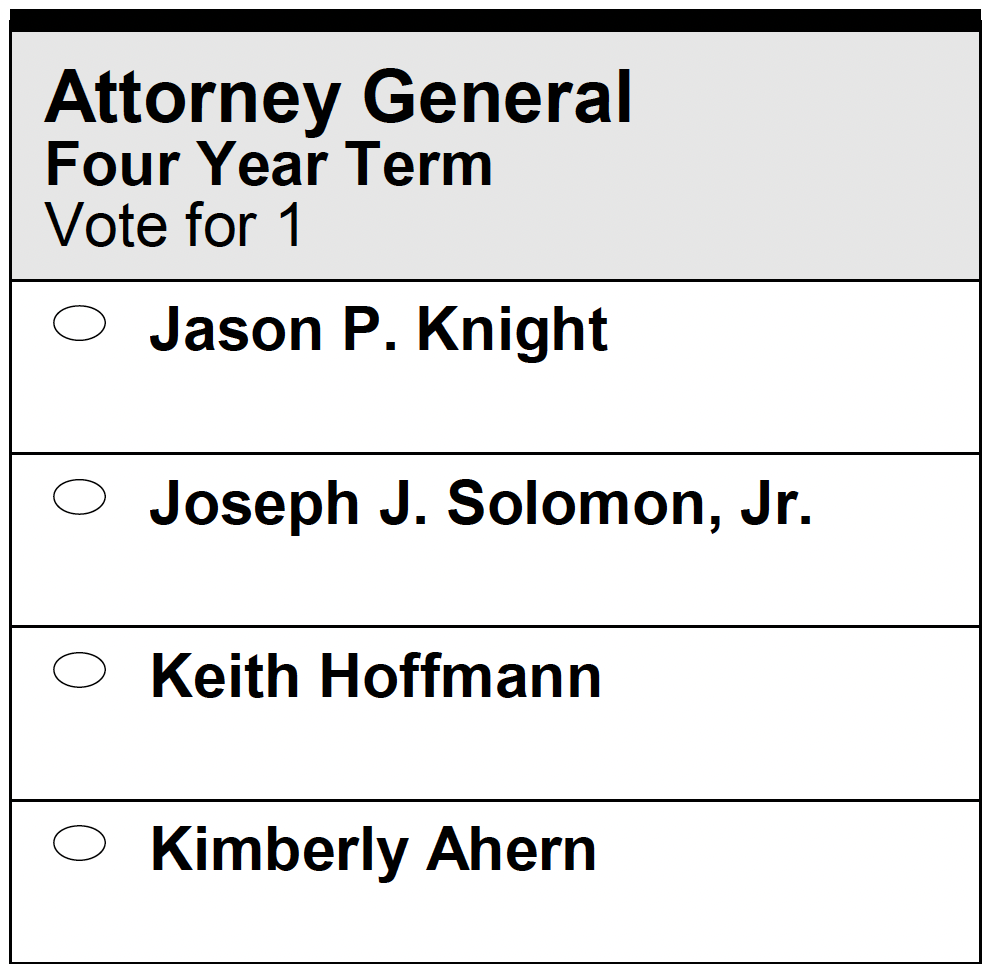
For Attorney General, incumbent Peter Neronha, whom I regard as progressive and quite like, is term-limited. There's a hotly contested primary to succeed him, in contrast to 2018, when Neronha had no opposition for the open seat. There are four Democrats running here: in ballot order, they are Jason Knight, Joseph Solomon Jr., Keith Hoffman, and Kim Ahern. Neronha has endorsed Hoffman, who oversaw policy under Neronha until recently; Hoffman also has the support of SEIU 1199NE, RIFTHP, IUPAT 11, and U.S. Sen. Elizabeth Warren. Ahern, a former prosecutor who chaired the Cannabis Control Commission until 2025, has the backing of UNAP, a couple other unions, and EMILY's List; her tenure at the Commission, during which not a single retail store was approved, has come under scrutiny in the race. Knight and Solomon, who are both state representatives, round out the field. Solomon, who represents part of Warwick, is the conservative here, winning support from conservative and moderate Democrats at the State House, mainly in Warwick, as well as Warwick Mayor Frank Picozzi (who is not a Democrat) and several unions, although most of them are police unions.7 Knight, who represents parts of Warren and Barrington, is regarded as a progressive and has been endorsed by various progressives at the State House, although there are also many backing Hoffman and a few backing Ahern. The state party hasn't endorsed; Solomon got 73 votes at the convention to 42 for Ahern, 22 for Hoffman, and 12 for Knight, with 10 abstentions (80 votes were needed). I for one am thankful Solomon fell short.
| Candidate | UNH | Pell | 12 News |
|---|---|---|---|
| Knight | 7% | 5% | 9% |
| Solomon | 12% | 10% | 14% |
| Hoffman | 20% | 13% | 18% |
| Ahern | 16% | 23% | 24% |
| Undecided | 46% | 46% | 35% |
We have some polling, which indicates a close race between Ahern and Hoffman, but with no candidate polling over 30% and a large share still undecided. Solomon is in third and Knight in last in all three polls. As the only woman, Ahern could do well with undecideds who haven’t been following the race closely.
Looking at fundraising, Ahern and Hoffman also lead. Since April 1, Ahern has raised the most from individual contributions, with Hoffman in second, while Hoffman has spent the most, with Ahern in second. This has been fairly consistent across filings, but full details are available in the appendix. (Also of note, all four candidates' campaigns owe the candidate at least $100K.)
Since these are the same polls as before, the English-only issue remains, but I think it's a bit harder this time to guess who will benefit. I did check FCC records for television ad buys on Telemundo's affiliate, WRIW-CD (Channel 51). Hoffman is the only candidate for state office who has run any ads there, purchasing hundreds of 30-second spots, although they only began running in late August. Hoffman also placed a radio ad buy on WKKB (Latina 100.3 FM) for several 60-second spots, which began earlier in August; no other AG candidates are running ads there.
All four candidates have run English-language television ads; as reported by the Current, Hoffman has placed the most. Hoffman, Ahern, and Solomon have all run ads via Google/YouTube, although Hoffman and Solomon curiously excluded younger voters from their targeting, with only Ahern including all adults. All four candidates have run Facebook ads. No outside spending had been reported on the RI Board of Elections website as of close of business Friday, September 4.
I rate this Tossup Ahern/Hoffman, but I’m still watching Solomon closely. There are several factors that could be decisive, some of which point to Hoffman and some of which point to Ahern. I reserve the right to update this until the end of Tuesday with a Tilt rating, especially if there are major developments, such as a new poll, one of the trailing candidates dropping out, or a large outside expenditure not yet reported.
Republicans do have a nominee here, Alan Gordon, who the state party notably did not endorse. Gordon lost the two-way 2018 general election to Peter Neronha, who was not yet the incumbent, by a 60% margin, but Gordon was the nominee of the pro-marijuana, er, I mean pro-cannabis Compassion Party that year. While he should do a bit better on the Republican line, I don't expect the general to be competitive; my rating is Safe Democratic, and I do not anticipate reevaluating that.
General Treasurer
There's no primary for Treasurer, where incumbent James Diossa will face Republican Micholas Credle in the general. Diossa won narrowly in 2022, when some unions opposed him not only in the primary but in the general election, but he should be in better shape this year, having already been endorsed by the AFL-CIO and NEARI. The 2022 Republican nominee, James Lathrop, raised over $14,000 in Q2, ended Q2 with over $16,000 on hand, and was able to self-fund to an extent; Credle's filings, which appear not to properly report his donors, indicate he had $186.78 on hand at the end of Q2 after raising $2,050 and spending $2,071.61 in Q2. For comparison, Diossa raised $46,671.18 in Q2, spent $61,106.07 and had $342,330.37 on hand. I rate the race Safe Democratic to start but will monitor any developments carefully.
Please subscribe or send me a tip if you found this valuable. If you've read this to the end, I'd especially appreciate a paid subscription.
Appendix: Detailed Financial Data
This is my first time trying to embed a Google sheet, so I wouldn't be surprised if this doesn't work very well, which is why I've also linked to the data directly.
28 days before primary (or see separate webpage):
7 days before primary (or see separate webpage):
Appendix: Poll Details
1 Ocean State Poll conducted by the University of New Hampshire Survey Center Aug. 20-24, likely general election voters, n=750 (451 for Dem. primary), English only, margin of error ±3.6% (±4.6% for Dem. primary), design effect ±2.2%. Weighted by sex, age, education, and region based on “most recent” American Community Survey data (presumably 2020-2024 or 2024 1-year); party registration via RI SoS; and 2024 election results. Members of the 2,300-member online Ocean State Panel were invited to complete the survey, and 583 did so; 268 non-panelists invited via text message also completed the survey. (The total sample was 851, of whom 750 were likely general election voters.) Results are here for Governor and here for U.S. Senate. UNH has a B- rating from the Silver Bulletin and a predictive plus/minus of +0.57, which is fairly average. The poll bears the logo of one major polling transparency initiative, AAPOR, in its header. It is unclear whether responses were randomized, presented in ballot order, or presented in a fixed order that was not ballot order.
2 Salve Regina University poll conducted by Embold Research for the University's Pell Center Aug. 3-11, likely primary voters (both Democratic and Republican), n=857 (553 for Dem. primary), modeled margin of error ±3.6%. Seemingly English only. This poll randomized candidate order, which is not consistent with how Rhode Island elections work. It was weighted by “age, gender, ethnicity, education, region, and 2024 presidential vote” using “available voter file data”. It is not clear what source was used for ethnicity and education data, which is not present in the state-maintained Rhode Island voter file. “Respondents were recruited via dynamic online sampling, and SMS text-to-web sampling to attain a sample reflective of the electorate.” The poll was directed by Pell Center Associate Director and Fellow Katie Sonder. I am not familiar with Embold Research, and they are not rated by the Silver Bulletin. They appear to be affiliated with Change Research, and their poll has an AAPOR methodology statement and provides crosstabs. The New York Times does not regard Embold Research as meeting its standards for a “select pollster”, unlike Emerson College and UNH, likely due to newness and lack of probability-based sampling.
3 12 News poll conducted by Emerson College Aug. 21-22, n=1,000 likely general election voters (528 Dem. primary), text-to-web and online panel, “credibility interval” ±3% (±4.2% for Democratic primary). English only. “The data sets were weighted by gender, education, race, age, party registration, and region based on U.S. Census parameters and voter file data. […] Data was collected by contacting registered voters from a voter file provided by Aristotle using MMS text-to-web, and panel interviews provided by PureSpectrum.” Transparency unclear, but Emerson is a well-known pollster. Emerson has an A rating from the Silver Bulletin and a predictive plus/minus of -0.61 (negative is good). Results are here for governor and here for other races.
4 Mattiello won power in 2014 after his more liberal predecessor, Gordon Fox, was dethroned by…the FBI and IRS. Don’t divert your campaign funds for personal use, kids!
5 The vote was actually 59-9-4 with three absences, but all three absent representatives, including Republican Barbara Fenton-Fung, wrote letters indicating they would have voted for Shekarchi.
6 Records differ as to whether the last name is “Buonanno Foulkes” or just “Foulkes”, but media generally refer to her as “Foulkes”, a pattern I have followed.
7 Solomon's late father served several terms on the Warwick City Council (representing one ninth of the city). Solomon Sr. then won a single term as mayor of Warwick in 2018 before losing to Picozzi in 2020.
Edits: Corrected a typographical error referring to Ken Block as a “business” rather than a “businessman”, 2026/09/19.