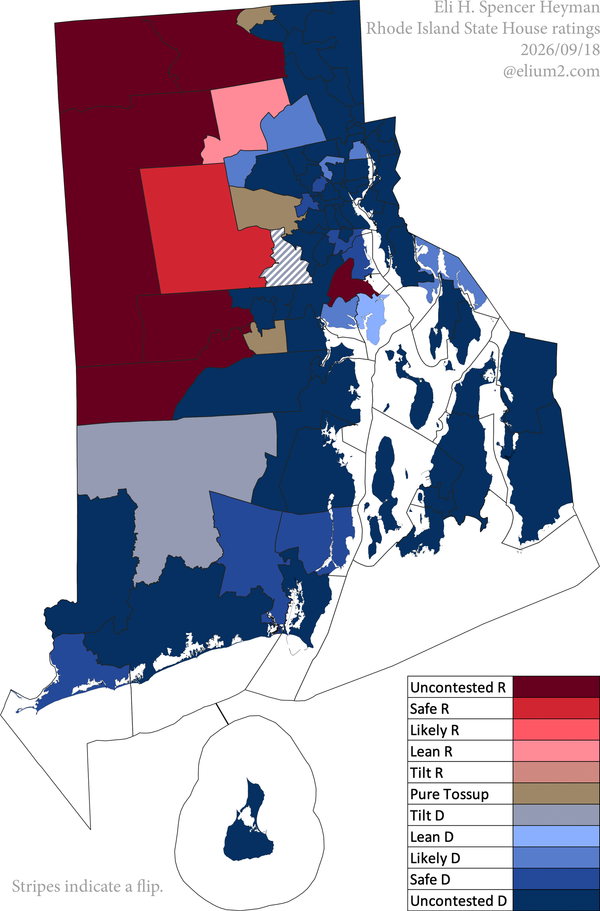
RI State Senate primary preview, 2026
My overview of every 2026 State Senate race in Rhode Island!

For an overview of the state of politics in Rhode Island, see my previous post.
There aren't too many contested races for the State Senate this year, with a mere six primaries and six general elections. Even 2024 was significantly busier, in part due to retirements. This year, all thirty-eight state senators are seeking reelection. Most of the primary challenges here are from the right, with just a single primary challenger who is clearly to the left of the incumbent.
Here, I provide previews for all eleven contested districts (SD 5 has both a primary and a general), plus a couple of bonus writeups about district party committees. Each district writeup includes a geographic, racial, and ethnic breakdown. Demographic statistics are five-year estimates from the U.S. Census's American Community Survey for the 2020-2024 period, except that the population share a municipality contributes to a district is based on the 2020 decennial census. For ancestry data, I have aggregated the specific ancestry “African-American” with “Black or African-American, specified” (where the specification is not actually present in the provided data) as well as “Black or African-American, unspecified”.
There are more tossups in here than I'd like, and I reserve the right to update my ratings until polls close at 8:00 p.m. Any such edits will be noted at the bottom. If you're not subscribed yet, I'd appreciate a subscription, either paid or free. One-time tips are also welcome.
Table of Contents
- Senate District 5
- Senate District 8
- Senate District 13
- Senate District 14 (General)
- Senate District 15
- Senate District 17 (General)
- Senate District 18 Committee
- Senate District 19
- Senate District 30 Committee
- Senate District 33 (General)
- Senate District 34 (General)
- Senate District 36
- Senate District 38 (General)
- Appendix: Fundraising and Endorsement Data
Senate District 5
![The heading says “Senator in General Assembly | District 5 | Two Year Term | Vote for 1” and then, equally large, “Senador en la Asamblea General | Distrito 5 | Periodo de dos años | Vote por [uno]”. The options are “Samuel W. Bell” (asterisked), “Theodore Newcomer, Jr.”, and “Cameron Moquin”.](https://storage.ghost.io/c/fc/f0/fcf0397a-be45-44af-ab11-740e2116f083/content/images/2026/09/SD-5-sample.png)
SD 5 is located in northwestern Providence, covering all of Federal Hill and parts of Mount Pleasant, Elmhurst, Valley, Smith Hill, and the West End. The district is 42% non-Hispanic white, 41% Hispanic, and 11% non-Hispanic Black; however, narrowing to adult citizens, it's 57% white and only 26% Hispanic. Of about 33K residents, the top ancestries here are Dominican (4.3K), Guatemalan (4.2K), unspecified Black/African-American (4.0K), Irish (3.2K), and Italian (3.1K). Sam Bell, a democratic socialist1 who was first elected in 2018, faces two primary challengers, Theodore Newcomer Jr. and Cameron Moquin. All three candidates are white. Bell has a strong record against more prominent challengers, crushing Jo-Ann Ryan in 2020 and comfortably defeating David Salvatore in 2022 (both were Providence City Council members); Bell also ousted an incumbent in his narrower 2018 victory.
In both 2020 and 2022, I correctly had Bell favored to win renomination.
Bell was a consistent, if sometimes lonely, critic of Senate leadership under Ruggerio, but he notably voted for Valarie Lawson in last year's election for Senate President. The state party has endorsed Bell, who controls the district committee now, and he has substantial union support, with the AFL-CIO, NEARI, and AFSCME/AFL-CIO Council 94 endorsing him. (Only Council 94 backed him in 2022.) Bell also retains support from various progressive issue organizations, although Reclaim and the WFP have both conspicuously declined to back him this time. Moquin, a firefighter, is partly self-funded and has the backing of the Providence firefighters’ union, as well as Providence City Council President Rachel Miller; the Globe's Dan McGowan observes that a recording of Bell criticizing Miller was recently released. Moquin’s stated beliefs are generally progressive, although his website bears signs of AI use. Newcomer, who is more right-wing, has the backing of just a single group, LORIB.
LORIB? Who is LORIB?
I’m so glad you asked. The League of Rhode Island Businesses has made a lot of headlines. When all is said and done, there may have been more words written about them than votes received by their candidates. Their stated goal is to support “common-sense principles” (gee, where have I heard that one before?) like a balanced budget, lower truck tolls, and lower taxes – in other words, they’re classic Rhode Island conservatives. They formed in response to the 2025 assault weapons ban, and their candidates are all anti-gun control. The League is most notable for having forty PACs, one statewide and one in each city in town, which it openly admits is done to exploit a loophole in campaign finance law allowing each PAC to max out to its favored candidates; the scheme allows donors of up to $9,900 to stay anonymous. I think this is too clever by half, and their spending and recruitment simply has not kept pace with their self-declared strength. Some of their candidates have more of a chance than others, and they'll all be addressed in turn.
If for some reason you'd like to read more than a single paragraph specifically about LORIB, the Current article linked in the previous paragraph is a good in-depth look.
Back to SD 5
I've long considered Bell a smart politician. Yes, he supports Medicare for All, but his main focus in office and his campaigns has been more tangible: reversing Medicaid cuts made under Gov. Raimondo. (He made significant progress on this, but the most recent budget made new cuts.) He also can boast that in March 2023, before Washington Bridge even closed, he was the only senator to vote against the reappointment of RI DoT director Peter Alviti, who resigned earlier this year over the bridge issue. Alviti was also a major supporter of the unpopular, developer-driven push to move the state bus hub out of Kennedy Plaza.
Looking at fundraising, Bell led Moquin comfortably in Q2 in both individual contributions and expenditures; Newcomer had yet to declare. In the 28BP filing, Bell slightly led Newcomer in spending and trailed him 3:1 in fundraising, with Moquin in a distant third in both. In the 7BP filing, Bell actually raised the least from individuals but led Newcomer 3:1 in spending and led Moquin 37:1 (yes, really). I was going to put a table here but it messed with the margins on mobile, so you can view my separate sheets linked in the appendix. Hopefully I'll figure it out soon enough. No outside expenditures have been reported in this race.
I would be quite surprised if Bell loses. I simply don't think Moquin has done enough to outperform him with progressives, nor do I think Newcomer will be able to surpass both of them. But it takes a lot for me to rate a race safe, and this one’s not quite there. My rating is Likely Bell. I'll certainly be watching the results to see if Bell again demonstrates political strength or appears to be more vulnerable going forward. There should be 1,380 early ballots and 453-722 mail ballots here.
SD 5 also has a general election, with the Democratic nominee facing repeat Republican nominee William Connell Jr. Regardless of who wins the Democratic primary, this is a Safe Democratic seat.
Senate District 8
![The heading says “Senator in General Assembly | District 8 | Two Year Term | Vote for 1” and then, equally large, “Senador en la Asamblea General | Distrito [ocho] | Periodo de dos años | Vote por 1”. The options are “Lori Urso” (asterisked) and “Gena Felix”.](https://storage.ghost.io/c/fc/f0/fcf0397a-be45-44af-ab11-740e2116f083/content/images/2026/09/SD-8-sample.png)
This district covers over a third of Pawtucket, in the city’s northeast. 61% of the adult citizen population is non-Hispanic white, 18.5% is Hispanic, and 16% is non-Hispanic Black; the total population is just over 50% NH white. Of roughly 29,000 residents, the top ancestries here are unspecified Black/African-American (5.9K), Irish (3.6K), Cape Verdean, English, and Portuguese (each 2.4K), Puerto Rican (2.3K), and French (2.2K); other meaningful Hispanic populations include Guatemalan (1.6K) and Colombian (1.4K), with Dominicans barely topping 1K. Immediately after winning the 2024 primary, in a classic Rhode Island development, Sen. Sandra Cano announced she was resigning from the State Senate to pursue an unspecified new career opportunity, which turned out to be with the Small Business Administration.2 The state party scrambled to fill the nomination, choosing Lori Urso, who easily won the general election. Urso voted for Sen. Lawson as Senate President, and while not an ideological conservative, she has been very aligned with the party establishment. Urso, who has the party endorsement, faces a challenge from nurse Gena Felix, the sister of progressive Rep. Leonela Felix, also of Pawtucket. In general, candidates who haven't had to face serious competition before tend to be weaker, and Urso is certainly in that category. The [Blackstone] Valley Breeze provided both candidates with an opportunity to make their cases to voters, and the Current previously wrote up the race. Urso outlined a focus on expanding health coverage (especially maternal coverage) and revitalizing Main Street, while Felix pointed to various issues, like data centers and housing insecurity.
Urso's ancestry is not immediately clear to me, although she is white, while Felix is the daughter of Dominican immigrants. Cano, for what it's worth, is a Colombian immigrant from Medellín.
I considered this more or less a tossup to start. A couple outside groups are involved here with independent expenditures (IEs). Reside & Thrive, a 527 controlled by the Rhode Island Builder's Association, has spent $5,601.43 on pro-Urso mail, and Planned Parenthood Votes! RI (PPVRI) has spent $2,065.58 on pro-Urso mail; no pro-Felix IEs have been reported. PPVRI usually refrains from direct independent expenditures, instead contributing to the RI Values Project, a joint effort with the RI Coalition Against Gun Violence (RICAGV) and the SEIU 1199NE healthcare workers' union. However, RICAGV is backing Felix, while PPVRI is backing Urso, so the Values Project left this race out of their spending.
Urso also has several union endorsements, while Felix has climate group Lead Locally, the PVD Streets Coalition, the Working Families Party, and left-wing pro-housing group Reclaim on her side. Fundraising and spending from the candidates have been highly competitive, with Felix actually slightly outspending Urso since April 1, while Urso has led in individual fundraising by a meaningful margin but less than 2:1. Considering Urso had $50K on hand to Felix's $3.9K as of Sept. 1, if Urso loses, she's certainly going to have some regrets.
This is a tough one, and I'm rating it a Pure Tossup; I suspect it'll be close either way. There should be 591 early ballots and 240-389 mail ballots here.
This is a safe blue district, but no Republican or independent made the ballot this year, unlike recent cycles. Either Democrat can look forward to an Uncontested Democratic general election.
Senate District 13
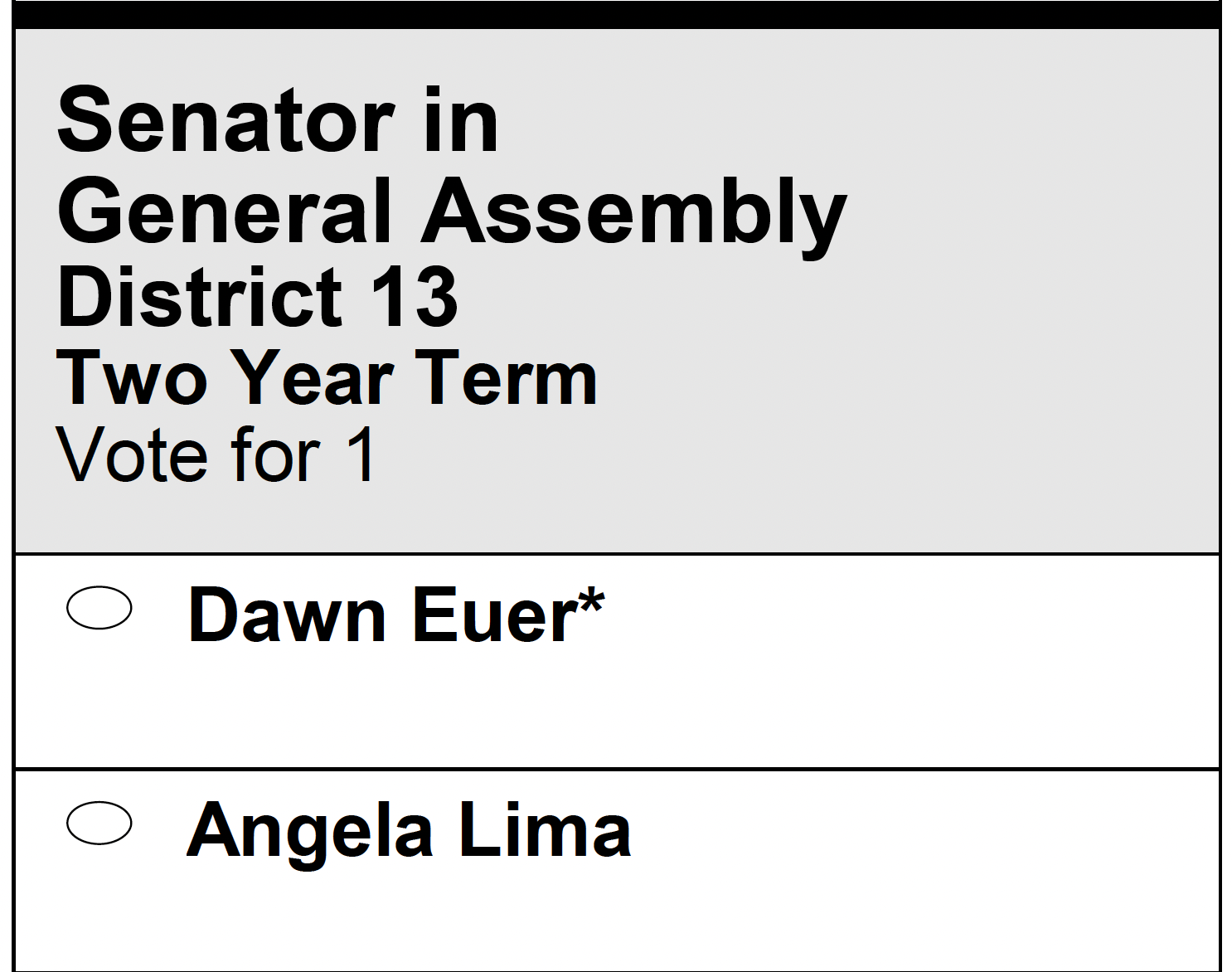
This district includes 90% of Newport (80% of the district) and all of Jamestown (20%). The district is 79% non-Hispanic white by total population, rising to 84% for adult citizens. Of an estimated 27.5K residents, the top ancestries are Irish (6.7K), English (3.5K), Italian (3.1K), German (2.6K), and unspecified Black/African-American (2.4K); the largest Hispanic ancestry is Puerto Rican (1.4K) by a long shot. Sen. Dawn Euer, 47, who is generally considered progressive, faces a challenge from Angela Lima, 45. Euer voted for Ryan Pearson for Senate President and has the party endorsement. LORIB was seeking a challenger here; instead, we have Lima, who is running as a leadership-aligned progressive. There is also a lone non-endorsed candidate for the district committee. The Current's Nancy Lavin wrote up the race.
Euer was first elected in a 2017 special election, succeeding conservative former Senate President Teresa Paiva-Weed. She won the July 18 special primary with 47%, defeating three other candidates by a large margin, including the party-endorsed candidate. She has never faced a contested regularly scheduled primary until now, although the Co-Op briefly announced a planned challenge to her that, uh, didn't pan out, to put it mildly. Euer was close to leadership for most of Ruggerio's tenure, serving as Environment Committee chair for the 2021-2022 session (during which the General Assembly passed the Act on Climate) and as chair of the Judiciary Committee for 2023-2024. However, Euer backed Ryan Pearson's challenge to Ruggerio in the 2025 caucus elections held in November 2024, and she conspicuously was removed from her chairship afterward. She has remained aligned against leadership since then. Her other major legislation includes the Let RI Vote Act and a shield law for reproductive and gender-affirming healthcare.
Lima was elected three times to the Newport City Council for Ward 1 under the name Angela McCalla, including winning contested races in 2018 and 2020, both by comfortable margins. She currently oversees government relations for the Women’s Fund of Rhode Island. She was the city's first openly queer councilmember and its second councilmember of color (she is Black and Asian), and the Current notes she bought her home with assistance from RIHousing. She contends that she better represents the district's population and that Euer is unresponsive. Euer, who is white, counters that she's been working for her constituents; the Current notes she still has outstanding student loan debt. As mentioned in the demographic statistics, the district is overwhelmingly white, and Euer and Lima are very close in age.
Looking at endorsements, Euer is backed by PPVRI, RICAGV, Climate Action RI (CARI), and the SEIU Council, which is generally the state's most progressive union. Lima is backed by the LGBTQ+ Victory Fund, the AFL-CIO, and the Building & Construction Trades Council (BCTC). I don't systematically track endorsements by individuals, but the Current points out that Euer is the only state legislative candidate backed by Attorney General Neronha.
I particularly appreciate that Lavin, the Current writer, pressed both Lima and the AFL-CIO on labor issues. Lima was unable to respond specifically to a question about the state's charter school moratorium, and AFL-CIO president Patrick Crowley merely offered a general statement that Lima was aligned with their values, refusing to be more specific. I'm not a reporter, so I'll say what Lavin can't: it's clear the labor backing for Lima is a reaction to Euer falling out with Senate leadership. (Lavin does quote Euer saying essentially the same thing.)
I could not find coverage of the race in the Newport Daily News, but the Jamestown Press wrote up Lima's announcement back in May, including quotes from both Lima and Euer. Looking at candidate fundraising, Euer and Lima were essentially tied in individual donations in Q2, but Lima had a 2:1 spending edge, even ignoring a substantial in-kind contribution. In the 28BP filing, Euer had a 2:1 individual fundraising edge, but Lima maintained her 2:1 spending edge. Finally, in the 7BP filing, Euer had a small fundraising edge and led nearly 4:1 in spending; she ended with $60K on hand to Lima's $11K. Overall, Lima leads narrowly in spending plus in-kind contributions since April 1, with $22K to $18K for Euer.
The race has also seen outside spending, with the aforementioned progressive RI Values Project spending $3,967.19 on mail and $1,346.45 on get-out-the-vote (GOTV) calls in support of Euer.
Special elections are strange things, and the people who win them usually are weaker incumbents than those who have won regularly scheduled contests. (Euer has won multiple contested general elections by large margins, in line with the district's partisanship.) Lima's two victories in nonpartisan contested races for Newport City Council are likely significant, but she's never won a regularly scheduled Democratic primary either. Generally speaking, I consider service in elected office, especially recent service, to make a candidate stronger. Lima will be an interesting test of how much of that is name recognition and how much of it is that it actually makes the candidate stronger.
My rating here is Tilt Euer, but this is an unusual race, and I wouldn't be shocked if it ends up not being all that close – one way or the other. There should be 1,525 early ballots and 229-319 mail ballots here.
Lima is also running for district committee, but there are seven positions to be elected and she's the only non-endorsed candidate, so even if she wins, there'd still be a supermajority of Euer allies on the committee. However, district committees often resign if the senator who's elected isn't aligned with them. Of course, if Euer wanted to run again, retaining control of the committee would be the strategically smart move.
Senate District 14 (General)
This district comprises nearly three-fifths of East Providence, covering the western portion of the city (which does not align with its neighborhood boundaries). 78% of the adult citizen population is non-Hispanic white. Senate President Valarie Lawson faces a general election challenge from former Rep. Brian Gary Coogan, an independent supported by the League of Rhode Island Businesses. Lawson, who is also president of the National Education Association-Rhode Island (NEARI), has a strong electoral record and should beat Coogan in this rather blue seat, which was at least 13% to the left of Rhode Island by margin in all 2022 statewide races. Coogan's first campaign finance report is due October 6, covering all activity since the end of Q2, when he had not yet started fundraising; Lawson had $336,650.61 on hand at the end of Q2. I'll keep an eye on this – it's not as if chamber leaders haven't lost general elections before – but it starts at Safe Democratic, and I don't expect that to change.
Senate District 15
![The heading says “Senator in General Assembly | District 15 | Two Year Term | Vote for 1” and then, equally large, “Senador en la Asamblea General | Distrito [quince] | Periodo de dos años | Vote por [uno]”. The options are “Meghan E. Kallman” (asterisked) and “Vanessa Lopez”.](https://storage.ghost.io/c/fc/f0/fcf0397a-be45-44af-ab11-740e2116f083/content/images/2026/09/SD-15-sample.png)
This district includes about one-third of Pawtucket (86% of the district), in the city’s southwest, and part of Providence (14%), specifically the Hope neighborhood and part of Mount Hope, which is a distinct neighborhood. The adult citizen population is 57% non-Hispanic white, 21% Hispanic, and 17% non-Hispanic Black, while the total population is only 49% NH white. Of about 28K residents, the top ancestries are unspecified Black/African-American (6.2K), Irish (2.9K), Cape Verdean (2.7K), Portuguese (2.3K), Italian (2.2K), and English (2.2K); the Hispanic population includes major Puerto Rican (2.0K), Dominican (1.7K), and Colombian (1.3K) segments. Left-wing Sen. Meghan Kallman, who opposed Ruggerio and supported Pearson over Lawson in 2025, faces Vanessa Lopez, another LORIB candidate. Unlike many progressives, Kallman voted for Ruggerio as Senate President in 2021. Kallman is white; Lopez is of Cape Verdean and Puerto Rican ancestry.
I don't believe Kallman, who previously served on the Pawtucket City Council and currently teaches at UMass Boston, has had a serious challenger since winning over a divided field in the 2020 primary. Seeing as she won that four-candidate primary with 61%, it's understandable no one's challenged her. The state party has endorsed Kallman, and she is a union member who has previously been backed by unions, although this year I’ve only seen one union, the progressive SEIU Council, endorse her. This is disappointing, but not surprising, given that Lawson does chair one of the state's largest unions. Kallman retains support from PPVRI, Reclaim RI, and climate groups, and Lopez has no endorsements that I track outside of LORIB.
I'm aware of two outside expenditures here: $3,298.82 for direct mail in support of Kallman from the RI Values Project, and $117.68 for postcards in support of Lopez from RI Right to Life. Yes, the anti-abortion group. They used to be far more active in Democratic primaries, before most Democrats turned on them, and I haven't seen an official endorsement for Lopez from them.
Unfortunately, Kallman hasn't filed the final pre-election campaign finance report, which is overdue. In Q2, she led in individual contributions nearly 3:1 but trailed in spending 1.75:1 ($2.9K for Kallman, $5.1K for Lopez). In the 28BP filing, Kallman trailed narrowly in individual contributions but led in spending by almost 6:1 ($12.3K for Kallman to $2.1K for Lopez). In the 7BP filing, Lopez raised $550 from individuals and spent $8.1K, with $7.6K left on hand. Seeing as Kallman had $42.9K on hand at the end of the 28BP report, one of the big questions here is how much of that stockpile she's spent.
The Valley Breeze covered the initial announcements by both Kallman and Lopez. Kallman mentioned accomplishments like “free R-Line buses”, referring to a pilot program some years ago, and improvements to statewide housing policy such as the Housing Land Bank and the so-called “Taylor Swift tax” on second homes in Rhode Island, both of which Kallman sponsored. Lopez also pointed to housing affordability, but she struck a very different note from Kallman by emphasizing that the state could be more attractive to businesses.
I'm simply not seeing anything from Lopez that suggests to me she's going to knock off Kallman. My rating is Likely Kallman, which is also the rating I (correctly) gave the 2020 race, although I again note that I lack data on Kallman's campaign spending in the last month. There should be 900 early ballots and 348-531 mail ballots here.
Senate District 17 (General)
This district includes most of Lincoln (69% of the district), about half of North Smithfield (25%), and a small part of North Providence (6%). 91% of adult citizens here are non-Hispanic white. Of 28.1K residents, the top ancestries are Irish (5.0K), Italian (4.7K), French (3.6K), English (3.1K), and French Canadian (2.3K). Sen. Thomas Paolino represents a seat that, on paper, should be a top Democratic target. Kamala Harris narrowly carried it in 2024, and it typically votes a split ticket in statewide races. It voted for Dan McKee by 7% in 2022; Republicans' three other seats all voted for Aaron Guckian, with only Elaine Morgan's seat being remotely close. However, Paolino has survived challenge after challenge since winning a close 2016 general election over Democratic nominee Jina N. Petrarca-Karampetsos, who herself won a contested primary. After narrowly beating progressive Democrat Dennis Lavallee in the 2018 general, Paolino easily beat John Douglas Barr II in 2020. He faced a divided field in 2022 comprising Democrat Cameron Joseph Deutsch and former state Rep. John “Jack” Lyle Jr., a progressive Republican (yes, really) who ran as an independent. Paolino won with 47% of the vote to 28% for Lyle and 25% for Deutsch. In a 2024 rematch with Deutsch, whose campaign was poorly funded, Paolino won with 58%.
Paolino draws a stark contrast with most Republicans in the General Assembly by largely keeping his mouth shut; to take just one metric, his Twitter account has a mere 254 posts. For comparison, Senate Minority Leader Jessica de la Cruz has 1,366, House Minority Leader Mike Chippendale has 9,463, and Brian Newberry has over 25,000. Keeping quiet is, in my view, a smart move for a swing-seat Republican. Democrats here seem to be poorly organized, holding just one seat on the five-member Lincoln Town Council (the other members are all independents, as is the town administrator) and lacking a district committee for SD 17, one of only two such districts. Paolino's predecessor, Edward O'Neill, was an independent who served four terms in the Senate and first won election by defeating then-Senate President Joseph Montalbano.
This year, Paolino, who is a professional chauffeur, faces clinical psychologist Nelly Burdette, a Democrat who is backed by the Working Families Party, PPVRI, and Lead Locally. I expect a hotly contested race. I am closely watching two independent candidates, John Douglas Barr and attorney Jina N. Petrarca, both of whom made the ballot. Yes, both are the same people who were previous Democratic nominees against Paolino. Barr is effectively a perennial candidate, having run for office eight times this century and lost every time. He did, however, serve for ten years in the State House…last century. Jina Petrarca's only past run for office is her 2016 campaign, but Peter Petrarca served multiple terms as a state representative. (I was unable to confirm Peter's relationship to Jina, but he is certainly her business partner.) This race is Lean Republican to start. This could very well be the year Paolino loses, but the independent candidates could easily play spoiler – or Burdette could, if Petrarca's campaign takes off. Barr, however, simply is not going to win.
The Valley Breeze printed Burdette's initial campaign announcement in April and briefly listed the candidates in July, although it said that Petrarca lost the 2016 race to the “sitting senator” (it was an open seat).
Senate District 18 Committee
This district includes 20-30% of both Pawtucket (in its southeast) and East Providence (its eastern edge) and is about evenly balanced between the two. 72% of the adult citizen population is non-Hispanic white. Sen. Robert Britto, a former East Providence City Council member, is unopposed, but there are two non-endorsed candidates for his district committee. Britto's allies will retain control of the seven-member committee regardless. While I’m curious what will happen here, as control of the committee isn’t up for grabs, I’m not going to attempt to issue any sort of rating or assessment.
Senate District 19
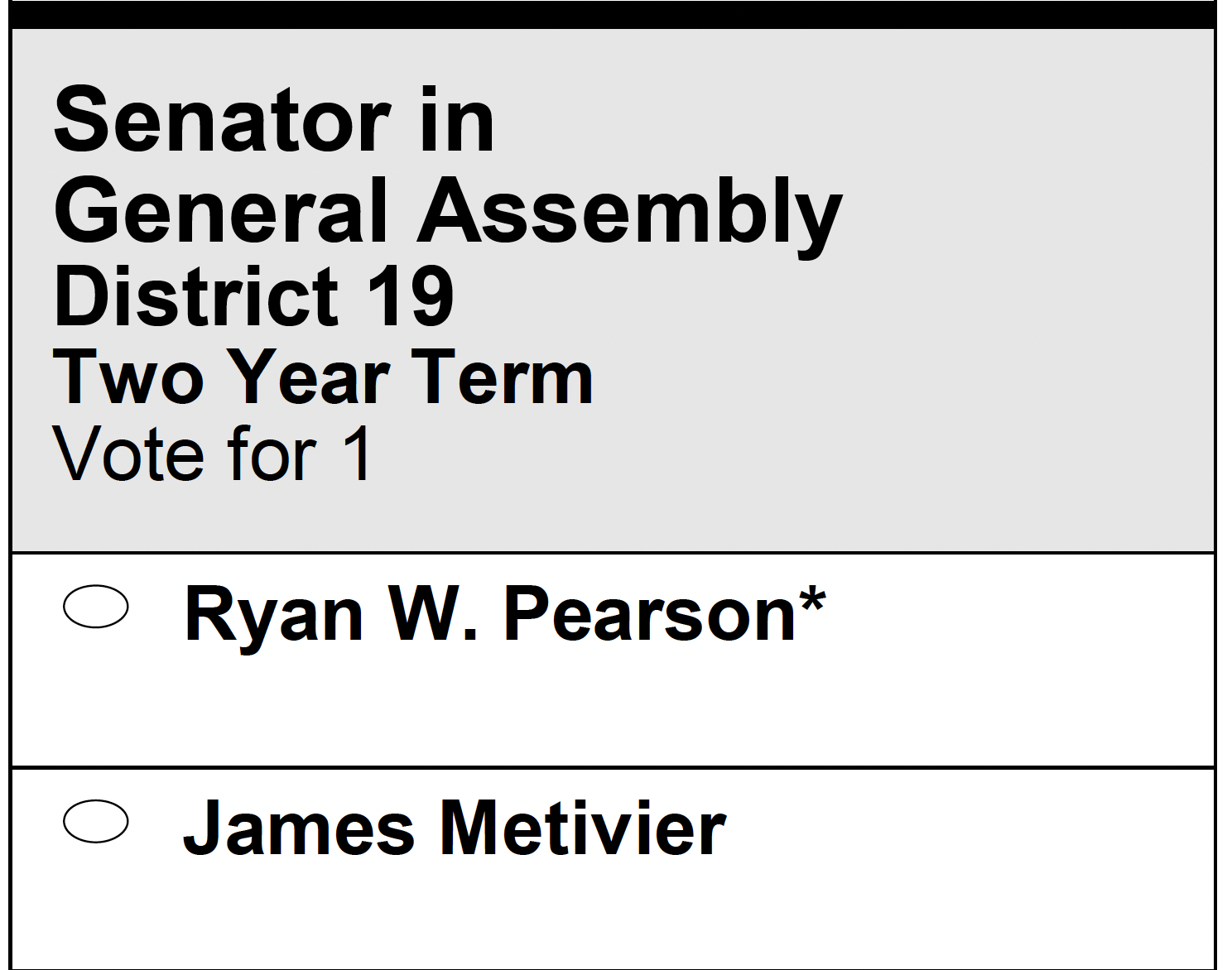
This district includes three-quarters of Cumberland (91% of the district) and a small part of Lincoln (9%). 91% of the adult citizen population is non-Hispanic white. Of 30.5K residents, the top ancestry is Irish by a long shot (6.4K), followed by Italian (4.1K), English (3.5K), French (3.2K), Portuguese (2.8K), and French Canadian (2.5K).
Former Majority Leader Ryan Pearson, a mainstream liberal, fell out of favor with Dominick Ruggerio in late 2024 after questioning Ruggerio's fitness to continue leading. Pearson then challenged Ruggerio for the presidency (within the Democratic caucus) and suffered a resounding loss, and went on to challenge Lawson for the presidency on the floor of the Senate after Ruggerio's death, again falling well short. I nevertheless give Pearson significant credit for his willingness to force a public leadership contest, which had not happened for some years. He conspicuously no longer holds any leadership position.
This year, Pearson faces a primary challenge from Cumberland Town Council member James Metivier; a planned general election challenger fell short of the signature threshold. The state party has endorsed Pearson, as have PPVRI, RICAGV, and some environmental groups. Metivier, like most LORIB candidates, has only their endorsement and no others that I track. Not a single union has endorsed here, rather glaringly. The Cumberland Democratic Town Committee has endorsed Pearson, as has the Lincoln committee; these endorsements don't appear on the ballot, but they can prove influential. The Cumberland Town Committee's early backing of liberal Brandon Voas in 2022 helped him oust a deeply conservative incumbent in the primary, and Voas won their rematch in the 2024 general election.
As the Current points out, Metivier has criticized Pearson's attendance record this year; Pearson argues he has still had an influence and attributes his missed sessions to his employment (he works for Citizens Bank, while Metivier is a retired insurance company employee).
Metivier has served three terms on the Cumberland Town Council representing District 1 (out of 5 districts). After losing the 2014 election, he won in 2016, then lost reelection in 2018, all of which were close races. He won comfortably in 2020, when the Council shifted to four-year terms, and won another term in 2024 unopposed. He ran as an independent each time, although Cumberland Town Council elections became entirely nonpartisan in 2024.
Metivier has led Pearson by large margins in individual fundraising for the last three periods. Metivier outspent Pearson narrowly in Q2 (excluding a six-figure loan payment Pearson made). Pearson outspent him nearly 2:1 in the 28BP filing, but in the 7BP filing Metivier outspent Pearson nearly 6:1. However, Pearson ended the 7BP period with more than three times Metivier's cash on hand ($61K to $20K). Overall, since April 1, Metivier has led in spending, $19.5K to $11.0K. The only independent expenditure I have logged here is by Right to Life, which spent $322.01 on postcards supporting Metivier.
This is, along with SD 36, one of LORIB's best chances at a win. There are a couple factors that suggest this might be more fertile ground for them than SD 36: SD 19 is in a more conservative area of the state that is more prone to electing conservatives to the General Assembly, and Metivier has served in local elected office. Metivier also appears well-organized (see below). However, Pearson has a fairly strong electoral track record of his own, and as noted above, voters in overlapping HD 57 previously chose a mainstream liberal over a conservative alternative with name recognition.
In addition to the Current writeup linked above, the Valley Breeze also wrote up the race, although I do not know why they think James Purcell will be on the general election ballot.
I'm putting this at Pure Tossup. While several factors point to Metivier, I think Pearson's strong electoral record is a substantial counterweight. There should be 788 early ballots and 291-383 mail ballots here. I've never had to rate a primary here before, but I correctly had Voas slightly favored in overlapping HD 57 in 2022.
There is also a full slate of non-endorsed candidates for district committee here, including Metivier himself. If the primary is at all close, Metivier and Pearson, and likely Frances Pearson as well, will all get elected to the committee, but it's tough to predict which side will control the seven-member committee after the primary, and I'm not going to try. However, it’s an impressive sign of organization on Metivier’s part that he has a slate for district committee; I can’t think of a challenger who had a full slate for committee since Jeanine Calkin in SD 30 – who, in fact, won control of the committee in 2018 despite losing reelection. More on the SD 30 committee below.
This seat is a bit iffy for Democrats in state races; in fact, Pearson was first elected in 2012, easily defeating incumbent Sen. Bethany Moura, a Republican, after losing a close 2010 race to Moura. Either Democrat will be glad to be unopposed. If Metivier loses a close primary, though, I'm sure he'll be reflecting on whether he should've run as an independent.
Senate District 30 Committee
This district is over a third of Warwick, covering the city’s southern portion. There’s no primary here, with left-wing former Sen. Jeanine Calkin still out of the running, leaving pro-leadership mainstream Democrat Mark McKenney unopposed. I'm only mentioning it to note that Calkin's allies, who maintained full control of the district committee in the 2024 primary despite Calkin not running, opted not to run this year and handed over control to McKenney's allies, which should secure him the party endorsement if a challenger arises in the future. I was surprised by this, but I have reviewed the paperwork, and Calkin's allies quite literally signed off on the endorsement of McKenney and his slate.
Senate District 33 (General)
This district includes nearly three quarters of Coventry (90% of the district) and about two fifths of West Greenwich (10%). The adult citizen population is 93% non-Hispanic white; of the 27.1K residents, the top ancestries are Irish (5.9K), Italian (5.0K), English (4.9K), and French (3.5K). The ACS estimates only 33 residents are of Greek ancestry, plus or minus 42. Sen. Leonidas “Lou” Raptakis, who is perhaps the most conservative Democrat in the Senate, faces a rematch with Republican James Pierson, who serves on the nonpartisan Coventry School Committee, representing District 5 (there are five districts). Pierson was poorly funded in 2024 and lost by about 17%, even as Trump and Morgan carried the district. The seat voted for Republicans in all five 2022 statewide races, with only Gov and AG within 4%. (Seth Magaziner did win the district in 2024.) I underrated Raptakis here in 2024, which if memory serves was his first contested race in quite some time. I'm starting this at Likely Democratic, but if Pierson's campaign shows signs of life, I'll reevaluate. I am only aware of one endorsement here so far: LORIB has endorsed Raptakis.
Senate District 34 (General)
This district includes Hopkinton (30% of the district), Richmond (28%), Exeter (23%), about half of Charlestown (15%), and about one fifth of West Greenwich (4%). The adult citizen population is 94% non-Hispanic white. Of 30.1K residents, the top ancestries are Irish (6.4K), English (5.9K), and Italian (5.3K), with French, German, and Portuguese each 2-3K.
Like Sen. Paolino, Sen. Elaine Morgan (R) represents a district that is often closely divided at the top of the ticket, although it's redder than Paolino's. In 2024, Magaziner won here, while Trump and Morgan carried the seat. In 2022, AG Neronha was the only statewide Democrat to carry the seat, although McKee came close. Morgan has been known to make controversial and Islamophobic remarks and is quite right-wing. Naturally, LORIB has endorsed her.
In 2024, Morgan beat Dem Stephen Moffitt by 7%, slightly ahead of Trump and Patricia Morgan's performances (Patricia is not related, to my knowledge). Moffitt is the former president of the Hopkinton Town Council; he was the top vote-getter for Town Council in 2020 and placed third in 2022 (the top five win election), running as an independent in both those races. Elaine Morgan faced progressive Jennifer Douglas the previous three times and won by 8-9% each time, ahead of most statewide Republicans. The last Democrat to hold this seat was Morgan's predecessor, Catherine Cool Rumsey, who ousted a Republican incumbent in 2012 by a 10-point margin; Morgan defeated Cool Rumsey in a close 2014 race (5%) and beat her in a 2016 rematch by 10%. 2012 was a long time ago.
The Democrat running this year, Richmond Town Council president Samantha Wilcox, is backed by the state party. In 2022, Wilcox, who works as a paralegal, was the sole Democrat elected to the Richmond Town Council, with Republicans winning the other four seats in the vote-for-five race (Wilcox placed third). In 2024, when Democrats won four of five seats (and did not run a fifth candidate), Wilcox was the top vote-getter by a decent margin and also notably received more votes than Morgan. On her website, she highlights not only her votes for various council initiatives but also her work with Rep. Megan Cotter (D) to kill a tax giveaway to wealthy residents and her opposition to the Council's illegal attempt to install a Republican on the Chariho School Committee.
Democrats have repeatedly lost to Morgan, and I'm skeptical this year will be different. It would take a lot for me to be convinced Wilcox is favored, but she seems to be a much stronger candidate than Democrats have previously had. I'm starting this at Lean Republican and will watch closely.
Senate District 36
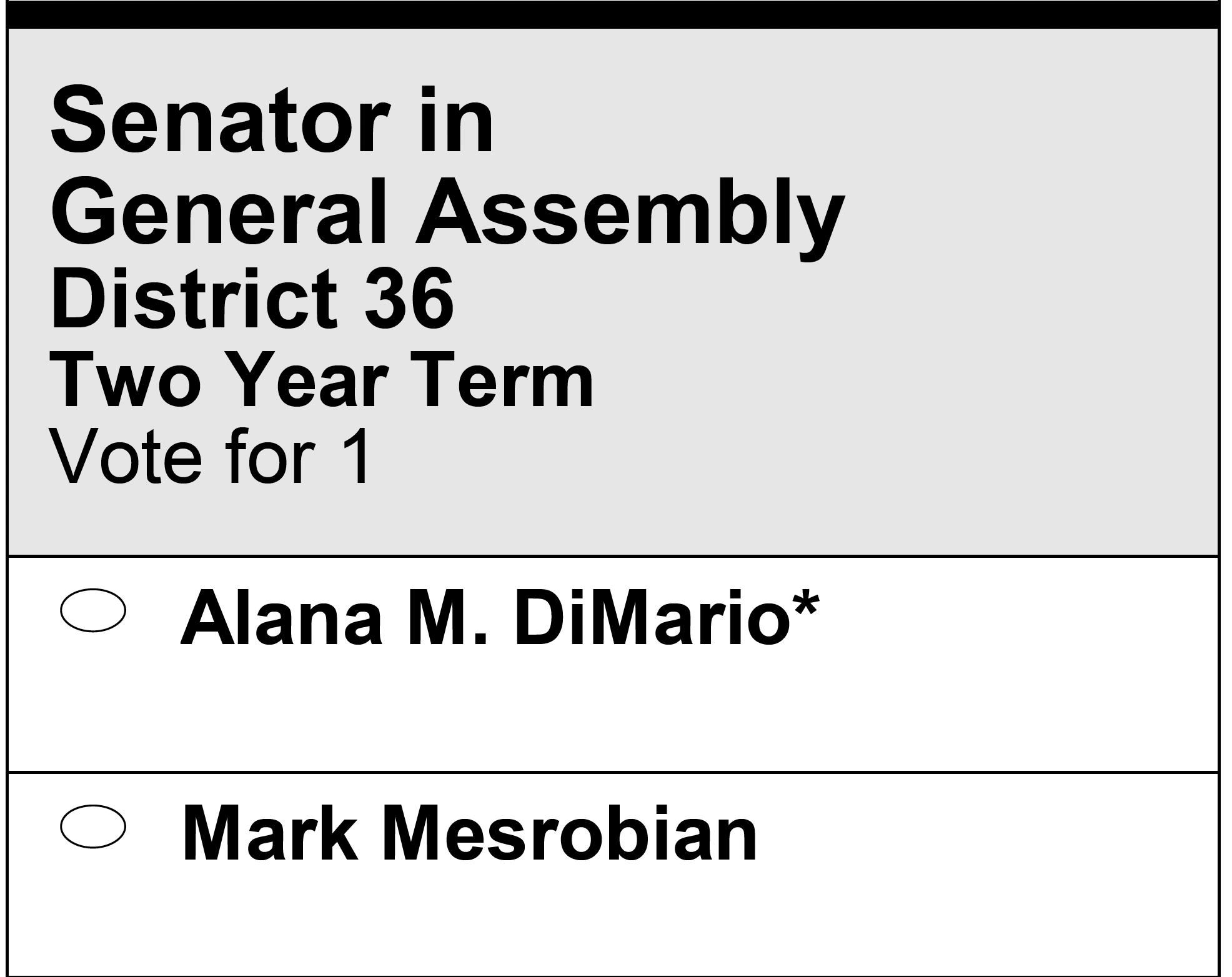
This district in southern Rhode Island contains Narragansett (48% of the district), about half of North Kingstown (47%), and all of New Shoreham, better known as Block Island (5%). 94% of the adult citizen population is non-Hispanic white. Of 29.2K residents, the largest ancestry segments are Irish (8.3K), Italian (6.5K), and English (5.0K); there are also German, French, Portuguese, and Scottish populations over 1K. There are an estimated 134 Armenian-Americans, plus or minus 83.
Progressive Sen. Alana DiMario, who is a licensed therapist, faces a primary from the LORIB's Mark Mesrobian, who is a business owner. DiMario voted for Pearson in the leadership race and was the progressive candidate for Majority Leader; she lost that race to Frank Ciccone III, 22-10. After losing a 2018 primary challenge against then-Sen. James “Jim” Sheehan, DiMario secured wider backing when Sheehan retired in 2020 and easily beat a token opponent in the primary. She also won general elections in both 2020 and 2022 without too much trouble, although she barely secured a majority in 2020 with a former town councilor running as an independent.
This is one of LORIB's more serious chances at a win. Mesrobian is supported by Majority Whip David Tikoian, who is a fellow Armenian-American and fellow conservative. (As noted, Armenians are a very small minority both in SD 36 and in Rhode Island, and they are likely more relevant to Mesrobian's fundraising than his campaigning.) Several other conservative Democrats attended Mesrobian's launch, although I am uncertain how many are openly backing him.
Mesrobian is tied to LORIB, but he's also a garden-variety old-school Rhode Island Democrat, and that brand still has some sway. While unions have steered clear of most of the Senate primaries featuring leadership opponents (or, in the case of SD 13, are backing the challenger), three I track have endorsed here: the SEIU Council and RI Council 94 are backing DiMario, while the NAGE/IBPO police union is backing Mesrobian, a very rare case of a LORIB candidate receiving a non-LORIB endorsement. DiMario also has the support of RIFTHP, which I don't track because they don't directly announce their endorsements, while Mesrobian has support from a couple of additional police unions and the conservative building trades union LiUNA.
Mesrobian has proven a strong fundraiser. In Q2, he outraised DiMario nearly 3:1 with individuals ($35.4K to $13.3K) but only narrowly outspent her. In the 28BP filing, DiMario actually outraised him 2.5:1 with individuals but was outspent 3:1. Finally, in the 7BP filing, Mesrobian outraised DiMario 4:1 with individuals and outspent her about 1.4:1. As of Sept. 1, Mesrobian had $84K on hand to DiMario's $52K. Overall, since April 1, Mesrobian has spent (or received in-kind contributions) totaling $66.1K to only $37.5K for DiMario. In the most recent filing, both candidates paid substantial fees to consultants, with Mesrobian also spending heavily on Facebook ads.
As for independent expenditures, this looks a lot like SD 15. Right to Life has spent $652.79 on postcards supporting Mesrobian (I assume this is for canvassing, but perhaps they are being mailed). The RI Values Project has spent $3,500.60 on pro-DiMario direct mail.
I could not find local coverage of the race, but the Current ran a good writeup.
This district is more liberal than SD 19, and Mesrobian would stick out like a sore thumb in the Democratic delegation. But he's run a credible campaign, and it's worth repeating that DiMario lost the only truly tough race she's had. I think this is a pure tossup. There are a whopping 2,209 early ballots here, by far the highest number of any district in the state (second place is 1,799), and 341-497 mail ballots. A majority of both categories are from Democrats, rather than unaffiliated voters.
In 2020, I correctly had DiMario as a strong favorite. In 2018, I rated her race against Sheehan a tossup; she lost by a 15% margin.
Senate District 38 (General)
This district contains Westerly (81% of the district), about half of Charlestown (12%), and a bit of South Kingstown (7%). 94% of the adult citizen population is non-Hispanic white, while just 2% is AAPI. Of 28.5K residents, the largest ancestry segments are Italian (7.5K), Irish (6.5K), and English (5.0K).
Sen. Victoria Gu, a progressive Democrat who voted for Lawson, faces a rematch with Republican Westin Place, who the LORIB is backing. Gu crushed Place last time around. Gu's immediate predecessor, Sen. Dennis Algiere, was the longtime Republican leader in the State Senate; Gu was the first Democrat to run for the seat since 2006 (and only the second since 1992), so Algiere's long tenure doesn't say much about the seat. This district always stuck out like a sore thumb when Republicans held it, being well to the left of even Paolino's seat, and Gu should easily win again. Safe Democratic.
If you've read this far, I'd really appreciate a subscription, either paid or free. One-time tips are also welcome.
Appendix: Fundraising and Endorsement Data
My statistics for the 28BP filing can be found here, and statistics for the 7BP filing can be found here. My independent expenditure table is here.
My compilation of organizational endorsements is here. If an endorsement is linked in a cell, that generally means I do not have a full list of the organization's endorsements.
1 Like the other state legislators initially elected with Providence DSA's support, Bell is no longer backed by Rhode Island DSA, which has sworn off Democratic primaries entirely.
2 Cano left the role when Trump took office, after only a couple of months. Cano's husband, former Central Falls mayor James Diossa, is currently seeking a second term as General Treasurer of Rhode Island.
Edits: Fixed error in the SD 38 writeup which referred to the “Irish Italian” population instead of the Italian population.